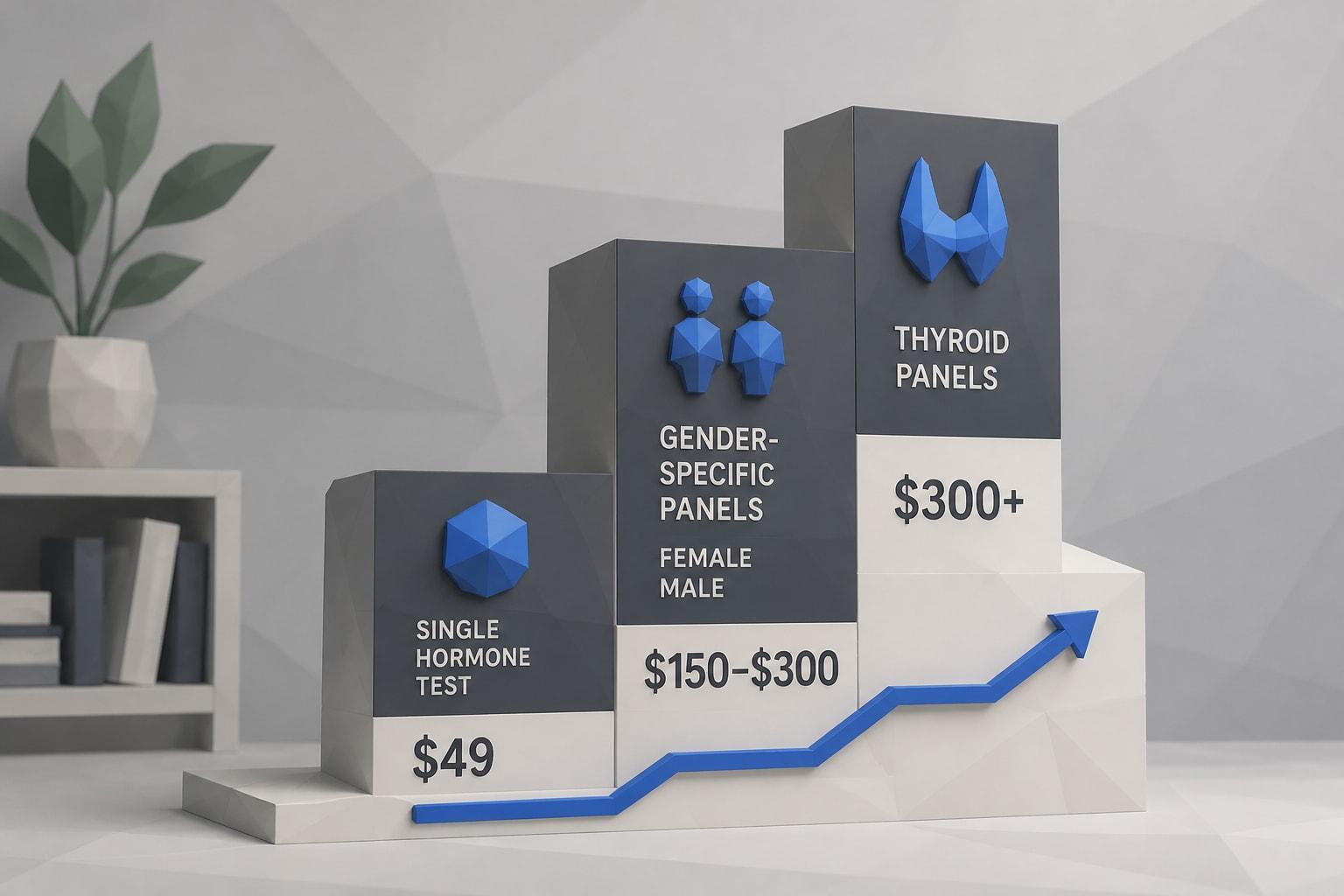
How much does a hormone panel cost without insurance? Single hormone tests start around $49, while broad panels can run from roughly $150 to over $500, and some telehealth bundles approach $1,000. The price you pay depends mostly on which hormones are measured and where you order.
Big picture
- What it is: A hormone panel is a blood test that measures several hormones at once, such as estradiol, FSH, LH, progesterone, testosterone, or thyroid hormones.
- Why it matters: Cash prices vary widely, and a larger panel does not always give you more useful information than a focused one.
- Who it affects: Adults without insurance or with high-deductible plans who pay out of pocket and want to order routine blood work themselves.
- Next step: Decide which symptoms or questions you are trying to answer, then compare the price of a targeted panel against the price of individual tests before you order.
- Good to know: Online self-pay labs typically list a fixed price up front, which makes budgeting simple.
How Much Does a Hormone Panel Cost Without Insurance?
Without insurance, a hormone panel can cost as little as $49 for a single test and more than $500 for an in-depth panel, depending on the number of markers and the seller. A November 2025 NBC News report found consumer hormone tests ranging from $49 for a single luteinizing hormone test to more than $500 for an in-depth panel, with some telehealth panels approaching $1,000.
The same reporting described consumer panels with list prices as high as $1,598, including one example discounted to $799 as of November 13, 2025. Those figures show how much the same category of testing can differ in price depending on branding, bundled services, and how many markers are included.
Here is a general view of what self-pay shoppers can expect:
| Test type | Typical cash price range | What you get |
|---|---|---|
| Single hormone test (LH, FSH, TSH) | About $49 to $100 | One marker |
| Focused panel (4 to 8 markers) | About $100 to $250 | Core hormones for one concern |
| Broad or "comprehensive" panel | About $250 to $500+ | Many markers, often with extras |
| Bundled telehealth panel | Up to about $1,000 | Panel plus consultation or program fees |
Treat these as ranges, not quotes. Prices change by seller, and you should confirm the exact list before you pay.
What Drives the Price of a Hormone Panel
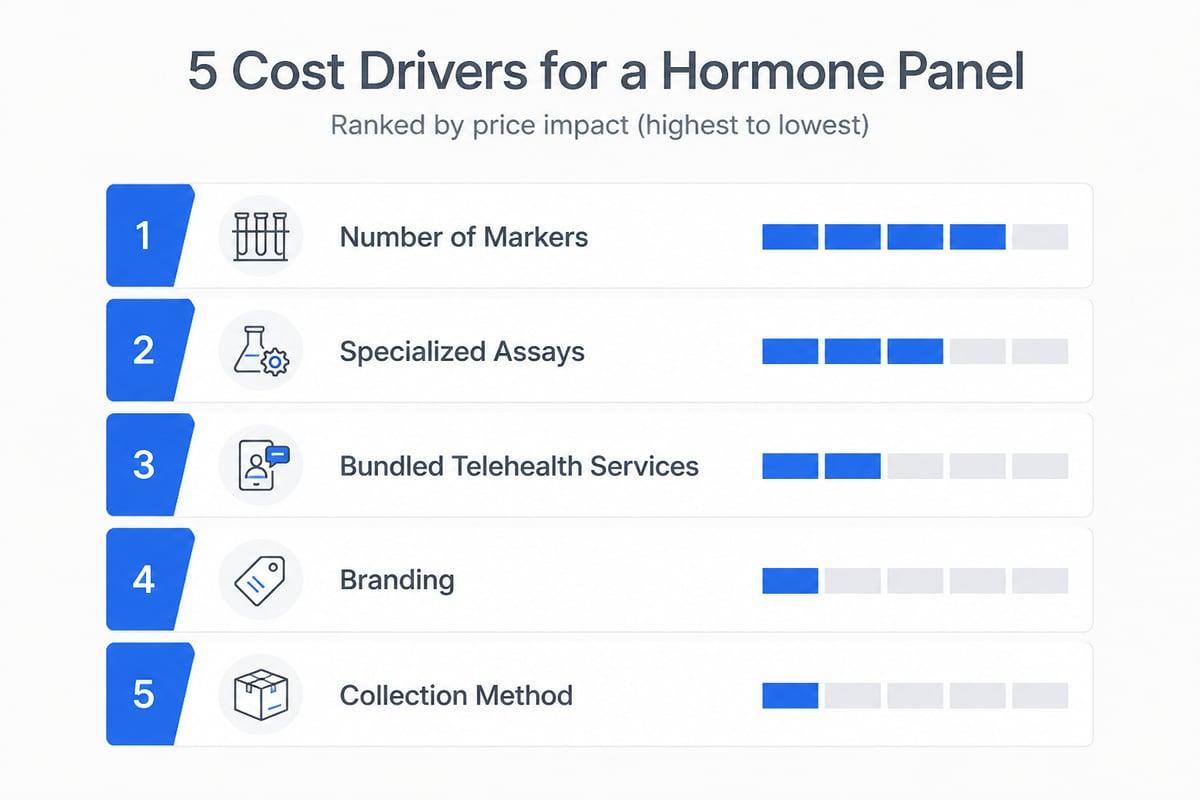
The number of markers is the largest cost driver, followed by the type of assays used, the seller's overhead, and whether services beyond the lab draw are bundled in.
Here is what moves the price most:
- Number of hormones tested. Each additional marker adds cost to the lab's processing.
- Specialized assays. Markers such as AMH or free testosterone by equilibrium dialysis cost more to run than routine tests like TSH.
- Bundled services. Telehealth programs may include a physician review, a care plan, or supplement recommendations, all of which raise the total.
- Marketing and branding. Premium-branded panels often cost more than the identical lab markers ordered directly.
- Collection method. At-home kits can carry shipping and handling fees on top of the test price.
A transparent price list lets you see exactly what you are paying for. That is the main difference between ordering a panel directly from a lab-testing service and buying a bundled program.
How Much Is a Hormone Test for Women?
A hormone test for women often costs $100 to $250 for a focused female panel, and more for broad panels that add extra markers. Female panels usually cover estradiol, FSH, LH, progesterone, and sometimes testosterone, DHEA-S, and prolactin.
Timing affects both cost and usefulness. Progesterone is usually drawn around day 21 of a regular 28-day cycle, while FSH and estradiol are often checked early in the cycle. If your cycles are irregular, a single draw may need to be repeated, which adds to your total spend.
If you want a fixed-price option, the JustLabs female hormone panel is available at a listed cash price with no doctor visit required. You can also read a breakdown of female hormone panel cash pricing before deciding which markers you need.
Female Hormone Panel
7 biomarkers
How Much Does a Hormone Profile Test Cost for Men?
A men's hormone profile often costs $75 to $250, depending on whether it includes only total testosterone or adds free testosterone, SHBG, estradiol, LH, FSH, and prolactin. Total testosterone alone is often the lowest-cost entry point, and it fits a first look at symptoms such as low energy or reduced libido.
Each added marker raises the price, but some additions explain the result better than others. Total testosterone shows overall circulating hormone, while SHBG and free testosterone indicate how much is actually available to the body. LH and FSH help show whether a low result originates in the testes or in the signaling from the brain. Estradiol and prolactin round out the picture when symptoms do not match a simple testosterone shortfall. Free testosterone by equilibrium dialysis is a specialized assay and costs more to run than routine markers.
Men with symptoms such as low energy, reduced libido, or changes in mood often start with a focused panel rather than a broad one. Testosterone levels vary through the day and are generally highest in the morning, so a morning draw gives the most consistent reading. A borderline result drawn in the afternoon may need repeating, which adds a second charge to your total. If you do pay for a broader profile, compare its price with the cost of ordering the same markers individually. A November 2025 NBC News report put some in-depth consumer panels above $500, so a profile priced near that level deserves a close look at what it includes.
Male Hormone Panel
6 biomarkers
Are There Tests for Perimenopause?
Yes, blood tests for perimenopause exist, and they typically measure FSH, estradiol, and sometimes LH, AMH, and thyroid markers. As a focused panel paid in cash, these tests often cost $100 to $250.
A single result is rarely definitive, because hormone levels swing widely during the transition. A normal reading does not rule out perimenopause, and an elevated one may not persist from one month to the next. Many clinicians weigh symptoms and cycle changes alongside lab values, so testing works best as one data point.
The Endocrine Society's guidance for hypothalamic amenorrhea, for example, lists TSH, free T4, prolactin, LH, FSH, estradiol, and AMH as part of an initial endocrine evaluation, with additional tests depending on clinical signs. That is a useful reference point for what a focused workup looks like, as opposed to a very broad bundle.
What Are the Signs You Might Need Hormone Testing?
Common signs of a possible hormonal imbalance include persistent fatigue, unexplained weight changes, irregular cycles, mood changes, and sleep disruption. Five signs that most often prompt testing are:
- Irregular or missed periods, or a notable change in cycle length.
- Persistent fatigue that does not improve with rest.
- Unexplained weight gain or loss without a change in diet or activity.
- Mood changes, including anxiety, irritability, or low mood.
- Sleep problems, including night sweats or difficulty staying asleep.
These symptoms overlap with many other conditions, including thyroid disease, iron deficiency, and stress. That overlap is why a targeted approach tends to be more informative than testing everything at once. If thyroid issues are a possibility, an inexpensive TSH test is often a sensible first marker, and a related post covers prolactin and irregular cycles.
Do Broad Hormone Panels Give You Better Value?
A broad panel often costs more without delivering more actionable information. The NBC News report noted that some marketed hormone panels may be expensive and not covered by insurance, and quoted an endocrinologist who cautioned that broad panels may not provide useful information.
Consider the tradeoff:
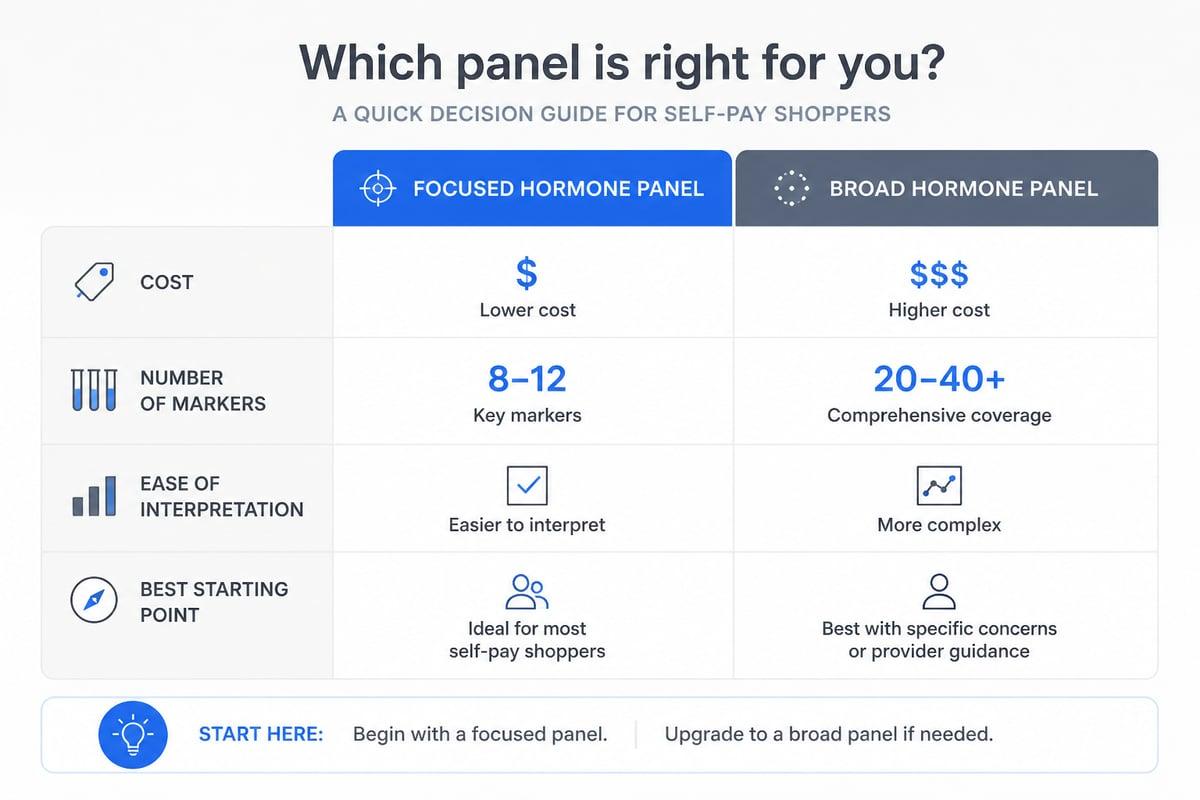
- Focused panel: Lower cost, clear link between symptoms and markers, easier to interpret.
- Broad panel: Higher cost, more numbers to interpret, greater chance of borderline results that raise questions without answering them.
A sensible approach is to start with the markers tied to your symptoms, review the results, and add targeted follow-up tests only if needed. That keeps your total spend predictable and limits the number of ambiguous results.
Ways to Lower What You Pay Out of Pocket
You can reduce hormone testing costs by choosing a focused panel, ordering from a seller with fixed cash prices, and using pre-tax health account funds if you have them.
Practical steps:
- Compare per-marker pricing. Divide a panel's price by its number of markers, and check whether the same markers cost less when ordered individually.
- Skip bundled extras you do not need. Consultations, supplement plans, and subscription features raise the price.
- Check for hidden fees. Look for shipping, processing, or draw-site charges before checkout.
- Use health account funds. HSA and FSA funds can often be applied to lab testing. If you have an FSA, review the rules for using your FSA before it expires.
- Order in advance of symptoms worsening. Early, targeted testing avoids repeat draws.
Self-pay pricing also keeps the cost visible. For comparison, a common routine test such as a lipid panel has a clearly listed cash price, which shows how upfront pricing works in practice.
How Ordering a Hormone Panel Online Works
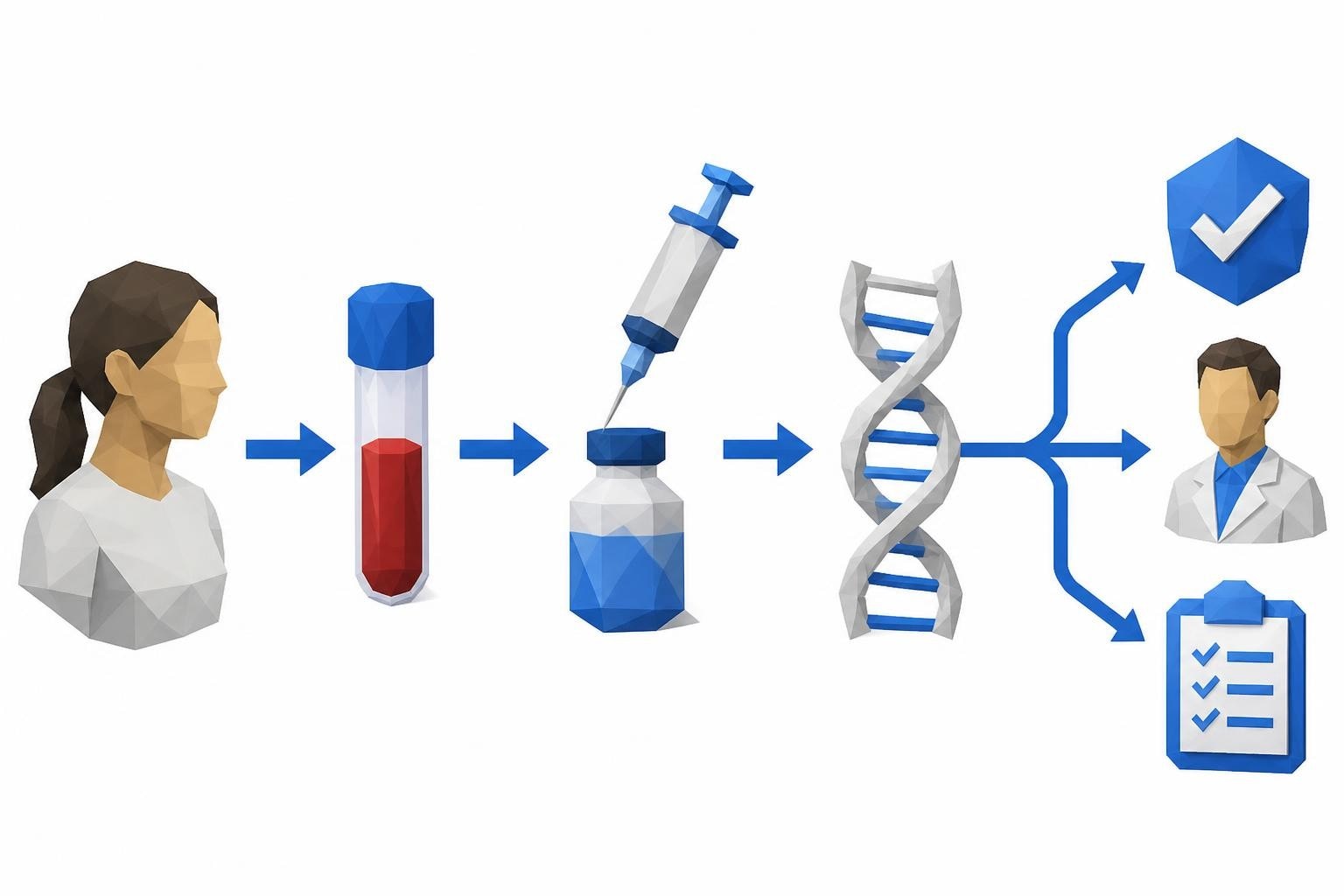
Ordering online typically involves choosing a panel, paying a flat cash price, visiting a draw site, and receiving results electronically. With JustLabs, you order without a doctor visit or insurance, then have your blood drawn at any of more than 2,200 Quest Diagnostics locations nationwide.
The process in four steps:
- Choose your panel based on the symptoms or questions you want to address.
- Pay the listed cash price, with no hidden fees.
- Visit a Quest Diagnostics location for your blood draw, using the same CLIA-certified labs doctors and hospitals rely on.
- Review your results online, generally within 1 to 3 business days, with clear values and reference ranges.
JustLabs offers over 130 individual tests and holds a 4.9/5 rating from its customers. It does not provide treatment decisions or prescriptions, and it is not a substitute for urgent care. Service is also not currently available in New York, New Jersey, Rhode Island, or Hawaii.
Key takeaways
- Without insurance, hormone testing ranges from about $49 for a single marker to more than $500 for broad panels, with some telehealth panels approaching $1,000. List prices for some consumer panels have reached $1,598, so the sticker price alone says little about the value of what you are buying.
- The number of markers, specialized assays, and bundled services drive most of the price difference. A routine TSH costs far less to run than AMH, and a consultation or supplement plan can double the total without adding a single lab value.
- Focused panels tied to your symptoms usually offer better value than broad bundles. An endocrinologist quoted by NBC News cautioned that broad panels may not provide useful information, and the Endocrine Society's initial workup for hypothalamic amenorrhea lists seven markers.
- Perimenopause testing is available, but one result is rarely definitive on its own, since hormone levels can swing from month to month.
- Fixed cash prices, HSA or FSA funds, and skipping extras are the most reliable ways to control cost. Dividing a panel's price by its marker count is a quick way to compare offers.
FAQ
How much is a hormone test?
A single hormone test often costs $49 to $100 when paid in cash, and a focused panel runs about $100 to $250. Broad panels can exceed $500.
How much does a hormone profile test cost?
A hormone profile test often costs $75 to $250 for a focused set of markers and over $500 for an in-depth profile. The final price depends on how many hormones are included and whether extra services are bundled in.
Can I use an HSA or FSA to pay for a hormone panel?
In many cases, yes. HSA and FSA funds can often be used for lab testing, but you should confirm eligibility with your plan administrator before purchasing.
Start by listing the two or three symptoms or questions driving your interest in testing, then match them to a focused panel rather than the largest bundle on the shelf. From there, you can browse tests at JustLabs, compare clear cash prices, and order online without insurance or a doctor visit.
Related Reading

References
Bhasin S, Brito JP, Cunningham GR, Hayes FJ, Hodis HN, Matsumoto AM, Snyder PJ, Swerdloff RS, Wu FC, Yialamas MA. Testosterone Therapy in Men With Hypogonadism: An Endocrine Society Clinical Practice Guideline. J Clin Endocrinol Metab. 2018 May 1;103(5):1715-1744. doi: 10.1210/jc.2018-00229. PMID: 29562364. https://pubmed.ncbi.nlm.nih.gov/29562364/
Basaria S. Male hypogonadism. Lancet. 2014 Apr 5;383(9924):1250-63. doi: 10.1016/S0140-6736(13)61126-5. PMID: 24119423. https://pubmed.ncbi.nlm.nih.gov/24119423/
Hale GE, Robertson DM, Burger HG. The perimenopausal woman: endocrinology and management. J Steroid Biochem Mol Biol. 2014 Jul;142:121-31. doi: 10.1016/j.jsbmb.2013.08.015. PMID: 24134950. https://pubmed.ncbi.nlm.nih.gov/24134950/
Nelson SM, Davis SR, Kalantaridou S, Lumsden MA, Panay N, Anderson RA. Anti-Müllerian hormone for the diagnosis and prediction of menopause: a systematic review. Hum Reprod Update. 2023 May 2;29(3):327-346. doi: 10.1093/humupd/dmac045. PMID: 36651193. https://pubmed.ncbi.nlm.nih.gov/36651193/