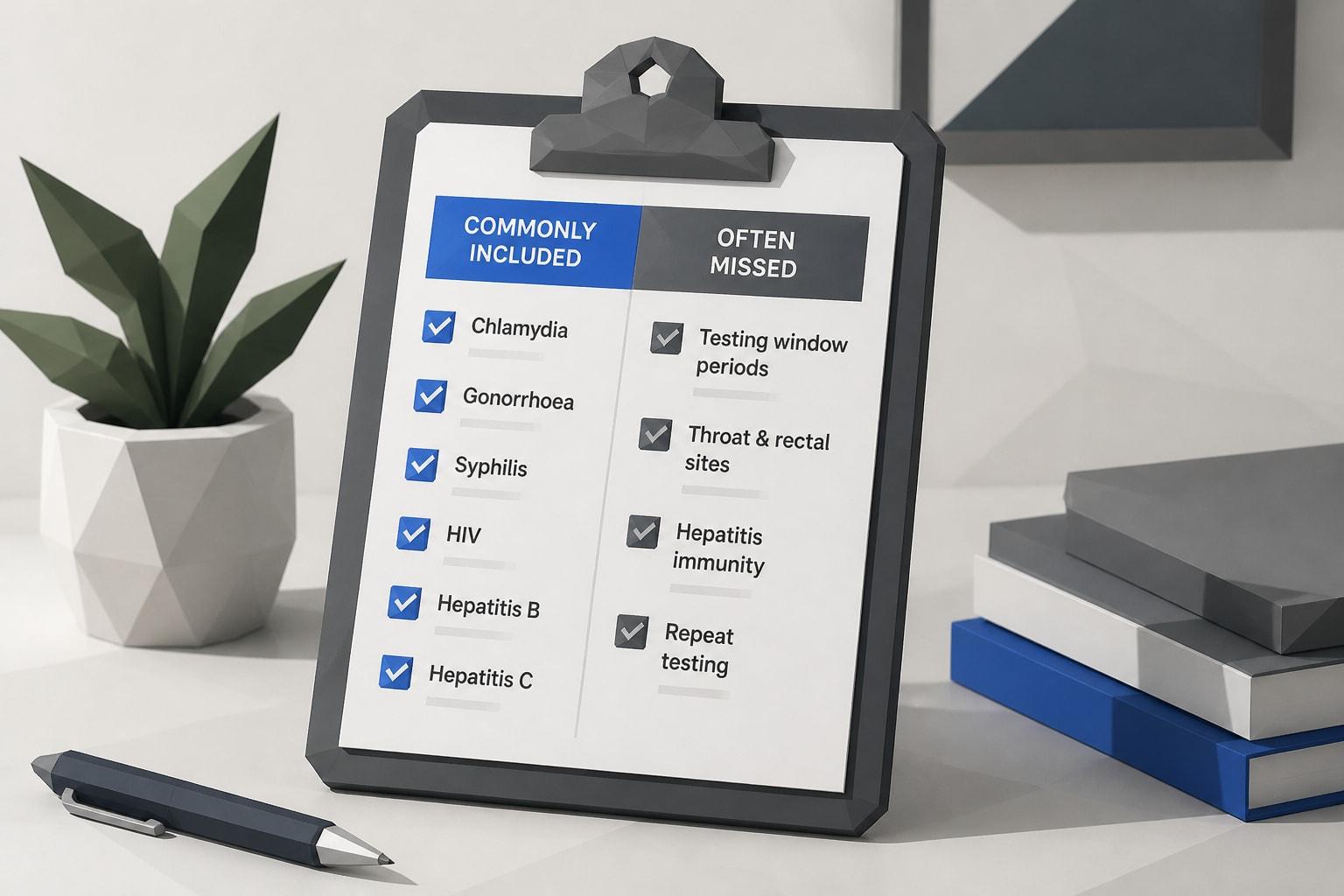
A standard STI panel usually covers the most common infections, such as chlamydia, gonorrhea, syphilis, and HIV, but it can miss infections that are outside the panel, infections that are too new to detect, and infections at body sites that were never sampled. Knowing those gaps lets you add the right tests instead of assuming a normal result means everything is clear.
Big picture
- What it is: A standard STI panel is a bundled set of tests, typically for chlamydia, gonorrhea, syphilis, and HIV, and sometimes hepatitis B, hepatitis C, and trichomoniasis.
- Why it matters: A negative panel only rules out what was tested, at the body sites sampled, at the time of the draw. Timing and scope both change what a result means.
- Who it affects: Any sexually active adult, especially people with new or multiple partners, a partner whose status is unknown, or past exposure they have not retested for.
- Next step: Compare your recent exposures and symptoms against the panel's contents, then add targeted tests or schedule a repeat test after the correct window period.
What does a standard STI panel usually include?
A standard STI panel usually includes tests for HIV, syphilis, and hepatitis B and C from a blood draw, often paired with chlamydia and gonorrhea testing. The exact contents vary by lab and by bundle, so reading the test list before you order matters more than the panel's name.
In practice, the infections most often bundled together are:
- HIV (antigen/antibody combination test)
- Syphilis
- Hepatitis B and hepatitis C
- Chlamydia and gonorrhea
- Trichomoniasis, in some bundles
According to CDC guidance on getting tested for STIs, HIV testing is recommended at least once for everyone ages 13 to 64, and people with certain risk factors should be tested at least annually. The same guidance recommends annual chlamydia and gonorrhea testing for sexually active women younger than 25, and for some women 25 and older at increased risk, such as those with new or multiple partners.
That is what is generally considered regular screening: a baseline set of tests on a set schedule, based on age and risk. It is a starting point, not a complete picture of your sexual health. You can see how one bundled option is structured on the JustLabs STI panel page.
Why does the testing window matter more than the panel?
The testing window matters because a test can only detect an infection after the body has produced enough of the target, such as antibodies or antigens, and that takes time. A test taken too soon can return a negative result even when an infection is present.
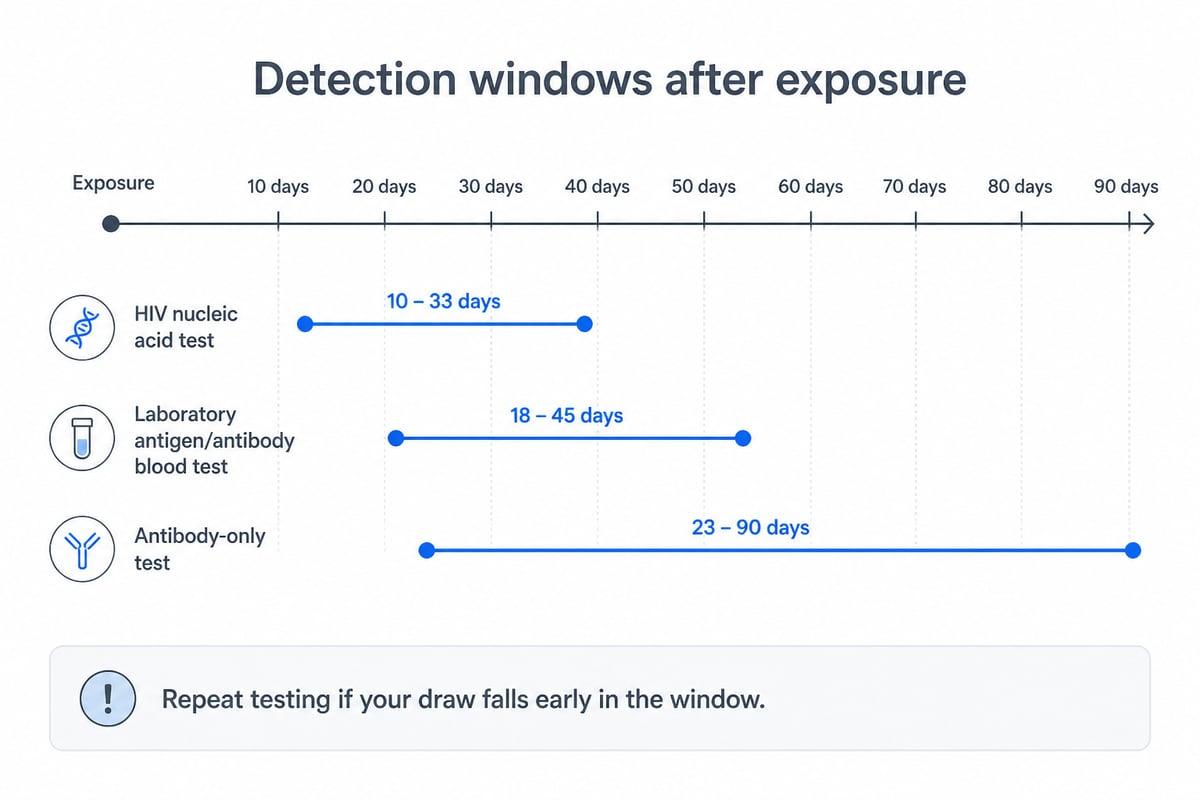
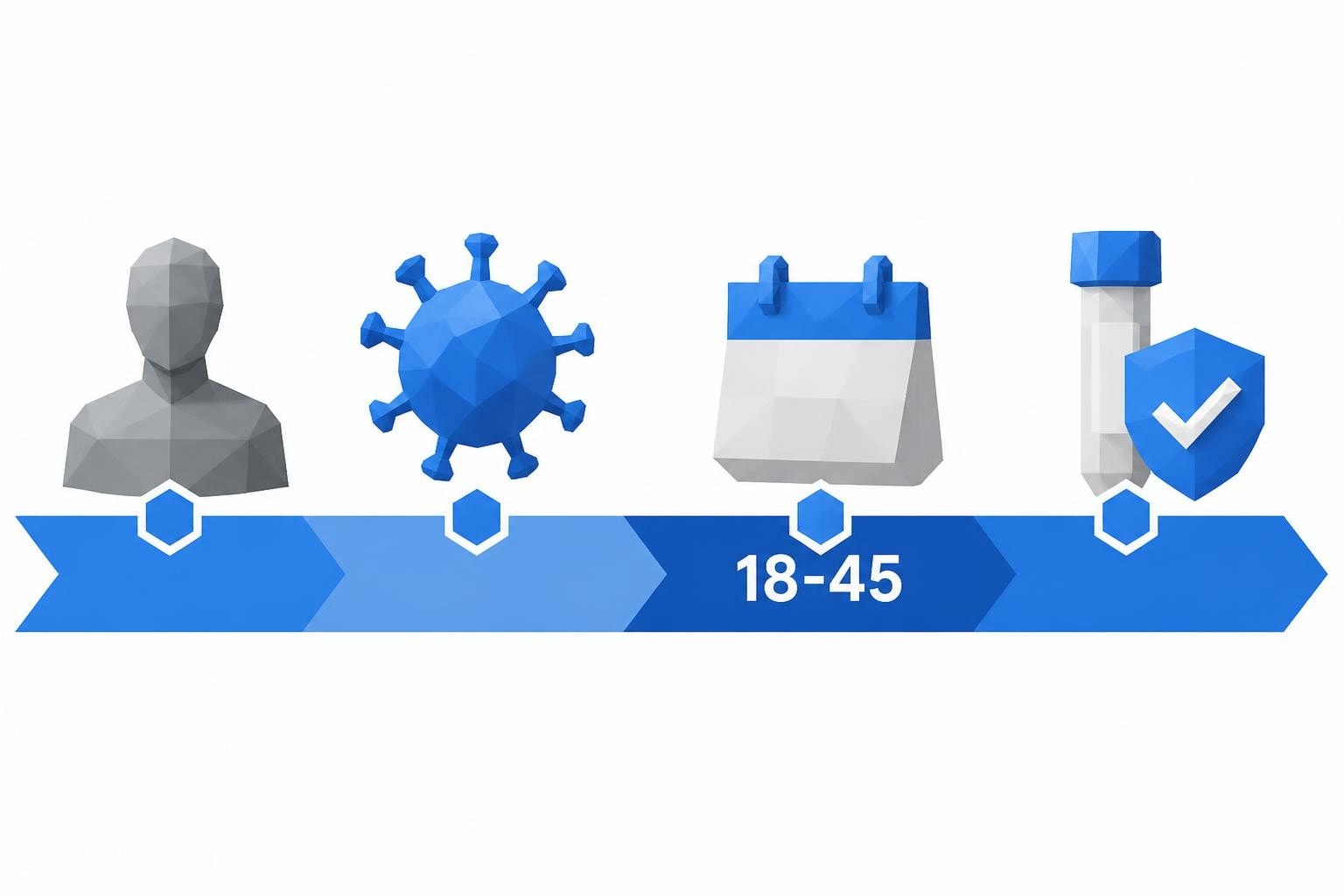
HIV is the clearest example. Per HIV.gov, antibody tests can usually detect infection 23 to 90 days after exposure, while a nucleic acid test can usually detect it 10 to 33 days after exposure. The CDC adds that a laboratory antigen/antibody test using blood from a vein can usually detect infection 18 to 45 days after exposure, while a finger-stick version can take 18 to 90 days.
A panel that tests for the right infection can still produce a misleading result if the draw happens inside the window. This is the first thing a standard STI panel misses: not a pathogen, but timing.
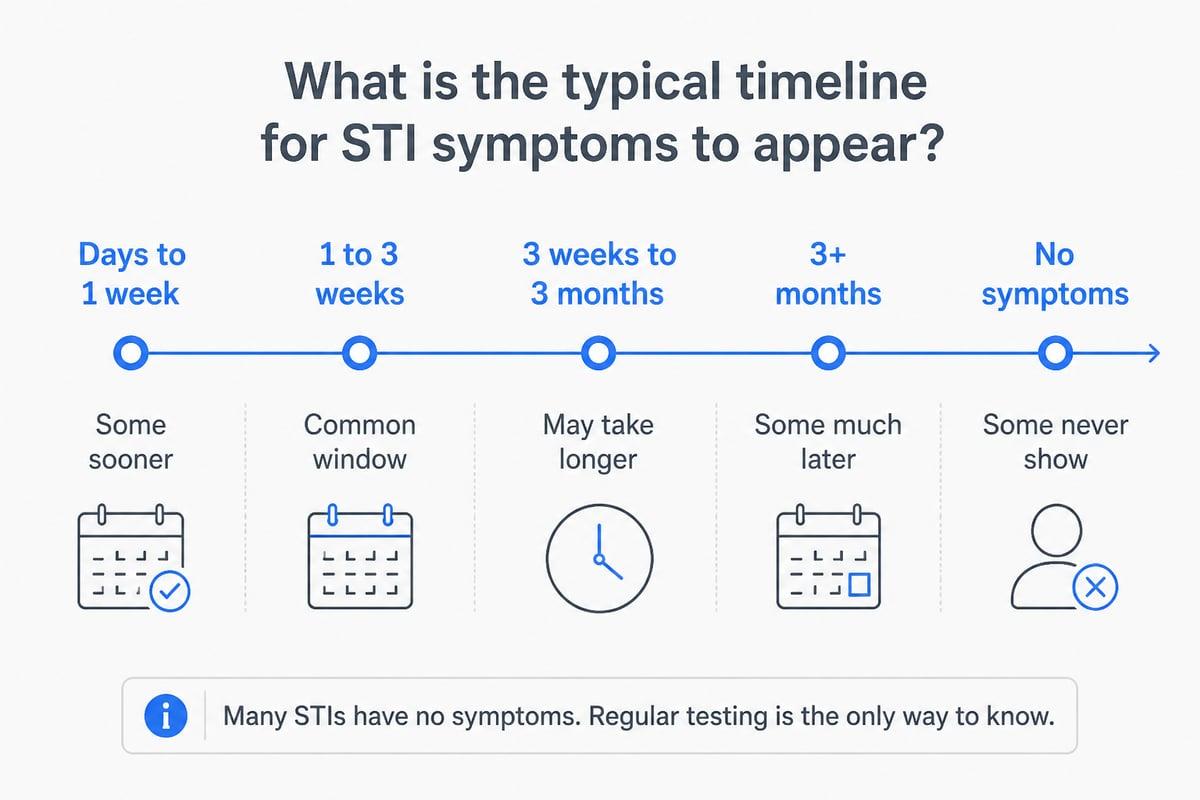
What is the typical timeline for STI symptoms to appear?
Symptoms can appear within days or weeks, or never appear at all, which is why symptoms are an unreliable guide for deciding when to test. Many people with chlamydia, gonorrhea, herpes, or HIV have no noticeable symptoms for long periods.
This matters for how you read a normal panel. The absence of symptoms does not substitute for a test, and a negative result does not reset your risk if you had an exposure last week. Two points are worth keeping in mind:
- Infections can be passed on while symptom-free.
- Symptom onset and test detectability follow different timelines, so a test may turn positive well before or well after you notice anything.
If you have symptoms such as severe pain, fever, or signs of a serious complication, seek in-person medical care rather than ordering a lab test online.
What a standard STI panel misses at the body-site level
A blood draw cannot detect infections that live at specific body sites, so a panel built mostly on blood tests can miss infections in the throat, rectum, or genital skin. This is one of the most practical gaps, and it is easy to overlook because the result looks complete.
Chlamydia and gonorrhea can infect the throat and rectum as well as the genital tract. A urine test samples only the urethra, and it does not tell you about infection at other sites. Someone whose exposure included oral or anal sex may need a swab from those specific sites, which is collected by a clinician rather than through a standard blood draw.
Herpes and HPV add another layer. Both can be present on skin without appearing in a routine bundle. Herpes blood tests detect antibodies, which show prior exposure to the virus but do not locate the infection or confirm an active outbreak. HPV has no standard blood test for the general population, and screening depends on cervical sampling for those with a cervix.
If your exposure involved sites a blood draw and urine sample do not reach, an in-person visit for site-specific swabs is the appropriate route, since a self-pay blood panel cannot substitute for that.
What does a urine STD test actually check for?
A urine test checks for chlamydia and gonorrhea in the urinary and genital tract by detecting genetic material from the bacteria. Some labs also test for trichomoniasis from the same sample.
What it does not check for is equally important:
- Syphilis, HIV, and hepatitis, which require blood
- Infections in the throat or rectum
- Herpes and HPV
A urine sample is a convenient and accurate option for its two or three targets, but treating it as a full screen leaves most of the list untested. If you are reviewing an older result, check whether it came from urine, blood, or both.
Which add-on tests close the common gaps?
The most useful add-ons depend on your exposure history, but several fill predictable gaps in a standard bundle. Start by matching each gap to a specific test.
| Gap | What may need adding | Why |
|---|---|---|
| Early HIV exposure | Repeat HIV test after the window closes | A single early draw can be falsely negative |
| Syphilis follow-up | Repeat testing after a recent exposure | Antibodies take time to develop |
| Hepatitis B immunity | Hepatitis B surface antibody | Distinguishes vaccinated or immune from unprotected |
| Herpes | Herpes type-specific antibody testing | Rarely included in a basic bundle |
| Other organ systems | Related baseline labs | Gives context for overall health |
Hepatitis B deserves special mention. A bundle may tell you whether you currently have the infection, but immunity is a separate question that determines whether vaccination would help you. Reviewing that distinction takes a few minutes and can change what you do next.
Recommended Test
Hepatitis B Surface Antibody
A blood test that detects protective antibodies against Hepatitis B, confirming immunity from vaccination or past infection.
Includes 1 biomarkers
$16
JustLabs offers over 130 individual tests, so you can add targeted items to a base panel rather than buying a larger bundle you do not need. Pricing is posted upfront, which makes it easier to compare a base panel plus add-ons against alternatives.
Why repeat testing is part of the answer
A single test is a snapshot, and one normal result does not cover future exposures or exposures within the window period. Retesting is how you convert a snapshot into reliable information.
Consider a retest in these situations:
- You tested within the early window after an exposure.
- You have a new partner or multiple partners since your last test.
- A partner tells you they tested positive for something.
- You previously had a positive result and were treated, and your clinician advises a follow-up test.
Annual screening is the baseline for many adults with risk factors, but your own schedule may be more frequent depending on your exposures. The reasoning in what to do when your results are borderline applies here: an unclear or early result is a reason to retest, not a reason to assume the worst or the best.
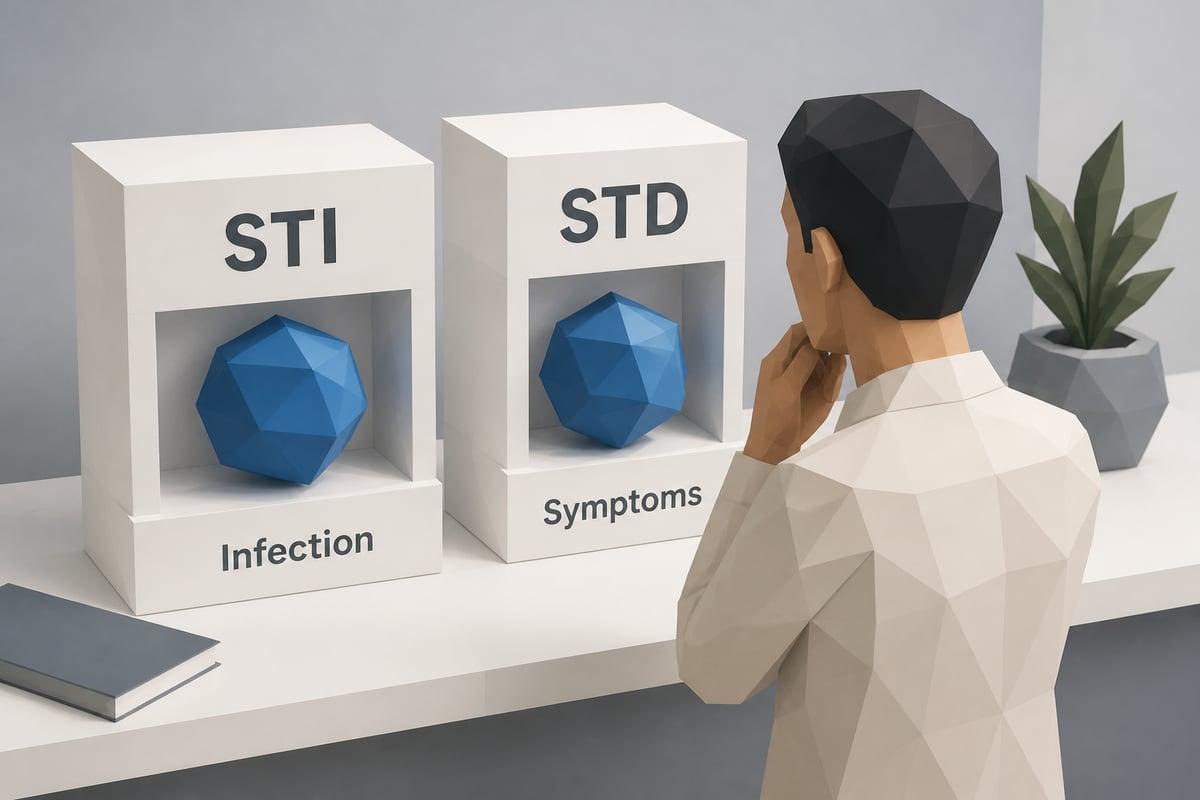
Is there a difference between an STI and an STD?
STI and STD are often used interchangeably, but STI is the broader and increasingly preferred term. An infection is the presence of a pathogen in the body, while a disease is what develops if that infection causes symptoms or damage. Many infections never progress to a disease, which is why clinicians favor the term infection when describing screening.
For testing purposes, the distinction has a practical effect. You are screening for infections, many of which have no symptoms, so a symptom-free body does not mean a clear result. The panel's name on your lab order may use either term and the tests inside will be the same.
How to order the right testing as a self-pay patient
You can order STI-related blood tests online, visit a Quest Diagnostics location for the draw, and receive results without insurance or a doctor visit. This route suits adults who want routine screening on their own schedule and at a known price.
JustLabs works through direct access lab testing, which means you order the tests yourself and the draw takes place at one of more than 2,200 Quest Diagnostics locations. Results are delivered securely online, generally within 1 to 3 days, with clear values and reference ranges. Service is not currently offered in New York, New Jersey, Rhode Island, or Hawaii.
A few practical steps help you get an accurate result:
- List your exposures and their dates before ordering.
- Count the days since the most recent exposure and compare against the window periods above.
- Choose a base panel, then add tests for the gaps that apply to you.
- Plan a repeat draw if you tested early.
- Read any flagged value carefully, since what a flagged result actually means is not always a diagnosis.
A self-pay blood test is a screening tool. It does not diagnose, and it does not decide treatment. If a result is positive, or if you have symptoms, a clinician needs to confirm the finding and prescribe treatment, since that decision is outside what an online lab order provides.
Recommended Panel
STI Panel
Save $8Five Quest tests covering six infections that often cause no symptoms: HIV, hepatitis B, hepatitis C, syphilis, chlamydia and gonorrhea. One visit for a blood draw and a small urine sample, and any automatic confirmation test is included in the $102 price.
Includes 12 biomarkers
$102
Related reading
Key takeaways
- A standard STI panel covers a fixed list of infections at limited body sites, so a normal result applies only to what was tested.
- Timing is a hidden variable: tests drawn inside the window period can miss a real infection, so repeat after the window closes.
- Blood and urine tests do not sample the throat or rectum, so exposures at those sites may require in-person swabs.
- Add-ons such as hepatitis B immunity and herpes antibody testing fill gaps that basic bundles often leave open.
- Annual screening is a baseline, and new partners or known exposures justify testing sooner.
- Seek in-person care for symptoms, positive results, or anything urgent.
FAQ
What is considered regular STI screening?
Regular STI screening is a routine set of tests based on age, sex, and risk, usually including HIV, syphilis, chlamydia, gonorrhea, and sometimes hepatitis. The CDC recommends HIV testing at least once for ages 13 to 64 and annual chlamydia and gonorrhea testing for sexually active women younger than 25.
Does a normal result mean I am clear of all STIs?
A normal result means you were negative for the infections tested, at the sites sampled, at the time of the draw. Infections outside the panel, at untested sites, or inside the window period can still be present.
Can I get a repeat test without seeing a doctor?
Yes, adults can order repeat blood tests directly and have the draw done at a Quest Diagnostics location without a doctor visit or insurance. Any positive result or symptom should still be reviewed with a clinician for confirmation and treatment.
Before you order anything, write down your most recent exposure date and count the days since, then compare that number to the window periods above to decide whether to test now or wait. If you want to add targeted tests to a base panel and see the cash price before you commit, you can browse tests at JustLabs and choose what fits your exposure history. Results arrive online, generally within 1 to 3 business days, so you can plan any repeat draw with real numbers in hand.
References
Workowski KA, Bachmann LH, Chan PA, Johnston CM, Muzny CA, Park I, Reno H, Zenilman JM, Bolan GA. Sexually Transmitted Infections Treatment Guidelines, 2021. MMWR Recomm Rep. 2021 Jul 23;70(4):1-187. doi: 10.15585/mmwr.rr7004a1. PMID: 34292926. https://pubmed.ncbi.nlm.nih.gov/34292926/
Owen L, Woolley I. Testing for human immunodeficiency virus. Aust Prescr. 2025 Dec;48(6):203-207. doi: 10.18773/austprescr.2025.048. PMID: 41416059. https://pubmed.ncbi.nlm.nih.gov/41416059/
Lau A, Hocking JS, Kong FYS. Rectal chlamydia infections: implications for reinfection risk, screening, and treatment guidelines. Curr Opin Infect Dis. 2022 Feb 1;35(1):42-48. doi: 10.1097/QCO.0000000000000804. PMID: 34840272. https://pubmed.ncbi.nlm.nih.gov/34840272/