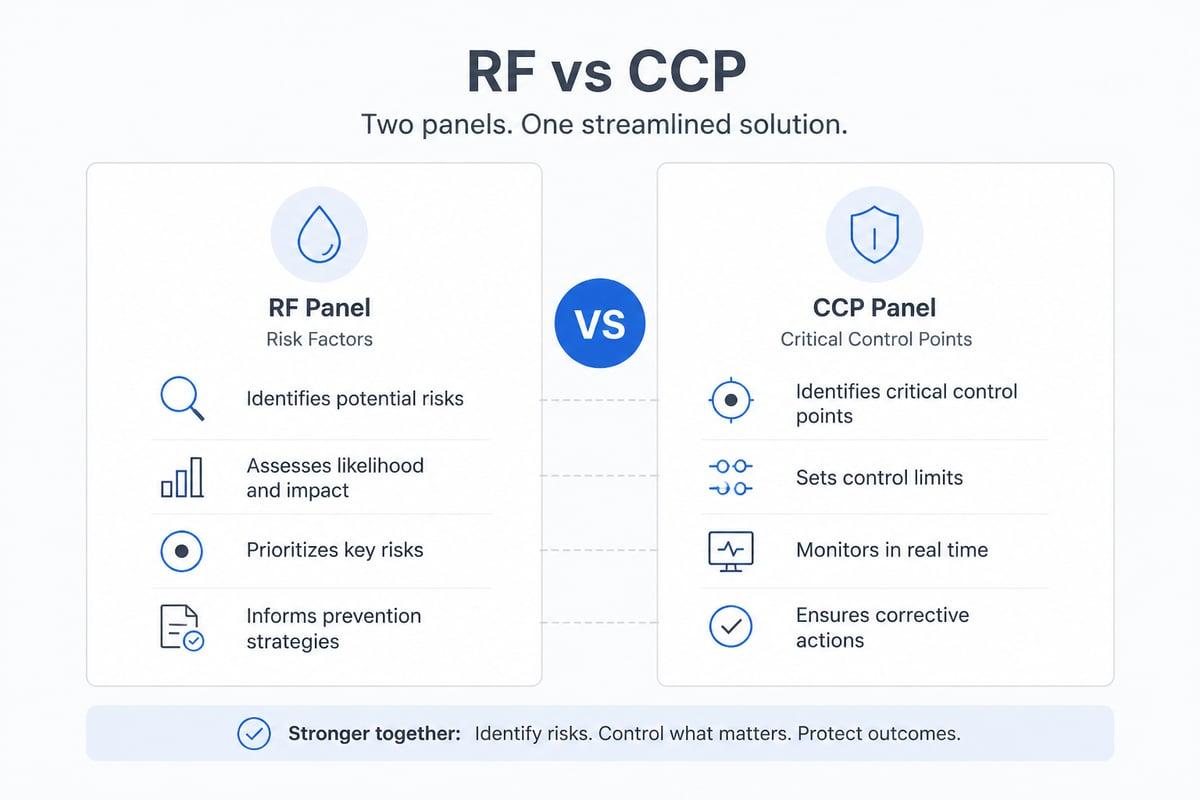
For rheumatoid arthritis, anti-CCP is generally the more specific test, while RF is the older and more widely available one. If you can order only one, anti-CCP is the stronger choice for confirming RA, and ordering both together gives the fullest picture. This RF vs CCP comparison explains what each test measures, how accurate each one is, and how to decide which to order when you are paying out of pocket.
What Is the Difference Between RF and Anti-CCP Antibody Tests?
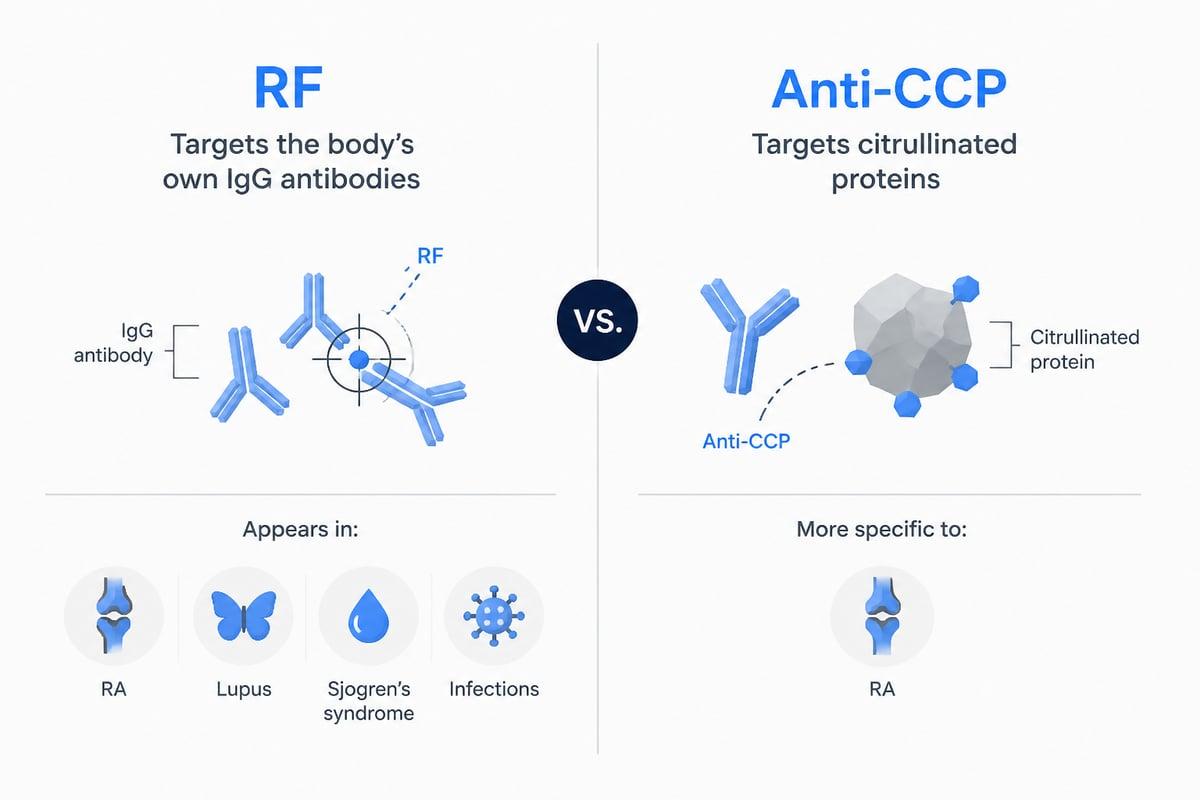
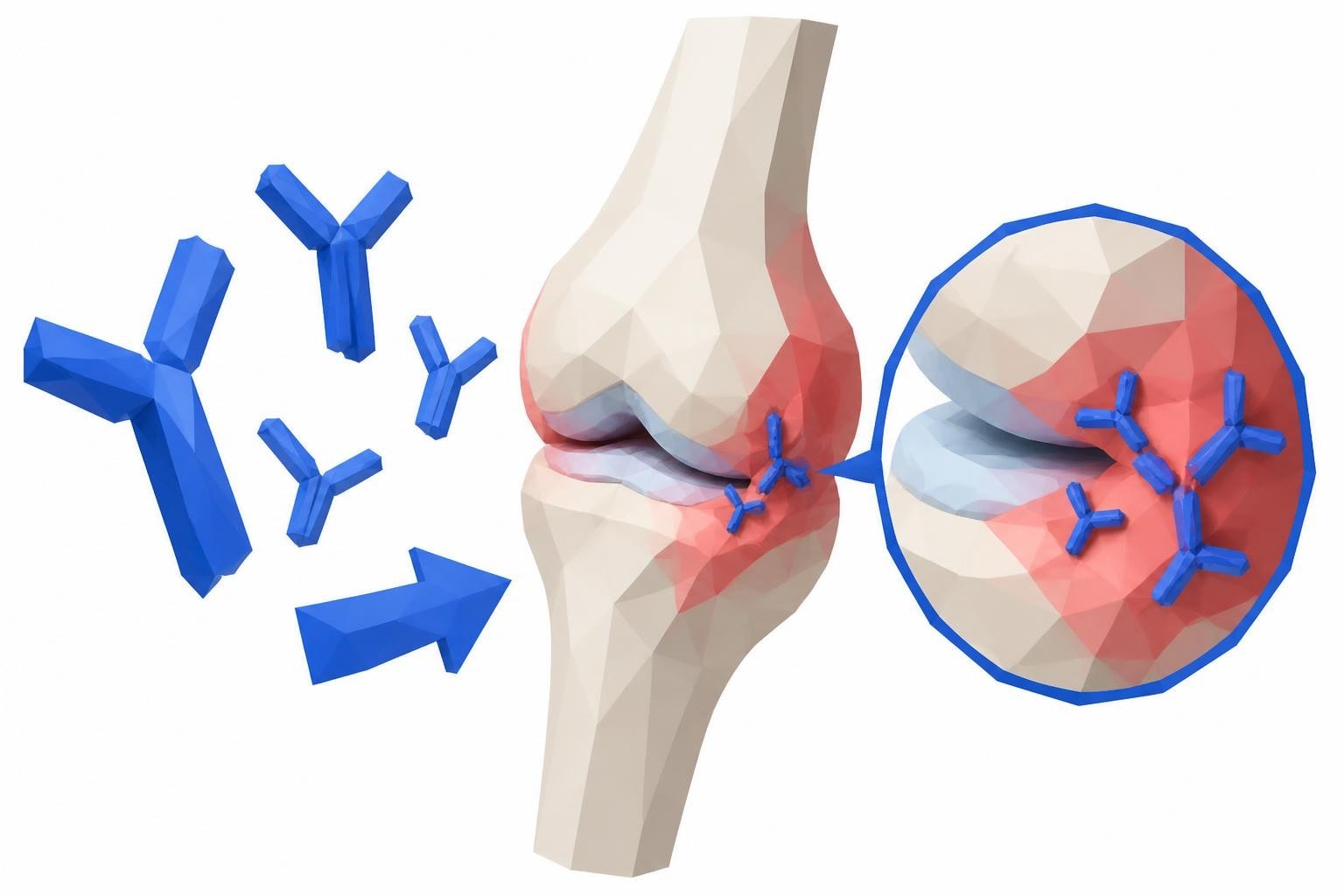
Both tests detect autoantibodies in the blood, but they look for different targets. Rheumatoid factor (RF) is an antibody that attacks the body's own immunoglobulin G. Anti-CCP (anti-cyclic citrullinated peptide) antibodies attack proteins that have been chemically modified through a process called citrullination, which occurs in inflamed joint tissue.
That difference shapes how each result should be read:
- RF appears in many conditions besides RA, including Sjogren's syndrome, lupus, chronic infections, and liver disease. It can also show up in healthy older adults.
- Anti-CCP is more closely tied to RA itself, which is why a positive result carries more diagnostic weight.
- Anti-CCP can appear years before joint symptoms begin, which makes it useful for people with early, unexplained joint pain.
Both are drawn from a single blood sample at a standard lab, and neither is a stand-alone diagnosis. A rheumatologist still combines the result with symptoms, a physical exam, and often imaging.
RF vs CCP: Accuracy, Sensitivity, and Specificity
Anti-CCP wins on specificity, while RF is roughly comparable on sensitivity but produces more false positives. According to the Merck Manual, RF is present in approximately 70% of people with rheumatoid arthritis, and anti-CCP has high specificity with roughly 77 to 86% sensitivity.
In plain terms, sensitivity is how often the test catches people who have the disease, and specificity is how often a positive result truly means the disease is present. The Arthritis Foundation reports anti-CCP antibodies in 60 to 80% of people with RA and notes the test is often run alongside RF.
False positives are the main weakness of RF. The NHS reports that about 1 in 20 people without RA test positive for RF. If you have a positive RF but no joint symptoms, that result alone is rarely cause for alarm.
False negatives matter too. A negative RF or anti-CCP result does not rule out RA, a point the National Institute of Arthritis and Musculoskeletal and Skin Diseases makes clearly: diagnosis also relies on clinical assessment and may include imaging and other blood tests. People with this pattern are often described as having seronegative RA, a limitation also covered by the Arthritis Foundation's overview of arthritis blood tests.
Side-by-Side Comparison: What Each Test Measures and When to Order It
The table below summarizes the practical differences. Neither the RF nor the anti-CCP test requires fasting, though it is reasonable to follow any instructions given at checkout.
| Test | What it measures | When to order it | Fasting needed? |
|---|---|---|---|
| RF (rheumatoid factor) | Antibodies directed at the body's own IgG | Persistent joint pain, stiffness, or swelling; a broad first look | No |
| Anti-CCP (CCP antibody) | Antibodies to citrullinated proteins | Joint symptoms where you want a more RA-specific answer; early or unexplained symptoms | No |
| RF plus anti-CCP together | Both antibodies from one draw | You want the most complete antibody picture before a specialist visit | No |
The practical split comes down to what you need the result to do. RF is the broader and older marker, present in roughly 70% of people with RA according to the Merck Manual, so it works as a general first look when joint symptoms are persistent but the cause is unclear. Anti-CCP, with high specificity, is the better choice when you want a positive result to mean something more definite. For example, someone with a few months of hand stiffness and no other autoimmune history gains more from anti-CCP than from RF alone, because a positive RF in that situation could simply reflect the false-positive rate the NHS describes. Ordering the pair makes sense when you already have an appointment booked and want both results in hand beforehand.
Which One Should I Order?
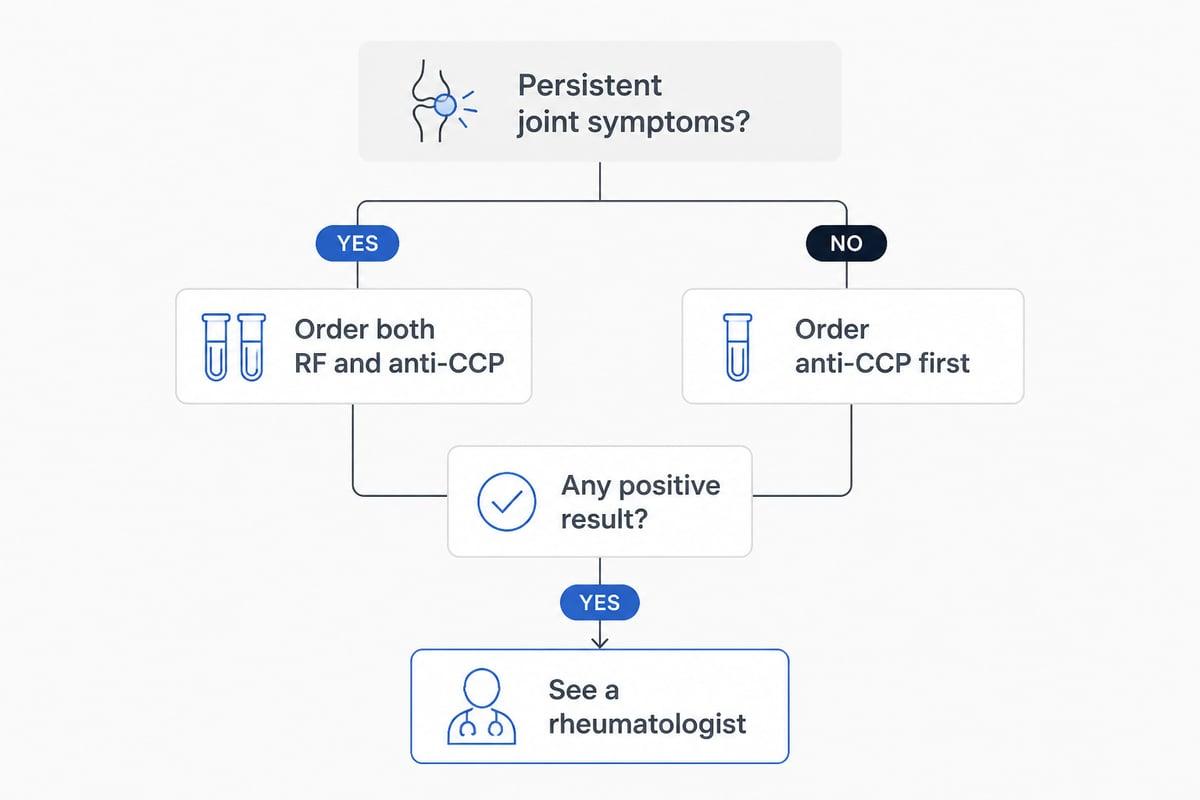
If you must choose one, order anti-CCP, because a positive result is more specific to RA and can appear earlier. Order RF alone only if cost is the deciding factor or you want a widely used baseline marker.
Use this quick guide:
- Joint pain with morning stiffness lasting over 30 minutes: order both RF and anti-CCP. Together they give the clearest antibody profile to bring to a rheumatologist.
- A single isolated symptom, or a family history without symptoms: start with anti-CCP, since a positive RF in this setting is more likely to be a false alarm.
- A previous positive RF with unclear meaning: add anti-CCP to see whether the result points toward RA or is probably incidental.
- A previous negative result but ongoing symptoms: repeat testing alone is rarely the answer. A rheumatologist can look at imaging and inflammatory markers such as ESR and hs-CRP.
You can order the CCP antibody test directly online without insurance or a doctor visit, with the blood draw done at one of 2,200+ Quest Diagnostics locations nationwide. Results are generally delivered securely online within 1 to 3 days, with clear values and reference ranges.
When You Need Both Tests
Ordering both is the better choice when the stakes of a missed or misread result are higher. The two markers answer slightly different questions, so the combination narrows uncertainty in a way neither does alone.
The combination matters for two reasons. First, the American College of Rheumatology and European League Against Rheumatism classification criteria, as summarized by the Merck Manual, award 0 points for negative RF and anti-CCP, 2 for low-positive results, and 3 for high-positive results. Because RF and anti-CCP are scored together within one serology category, a clinician reviewing both gets more to work with than a single value.
Second, the pattern carries prognostic information. The NHS says people positive for both RF and anti-CCP may be more likely to have severe RA requiring higher levels of treatment. That is a reason to bring both results to your appointment rather than one.
One result type can also clarify the other. A high-titer anti-CCP with a negative RF still strongly suggests RA, while a mildly positive RF with a negative anti-CCP is often not RA at all.
Recommended Test
Cyclic Citrullinated Peptide (CCP) Antibody, IgG
Anti-CCP antibodies are found in most people with rheumatoid arthritis and rarely in people without it. Paired with rheumatoid factor, this test helps a clinician evaluate joint pain and stiffness that might be RA.
Includes 1 biomarkers
$29
Recommended Test
Rheumatoid Factor
Rheumatoid Factor is an autoantibody commonly elevated in rheumatoid arthritis. This test helps diagnose RA and assess disease severity, though RF can also be elevated in other conditions.
Includes 1 biomarkers
$8
Panels That Bundle RF and CCP
If you want RF and anti-CCP in one order, several panels from Quest Health bundle them with related markers. Here is how they compare.
- Rheumatoid Arthritis Test Panel: priced at $110, plus a $6 physician service fee. It measures RF, CCP, and MCV antibodies from a blood sample, with results in 3 to 5 business days, for ages 18 to 100. It is the most focused option for an RA-related workup.
- Autoimmune and Inflammation Marker Test Panel: priced at $199, plus a $6 physician service fee. It measures 7+ markers, including RF, CCP, ANA, MCV, 14-3-3 eta, CRP, and ESR. This suits people who want broader autoimmune and inflammation screening alongside RA markers.
- Autoimmune Screening Test (ANA with Reflex): priced at $112. It screens for ANA with reflex to titer and pattern and is a better fit when lupus or another connective tissue condition is the concern rather than RA.
The tradeoff is breadth versus focus. A narrow panel keeps cost down and answers the RA question directly. A wider panel can surface patterns you did not know to look for, though more markers also means more results that may need professional interpretation.
CCP vs CRP: A Common Mix-Up
CCP and CRP are different tests that sound alike. Anti-CCP is an autoantibody test used to help identify rheumatoid arthritis, while CRP (C-reactive protein) is a general inflammation marker that rises with infection, injury, and many chronic conditions.
CRP cannot tell you why inflammation is present. A raised CRP in someone with swollen joints supports the idea of active inflammation, but it does not point to RA specifically. That is why the two are complementary rather than interchangeable. A person with a cold, a dental abscess, or a recent injury can have an elevated CRP with no arthritis at all, while someone with early RA can have a CRP that is only mildly raised or even normal. Anti-CCP, by contrast, is not an inflammation measure. It reports on a specific antibody, so it does not rise and fall with every infection.
There is also a version of CRP aimed at heart health. The high-sensitivity CRP (hs-CRP) test detects low levels of C-reactive protein and is associated with cardiovascular risk, not joint disease, so it is not a substitute for arthritis testing. It is priced at $15, with the blood sample collected at Quest Diagnostics and results in 1 to 2 days. If you are unsure which CRP result you are looking at, this explanation of hs-CRP levels in heart risk versus infection clarifies what each range means.
What Your Results Can and Cannot Tell You
Your results are a starting point for a conversation with a clinician, not a verdict. A few realities are worth knowing before you order.
Levels do not track flares. According to the Merck Manual, RF and anti-CCP levels do not fluctuate with RA disease activity. Repeating the test every few months to monitor symptoms will not tell you whether you are better or worse. Inflammatory markers such as the ESR (sed rate) and clinical assessment serve that purpose.
A one-time baseline is usually enough. Because these antibodies are fairly stable, retesting is rarely needed unless the original result was borderline or the clinical picture has changed substantially. This is useful if you are managing costs, since you generally need the panel once.
A single blood count can add context. Anemia of chronic disease is common in long-standing inflammatory conditions, so a Complete Blood Count (CBC) with Differential is a reasonable low-cost companion test to bring along. It does not diagnose RA, and a normal CBC does not rule it out, but it shows your overall blood cell picture.
Bring the report, not just the number. A rheumatologist will want the reference ranges, units, and lab name printed on the report. Self-pay results from certified labs include these, which makes them usable at an appointment.
If you have severe swelling, fever alongside joint pain, or sudden loss of function in a joint, seek medical care promptly rather than waiting on lab results. Online testing is for non-urgent questions, and treatment decisions belong with a physician.
FAQ
What is rheumatoid arthritis?
Rheumatoid arthritis is a chronic autoimmune condition in which the immune system attacks the lining of the joints, causing pain, swelling, and stiffness, often in the hands, wrists, and feet. Without treatment it can lead to joint damage over time. Diagnosis combines symptoms, a physical exam, blood tests, and sometimes imaging.
What does a rheumatoid factor blood test check for?
It checks for rheumatoid factor, an antibody that targets the body's own immunoglobulin G. A positive result supports a diagnosis of RA but is not conclusive, since RF also appears in other autoimmune diseases, chronic infections, and some healthy people.
Can I have RA with negative RF and anti-CCP results?
Yes. Some people have seronegative RA, meaning both antibody tests come back negative even though the disease is present. A clinician relies on symptoms, exam findings, and imaging in these cases, which is why a negative blood test should never end the investigation if joint symptoms persist.
Your next step is to write down your joint symptoms, how long they have lasted, and any family history, then decide whether you want anti-CCP alone or RF and anti-CCP together. If you want a straightforward way to get the antibody result, the CCP antibody test can be ordered online without insurance or a doctor visit. JustLabs publishes clear cash prices up front, and you can browse tests to find the blood work that fits your question and take your results to a rheumatologist for interpretation.
Related Reading


References
Nishimura K, Sugiyama D, Kogata Y, Tsuji G, Nakazawa T, Kawano S, Saigo K, Morinobu A, Koshiba M, Kuntz KM, Kamae I, Kumagai S. Meta-analysis: diagnostic accuracy of anti-cyclic citrullinated peptide antibody and rheumatoid factor for rheumatoid arthritis. Ann Intern Med. 2007 Jun 5;146(11):797-808. doi: 10.7326/0003-4819-146-11-200706050-00008. PMID: 17548411. https://pubmed.ncbi.nlm.nih.gov/17548411/
Sun J, Zhang Y, Liu L, Liu G. Diagnostic accuracy of combined tests of anti cyclic citrullinated peptide antibody and rheumatoid factor for rheumatoid arthritis: a meta-analysis. Clin Exp Rheumatol. 2014 Jan-Feb;32(1):11-21. PMID: 24050751. https://pubmed.ncbi.nlm.nih.gov/24050751/
Aletaha D, Neogi T, Silman AJ, Funovits J, Felson DT, Bingham CO 3rd, Birnbaum NS, Burmester GR, Bykerk VP, Cohen MD, Combe B, Costenbader KH, Dougados M, Emery P, Ferraccioli G, Hazes JM, Hobbs K, Huizinga TW, Kavanaugh A, Kay J, Kvien TK, Laing T, Mease P, Ménard HA, Moreland LW, Naden RL, Pincus T, Smolen JS, Stanislawska-Biernat E, Symmons D, Tak PP, Upchurch KS, Vencovský J, Wolfe F, Hawker G. 2010 Rheumatoid arthritis classification criteria: an American College of Rheumatology/European League Against Rheumatism collaborative initiative. Arthritis Rheum. 2010 Sep;62(9):2569-81. doi: 10.1002/art.27584. PMID: 20872595. https://pubmed.ncbi.nlm.nih.gov/20872595/
O'Neil LJ, Alpízar-Rodríguez D, Deane KD. Rheumatoid Arthritis: The Continuum of Disease and Strategies for Prediction, Early Intervention, and Prevention. J Rheumatol. 2024 Apr 1;51(4):337-349. doi: 10.3899/jrheum.2023-0334. PMID: 38224993. https://pubmed.ncbi.nlm.nih.gov/38224993/
De Stefano L, D'Onofrio B, Gandolfo S, Bozzalla Cassione E, Mauro D, Manzo A, Ciccia F, Bugatti S. Seronegative rheumatoid arthritis: one year in review 2023. Clin Exp Rheumatol. 2023 Mar;41(3):554-564. doi: 10.55563/clinexprheumatol/go7g26. PMID: 36971084. https://pubmed.ncbi.nlm.nih.gov/36971084/