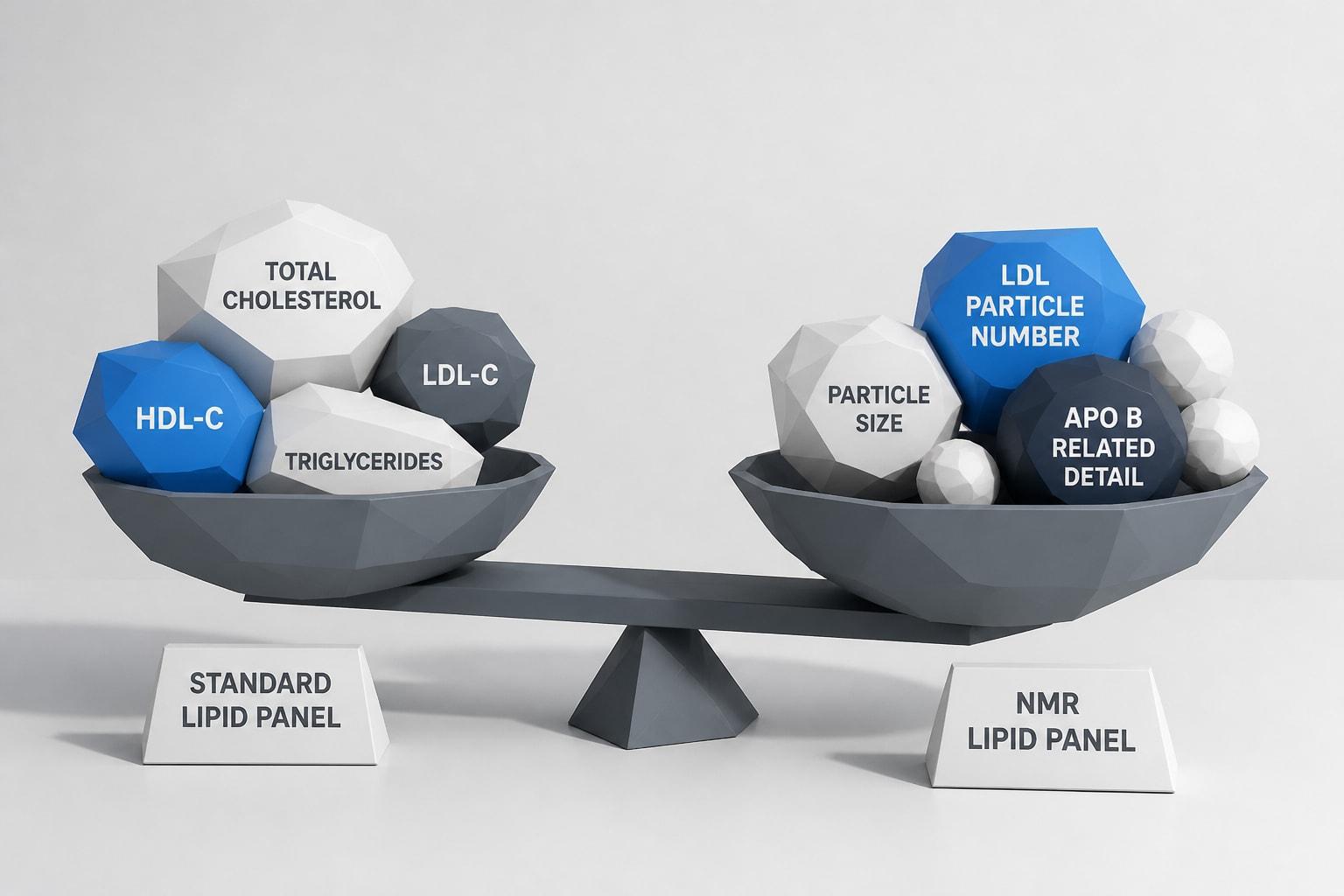
In the NMR vs lipid panel comparison, the standard lipid panel measures how much cholesterol your blood carries, while an NMR lipid panel counts and sizes the lipoprotein particles that carry it. The standard test is cheaper and covers most routine screening needs. The NMR test adds detail that can matter when your cholesterol numbers and your risk do not seem to match.
Big picture
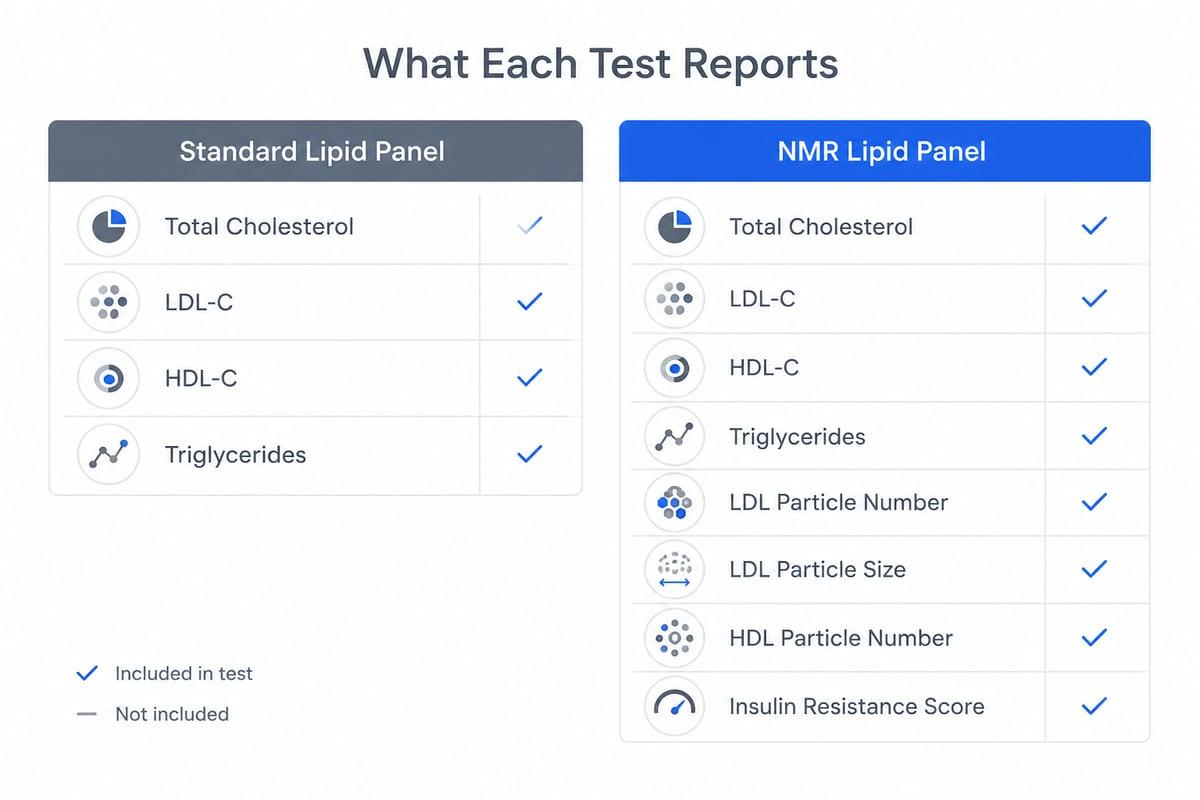
- What it is: A standard lipid panel reports total cholesterol, LDL cholesterol, HDL cholesterol, and triglycerides. An NMR lipid panel uses nuclear magnetic resonance to measure the number and size of lipoprotein particles, in addition to those standard values.
- Why it matters: Two people can have the same LDL cholesterol number and carry very different numbers of LDL particles. Particle count can change how risk is read.
- Who it affects: Adults who check cholesterol on their own, especially those with diabetes, metabolic syndrome, high triglycerides, or a family history of early heart disease.
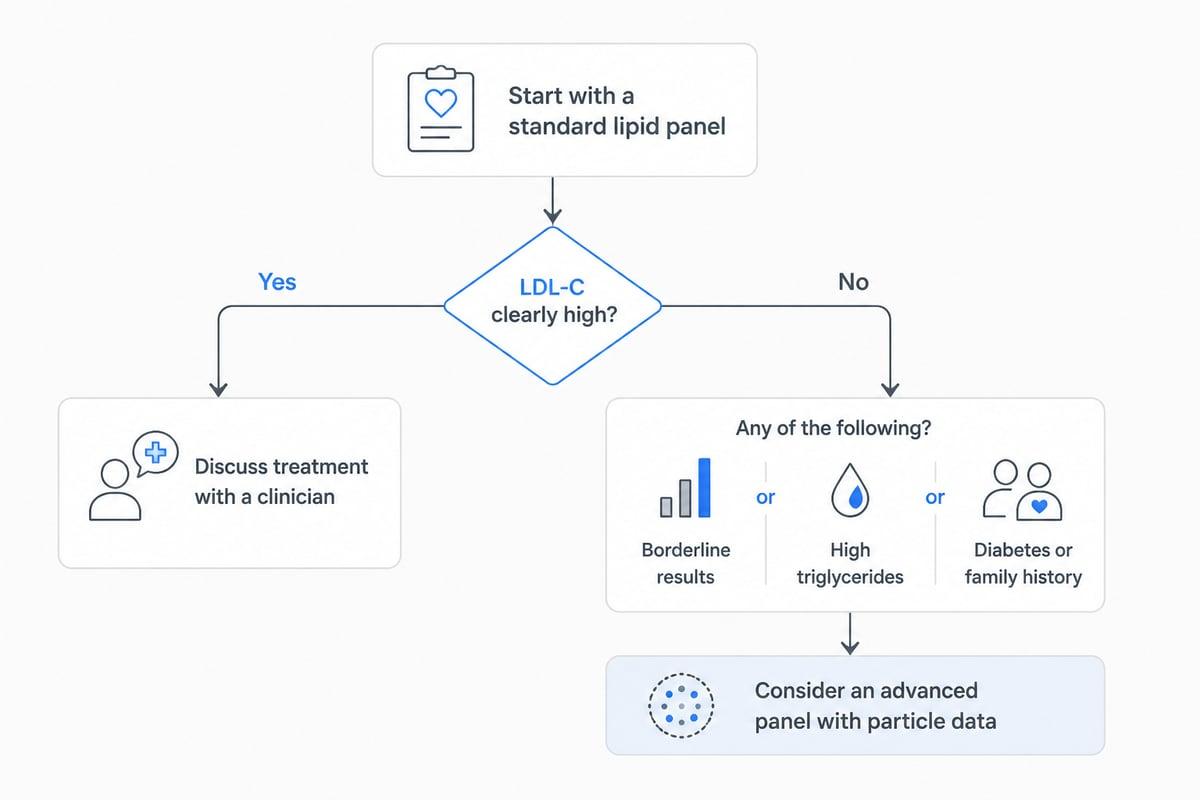
- Next step: Start with a standard lipid panel. If results are borderline or confusing, consider an advanced panel and review results with a clinician.
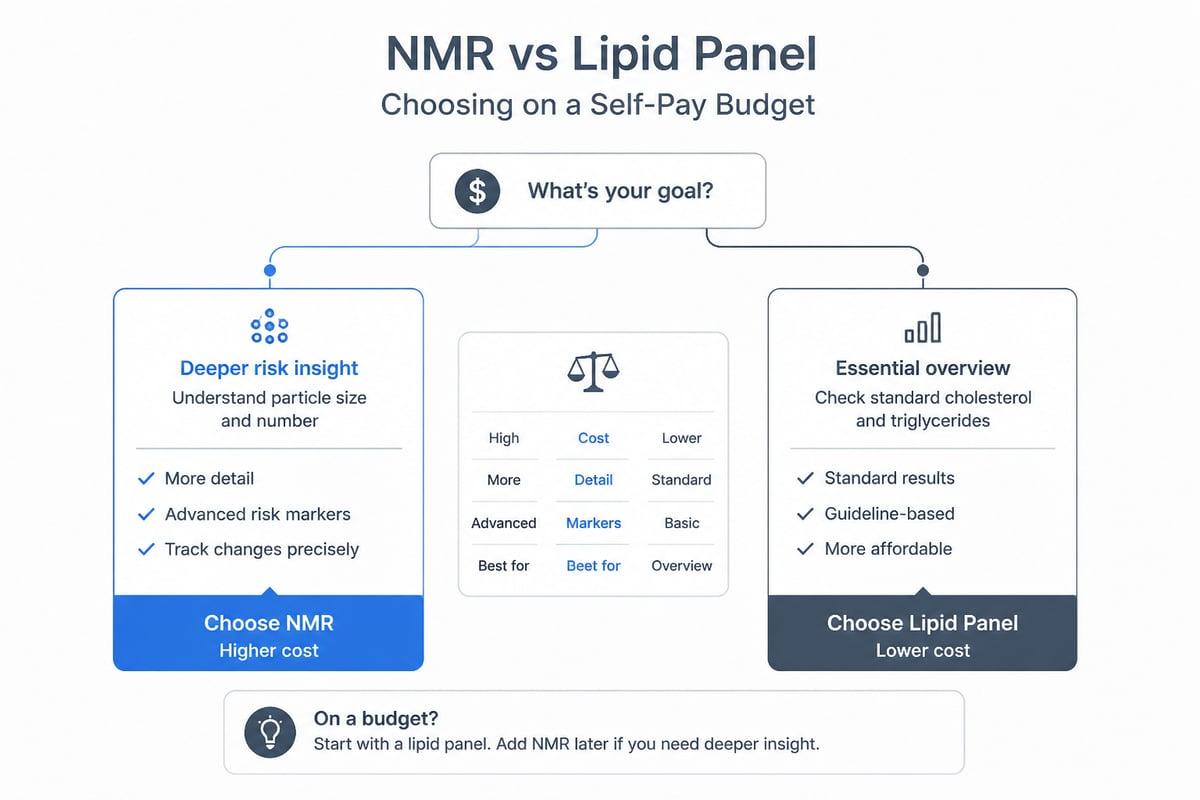
- Cost angle: Self-pay pricing makes it practical to choose the test that fits your question rather than the one a plan happens to cover.
What a standard lipid panel measures
A standard lipid panel, also called a lipid profile, is a blood test that measures cholesterol and triglycerides. According to Mayo Clinic, it reports four values: total cholesterol, LDL cholesterol, HDL cholesterol, and triglycerides.
Here is what each number represents:
- Total cholesterol: The combined cholesterol carried in all lipoprotein particles.
- LDL cholesterol (LDL-C): The cholesterol carried in low-density lipoproteins, often called "bad" cholesterol because these particles can deposit cholesterol in artery walls.
- HDL cholesterol (HDL-C): The cholesterol carried in high-density lipoproteins, which help return cholesterol to the liver.
- Triglycerides: A type of fat in the blood that rises with excess calories, sugar, and alcohol.
In most standard panels, LDL cholesterol is not measured directly. Labs typically calculate it from the other values using a formula, which is why very high triglycerides can make the estimate less reliable.
If you want a closer look at what counts as a healthy result, the lipid panel normal range page lists typical reference values.
What an NMR lipid panel adds
An NMR lipid panel uses nuclear magnetic resonance spectroscopy to detect the signals given off by lipoprotein particles in a blood sample, then converts those signals into particle counts and sizes. It reports the familiar cholesterol and triglyceride values and adds measurements that a standard panel cannot provide.
Common additions include:
- LDL particle number (LDL-P): The count of LDL particles in circulation, usually reported in nanomoles per liter.
- LDL particle size: Whether particles skew small and dense or large and buoyant.
- HDL particle number and size: A view of HDL beyond its cholesterol content.
- Large VLDL particles and insulin resistance markers: Some NMR reports include a score tied to insulin resistance, which can flag metabolic risk early.
The logic behind particle counting is simple. Cholesterol travels inside particles, and each particle can contribute to plaque. Someone with a moderate LDL-C but a high particle count has more particles crossing the artery wall than the cholesterol number suggests.
NMR vs lipid panel: side-by-side differences
The core difference in an NMR vs lipid panel comparison is what gets measured: cholesterol content versus particle number and size. The table below summarizes how the two tests differ on the points that matter most to someone paying out of pocket.
| Feature | Standard lipid panel | NMR lipid panel |
|---|---|---|
| Method | Chemical assay plus calculation | Nuclear magnetic resonance spectroscopy |
| Core results | Total cholesterol, LDL-C, HDL-C, triglycerides | Standard values plus particle numbers and sizes |
| LDL particle count | Not reported | Reported as LDL-P |
| Typical use | Routine screening and monitoring | Refining risk when standard results are unclear |
| Fasting | Sometimes requested | Often not required, but follow test instructions |
| Cost | Lower | Higher |
Neither test diagnoses heart disease. Both estimate risk, and both work best when interpreted alongside blood pressure, blood sugar, family history, smoking status, and age.
When standard cholesterol numbers can mislead
Standard results can mislead when LDL cholesterol and LDL particle count disagree, a pattern called discordance. In that situation, LDL-C looks acceptable while the particle count is high, which can leave risk underestimated.
Discordance is more common in people with:
- Type 2 diabetes or prediabetes
- Metabolic syndrome, including central weight gain and high blood pressure
- High triglycerides with low HDL-C
- A strong family history of early heart disease despite normal-looking cholesterol numbers
Current lipid guidance points in the same direction. The American Heart Association describes apoB and lipoprotein(a), among other markers, as additional measures that can help refine an individual's cardiovascular risk. NMR panels and apoB tests both belong to this broader family of particle-based measurements, and they answer a similar question: how many atherogenic particles are circulating.
Not everyone needs this level of detail. For many adults with clearly normal or clearly elevated results, the standard panel is enough to guide the next step.
Preparing for each test
Fasting rules depend on the test and the lab. Mayo Clinic notes that fasting for about 9 to 12 hours may be requested before a cholesterol test, while some tests do not require fasting at all. Because triglycerides rise after eating, fasting gives a cleaner triglyceride and calculated LDL reading.
A practical approach:
- Read the preparation notes on the specific test you order.
- Drink water normally unless instructed otherwise.
- Take regular medications unless a clinician has told you otherwise.
- Avoid heavy meals and alcohol the evening before a fasting draw.
For a deeper walkthrough of timing and exceptions, see this guide to lipid panel fasting rules.
Choosing between them on a self-pay budget
For most self-pay adults, the standard lipid panel is the right first test because it is inexpensive, widely understood, and sufficient for routine tracking. An advanced panel makes sense as a second step when the first result raises questions.
Consider the standard panel if you are:
- Checking cholesterol for the first time in years
- Tracking changes after diet, exercise, or weight loss
- Monitoring a known, stable pattern
Consider an advanced panel if you:
- Have borderline LDL-C but diabetes, prediabetes, or high triglycerides
- Have a family history of early heart disease with unremarkable standard numbers
- Want particle-level detail to share with a clinician
JustLabs offers both routes. The Lipid Panel covers the four standard values, and you can check the lipid panel cost page for current cash pricing. For a more detailed cardiovascular look, the Lipid Panel with Cardio IQ adds advanced markers beyond the standard four. Blood draws happen at Quest Diagnostics locations, and results are typically available online within 1-3 days.
Recommended Panel
Advanced Heart Health Panel
Save $4Go beyond basic cholesterol testing. This advanced panel includes the markers cardiologists use to assess true cardiovascular risk: ApoB, Lp(a), homocysteine, and inflammation.
Includes 10 biomarkers
$81
Fasting required
Self-ordering gives you data, not a treatment plan. If a result is high, or if you are unsure how to read it, bring the report to a licensed clinician who can decide on medication or other care.
How to lower LDL particle number
Lowering LDL particle number follows the same principles as lowering LDL cholesterol, because the underlying drivers overlap. Lifestyle changes that reduce LDL-C and improve insulin sensitivity tend to reduce particle count as well.
Habits with the strongest track record include:
- Cutting saturated fat: Swap fatty meats, butter, and full-fat dairy for fish, legumes, nuts, and olive oil.
- Adding soluble fiber: Oats, beans, lentils, apples, and psyllium help lower LDL.
- Losing excess weight: Even modest weight loss can lower triglycerides and improve particle patterns.
- Exercising regularly: Aerobic activity supports healthier HDL and triglyceride levels.
- Limiting refined carbohydrates and alcohol: Both raise triglycerides and can shift LDL toward smaller, denser particles.
- Quitting smoking: It worsens the overall lipid and vascular picture.
When particle count stays high despite these changes, medication may be appropriate. That decision belongs with a prescribing clinician, not with a self-order test.
Where cholesterol appears on lab results
On a standard report, cholesterol results usually sit under a section labeled "Lipid Panel" or "Cholesterol," with each value listed on its own line next to a reference range and a flag for results outside that range. The flag is typically a letter such as "H" or "L," or a note reading "High" or "Low," so a quick scan of that column shows which values the lab considers out of range.
Look for these line items:
- Cholesterol, Total
- HDL Cholesterol
- Triglycerides
- LDL Cholesterol, often marked "calculated"
The "calculated" label matters. It tells you the lab derived LDL from the other values rather than measuring it directly, which is the standard approach and is why very high triglycerides can make that estimate less reliable.
On an NMR report, the standard values appear alongside additional lines such as LDL particle number and LDL particle size, and the layout is often more detailed. Units are typically mg/dL for cholesterol and triglycerides and nmol/L for particle counts. Because the units differ, a particle number should not be compared directly with an LDL-C value. Read each line against its own reference range, and keep both reports together if you track results over time so the same lines can be compared draw to draw.
Key takeaways
- A standard lipid panel measures cholesterol content: total cholesterol, LDL-C, HDL-C, and triglycerides. An NMR lipid panel reports those same values and also counts and sizes the particles that carry cholesterol, which gives a second angle on the same question.
- Discordance between LDL-C and LDL particle number is most likely with diabetes, metabolic syndrome, and high triglycerides. If your LDL-C looks acceptable but you have any of these conditions, particle data can show whether risk is being underestimated.
- Current guidance recognizes apoB, lipoprotein(a), and similar markers as tools that can help refine standard risk assessment. The standard panel remains the foundation, and advanced markers add detail on top of it.
- Start with the standard panel and add advanced testing when results are borderline or do not match your risk profile. A clearly normal or clearly elevated result usually does not need particle-level follow-up to guide the next step.
- Follow the preparation instructions for the specific test you order, since fasting requirements vary by test and lab.
- Test results inform decisions but do not replace a clinician's judgment on treatment. Bring any high or confusing result to a licensed clinician, who can weigh it against blood pressure, blood sugar, family history, smoking status, and age.
FAQ
Is a lipid test the same as a cholesterol test?
Yes, in everyday use the two terms describe the same blood test. A lipid panel measures cholesterol and triglycerides, so it is commonly called a cholesterol test or lipid profile.
What is a NMR LipoProfile test?
NMR LipoProfile is a branded type of NMR lipid panel that measures lipoprotein particle number and size using nuclear magnetic resonance. It is most often used to clarify cardiovascular risk when standard cholesterol numbers leave questions open.
How do I get my LDL particle number down?
Reduce saturated fat, eat more soluble fiber, exercise regularly, and work toward a healthier weight. If your count stays high after consistent changes, a clinician can discuss whether medication makes sense.
Take one concrete step today: pull up your most recent cholesterol results, or order a baseline if you do not have any, and note whether your LDL cholesterol, triglycerides, and any metabolic risk factors suggest a standard panel is enough or an advanced one is worth adding. JustLabs lets you compare prices and choose the right test online, and you can browse tests with transparent cash pricing, then complete your draw at a nearby Quest Diagnostics location without insurance or a doctor visit.