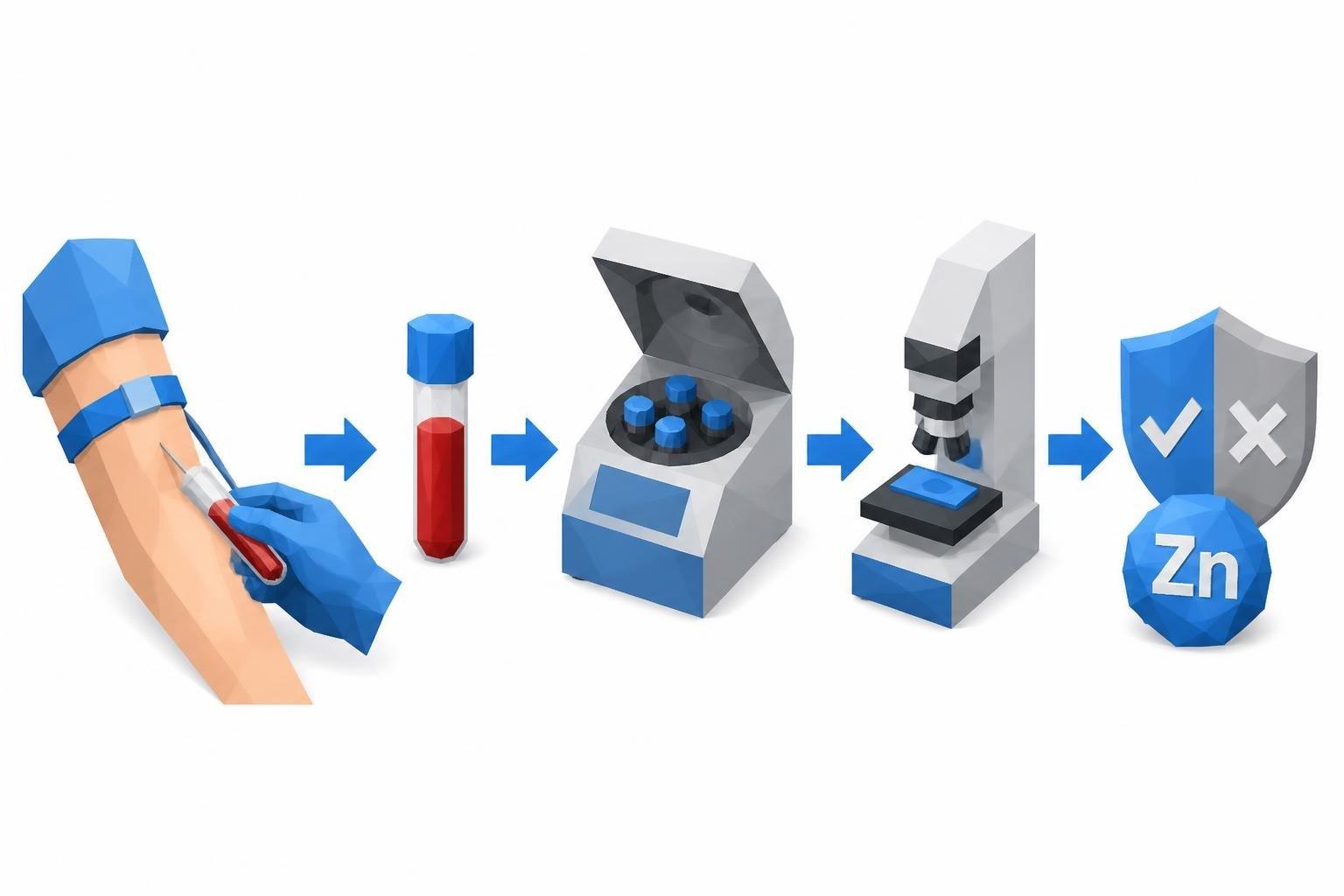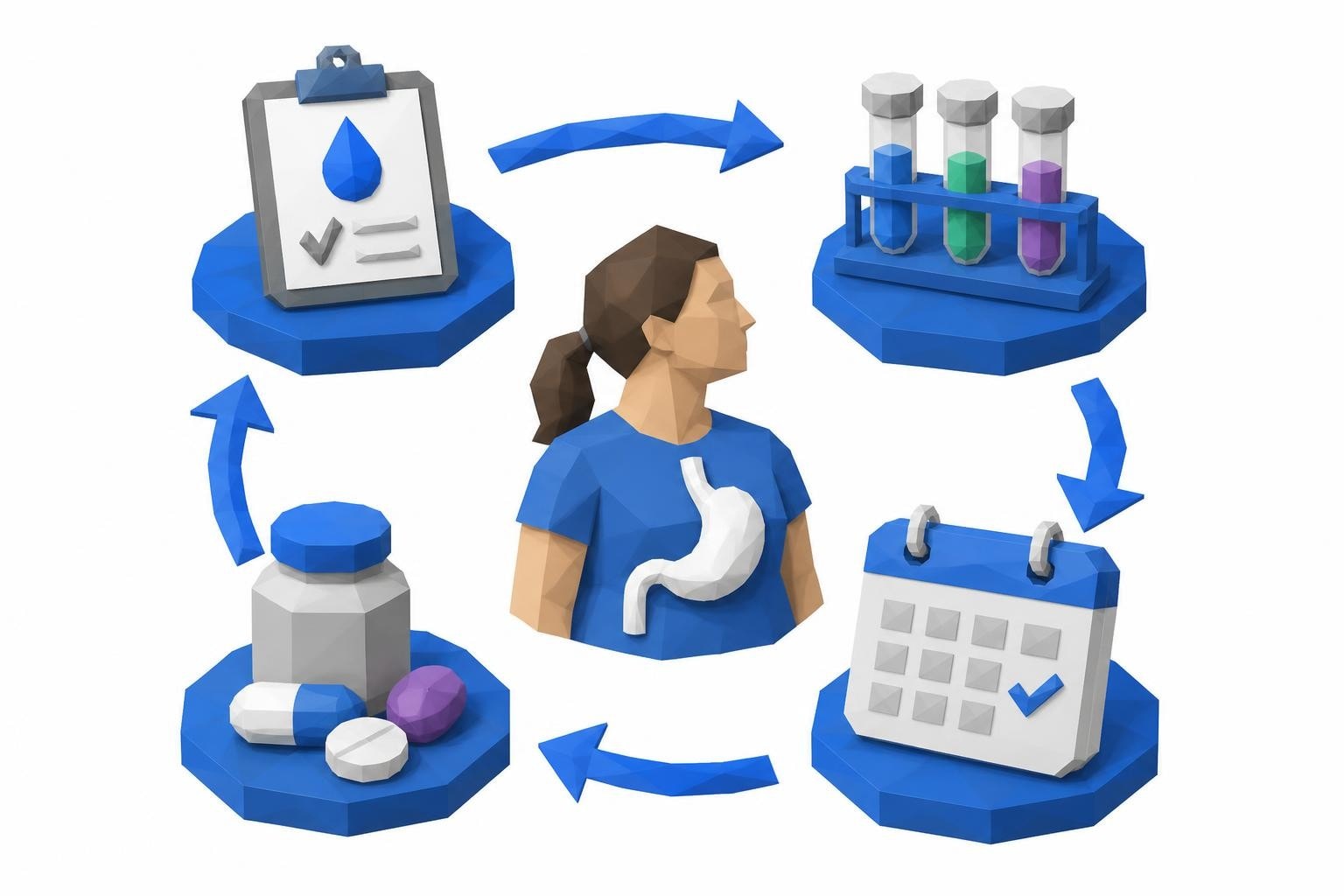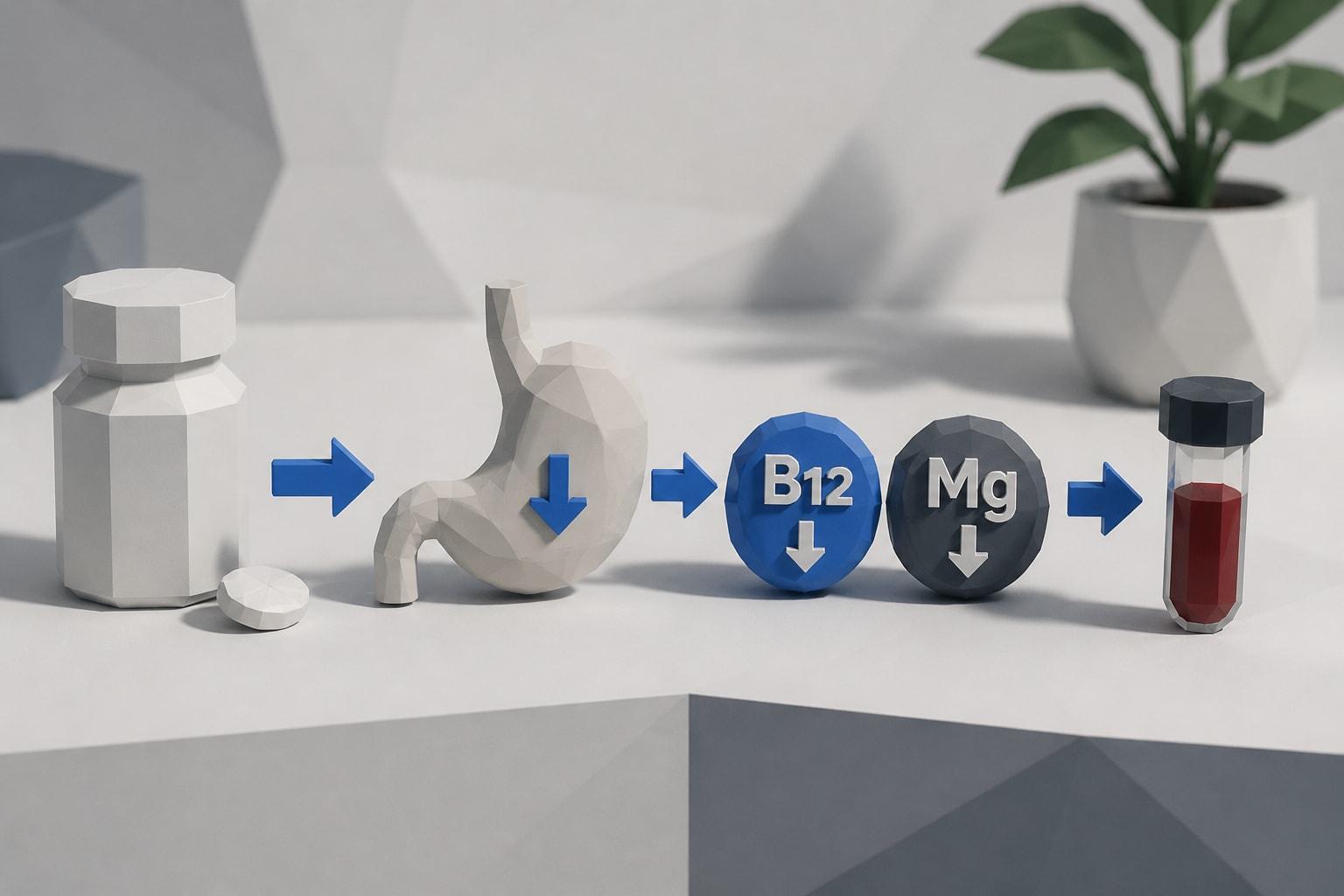
Yes, long-term omeprazole use can lower both vitamin B12 and magnesium in some people, though it does not happen to everyone and it usually takes months to years of daily use. The link is well documented in regulatory and public health sources, but a low level on a blood test is what confirms a problem, not the medication alone.
Big picture
- What it is: Omeprazole is a proton pump inhibitor (PPI) that reduces stomach acid. Less acid can mean less absorption of vitamin B12 from food, and PPIs are also linked to low blood magnesium.
- Why it matters: Low B12 can cause fatigue, numbness, and anemia. Low magnesium can cause muscle cramps, irregular heart rhythm, and low calcium or potassium that is hard to correct.
- Who it affects: Mainly adults who take omeprazole daily for more than a year, especially older adults, people on a vegetarian or vegan diet, and those taking other magnesium-lowering medicines.
- Association, not certainty: Many long-term users never become deficient. Testing is how you find out where you stand.
- Actionable next step: If you take omeprazole regularly, check your B12 and magnesium with a blood test and bring the results to your prescriber. Do not stop or change a prescribed medication without clinical advice.
Does omeprazole lower B12 and magnesium?
Omeprazole can lower both nutrients, but the evidence differs by timeline and by nutrient. Regulators and health agencies describe a pattern tied to duration of use rather than a quick effect.
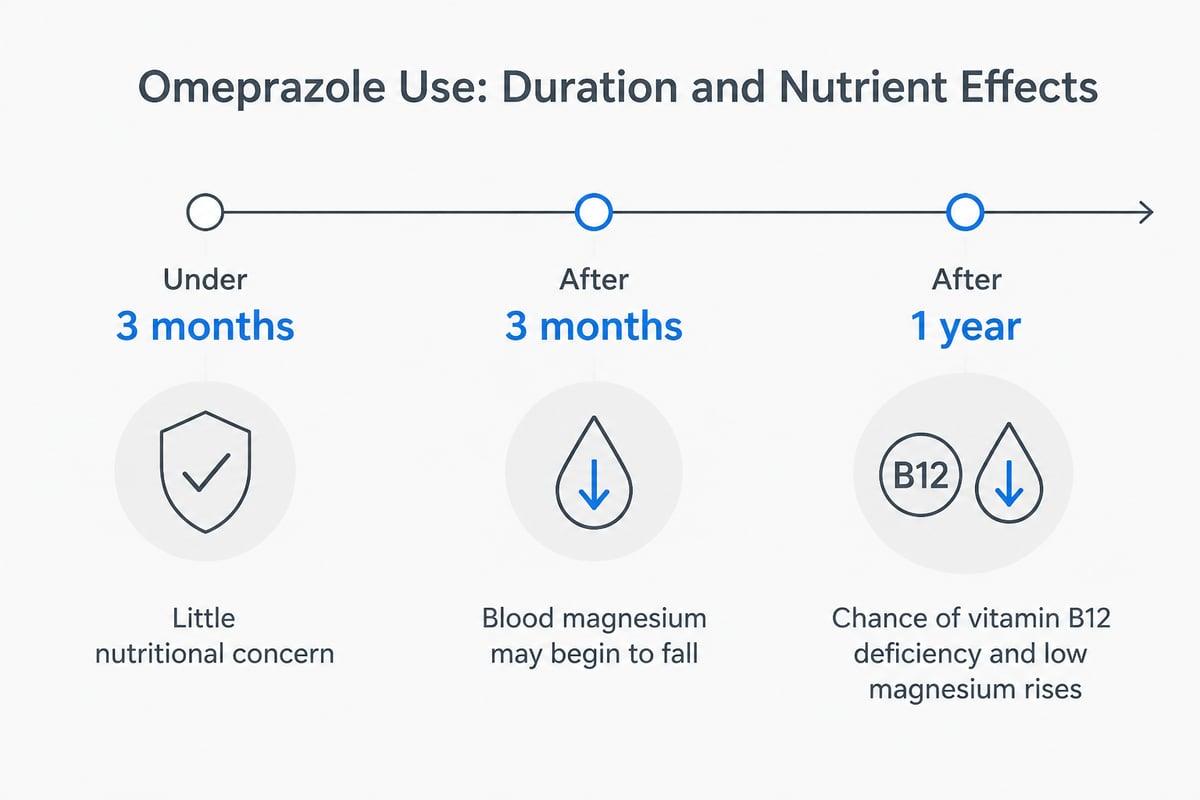
The Irish Health Service Executive notes that blood magnesium may fall after more than 3 months of omeprazole use, while use for more than 1 year can increase the chance of vitamin B12 deficiency. That timeline is a useful anchor. A two-week course for a flare of heartburn carries little nutritional risk. Years of daily use is a different situation.
Two points keep this in perspective:
- The risk is a possibility, not a guarantee. Studies describe an increased likelihood of low levels in groups of PPI users. They do not predict what will happen to one individual.
- Both problems are detectable. Neither low B12 nor low magnesium has to be guessed at. A blood draw measures both.
The sections below explain the mechanisms, the symptoms, and how to test.
How does omeprazole affect B12 absorption?
Omeprazole affects B12 absorption by reducing stomach acid, which food-bound B12 needs in order to be released and absorbed. Dietary B12 is attached to proteins in food. Stomach acid and an enzyme called pepsin separate the vitamin from those proteins, and the freed B12 then binds to a carrier protein called intrinsic factor for absorption in the small intestine.
When acid output is suppressed for long periods, the first step becomes less efficient. The vitamin stays attached to food protein and passes through without being fully absorbed.
This mechanism has a few practical consequences:
- Food-bound B12 is affected most. The B12 in fortified foods and in supplements is already in a free form and does not depend on stomach acid in the same way. This is why some clinicians suggest a supplement or fortified foods for long-term PPI users.
- Stores buffer the effect. The liver holds a reserve of B12 that can last for years, so a deficiency typically develops slowly. That delay is one reason the HSE ties the added risk to use beyond a year.
- Absorption declines with age anyway. Many older adults already produce less stomach acid, so the effect of a PPI can compound an existing tendency.
Reduced absorption does not automatically mean deficiency. It means the margin gets smaller, and a person with a thin dietary intake has less room to absorb the difference.
How does omeprazole lower magnesium?
Omeprazole is linked to low magnesium, though the exact mechanism is not fully settled. The leading explanation is that long-term acid suppression interferes with magnesium absorption in the intestine, possibly by affecting the channels that move magnesium across the gut wall.
The NIH Office of Dietary Supplements reports that PPI-related low magnesium (hypomagnesemia) typically occurs after prolonged use, usually more than a year. It also notes that in some FDA-reviewed cases, magnesium supplements did not correct the low level and patients had to stop the PPI. That detail suggests that for a small share of people, the medication itself is driving the deficiency, and extra magnesium alone may not fix it.
This is a clinical decision, not a do-it-yourself one. If a magnesium level stays low despite supplementation, the right response is a conversation with the prescriber about whether the PPI is still needed, whether a lower dose would work, or whether another approach to acid control makes sense. Stopping a prescribed medicine on your own can cause rebound acid symptoms and may be inappropriate for people with conditions such as Barrett's esophagus or a history of ulcers.
Who is most at risk of low B12 or magnesium on omeprazole?
The people most at risk are those who combine long-term PPI use with other factors that lower B12 or magnesium. Risk is cumulative, so each added factor narrows the margin.
Common risk factors include:
- Duration and dose. Daily use for more than a year, particularly at higher doses, carries more risk than occasional use.
- Age over 60. Absorption of B12 tends to fall with age, and older adults are more likely to take several medications at once.
- Vegetarian or vegan eating patterns. B12 occurs naturally almost only in animal foods, so a plant-based diet already depends on fortified foods or supplements.
- Other magnesium-lowering medicines. Diuretics are a well-known example, and combining them with a PPI can compound the effect.
- Digestive conditions. Celiac disease, Crohn's disease, and past bariatric surgery can all reduce nutrient absorption on their own.
- Heavy alcohol use. Alcohol affects both magnesium status and B12 handling.
- Metformin use. Metformin is also associated with lower B12, so taking it alongside a PPI stacks two influences.
If several of these apply to you, regular checks make more sense than waiting for symptoms. If none apply and you have taken omeprazole for a few weeks, routine testing for this reason alone is rarely necessary.
What symptoms suggest low B12 or low magnesium?
Low B12 and low magnesium produce symptoms that overlap with many common conditions, which is why they are easy to miss. Symptoms alone cannot confirm either one.
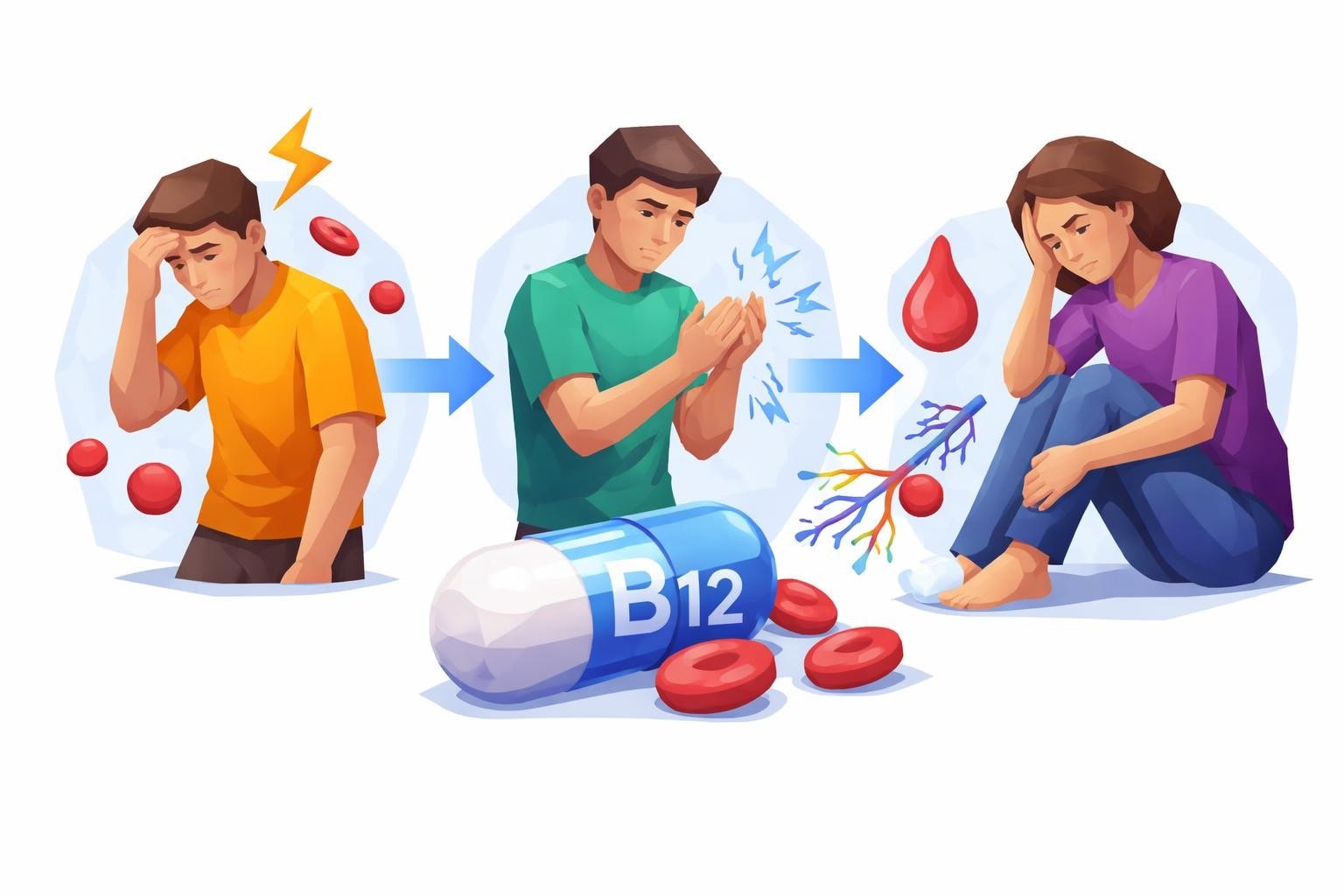
Possible signs of low B12:
- Persistent fatigue or weakness
- Tingling, numbness, or "pins and needles" in the hands and feet
- Difficulty with balance or walking
- Pale or slightly yellow skin
- A sore, smooth tongue
- Memory trouble, low mood, or trouble concentrating
- Shortness of breath with exertion
Possible signs of low magnesium:
- Muscle cramps, twitching, or spasms
- Tremor or restlessness
- Weakness and fatigue
- Irregular or rapid heartbeat
- Nausea or loss of appetite
- In more serious cases, seizures or very abnormal heart rhythms
Mild deficiencies often cause no symptoms at all. Severe symptoms such as chest pain, fainting, a very irregular heartbeat, or seizures need urgent medical care, not an online lab order.
What else can cause low B12 besides omeprazole?
Omeprazole is only one of several possible causes of low B12, and the true cause often involves more than one factor. Identifying the cause matters because the treatment differs.
Other common contributors include:
- Pernicious anemia. An autoimmune condition in which the body does not make intrinsic factor, so B12 cannot be absorbed even with a good diet.
- Atrophic gastritis. Chronic inflammation of the stomach lining reduces acid and intrinsic factor, and it becomes more common with age.
- Dietary shortfall. Vegan and some vegetarian diets provide little B12 without supplements or fortified foods.
- Metformin. Long-term use is associated with lower B12 levels.
- H2 blockers. Acid reducers such as famotidine can also lower acid, though the effect is generally considered smaller than with PPIs.
- Intestinal disease or surgery. Celiac disease, Crohn's disease, and procedures that remove or bypass parts of the stomach or small intestine can limit absorption.
- Nitrous oxide exposure. Repeated or heavy use inactivates B12 in the body.
Because the causes vary, a B12 result is most useful when read alongside your medication list, diet, and symptoms. If the result is borderline, a follow-up marker can help clarify whether true deficiency is present, and our guide to methylmalonic acid and B12 deficiency explains how that works.

Does taking omeprazole deplete B12?
Taking omeprazole can deplete B12 over time, but only in some people and usually after a year or more of daily use. The reduced acid makes it harder to pull B12 from food, and the body's liver stores can mask the shortfall for a long while before blood levels drop.
That delay shapes how to think about the risk. A person who started omeprazole six months ago is unlikely to be deficient because of it. A person who has taken it daily for five years, eats little meat or dairy, and has noticed tingling in the feet has a more reasonable case for checking.
Depletion also depends on baseline status. Someone with generous B12 stores and a varied diet may stay in the normal range for years on a PPI. Someone who started with borderline levels may cross into deficiency sooner. This is why a single blood test, taken at a point in time, tells you more than a general statistic about PPI users.
What happens to your body if you take omeprazole every day?
Daily omeprazole reduces stomach acid substantially, which relieves acid reflux and heals acid-related damage but can also change how the body absorbs certain nutrients over the long term. For many people with reflux disease or ulcers, the benefit clearly outweighs the risk.
Over months to years, the documented nutritional effects of long-term use include:
- Lower B12 absorption from food, as described above
- Lower blood magnesium in a subset of users
- Possible effects on absorption of other nutrients, such as iron and calcium, because stomach acid helps with their uptake
Daily use also changes how the stomach behaves. Stopping suddenly can trigger rebound acid production, which makes symptoms feel worse than before. That is another reason not to stop without guidance from the clinician who prescribed it.
The practical takeaway is balance. Daily omeprazole is a legitimate, often necessary treatment. Periodic monitoring of nutrient status simply makes long-term use safer.
When should you test B12 and magnesium?
Testing makes sense if you have taken omeprazole daily for a year or more, have symptoms that fit low B12 or magnesium, or have additional risk factors such as older age, a vegan diet, or a diuretic. A baseline check followed by periodic rechecks gives you a trend instead of a single number.
A reasonable approach:
- Check your baseline. If you have been on a PPI for over a year and never tested, a first set of results shows where you stand.
- Match tests to your concerns. B12 and magnesium are the two directly tied to PPI use.
- Add context markers if needed. A complete blood count (CBC) can show whether low B12 has begun to affect red blood cells, such as unusually large cells or anemia.
- Recheck at intervals. If a value is borderline or you start supplementing, a repeat test confirms whether it is improving.
- Share results with your prescriber. They can decide whether a change in dose, a supplement, or a different treatment plan is appropriate.
For adults who pay out of pocket or have a high deductible, self-ordered testing can be a practical way to do this. Our overview of why your deductible resets and what it costs explains why routine monitoring often falls outside what insurance makes easy.
Which blood tests check B12 and magnesium?
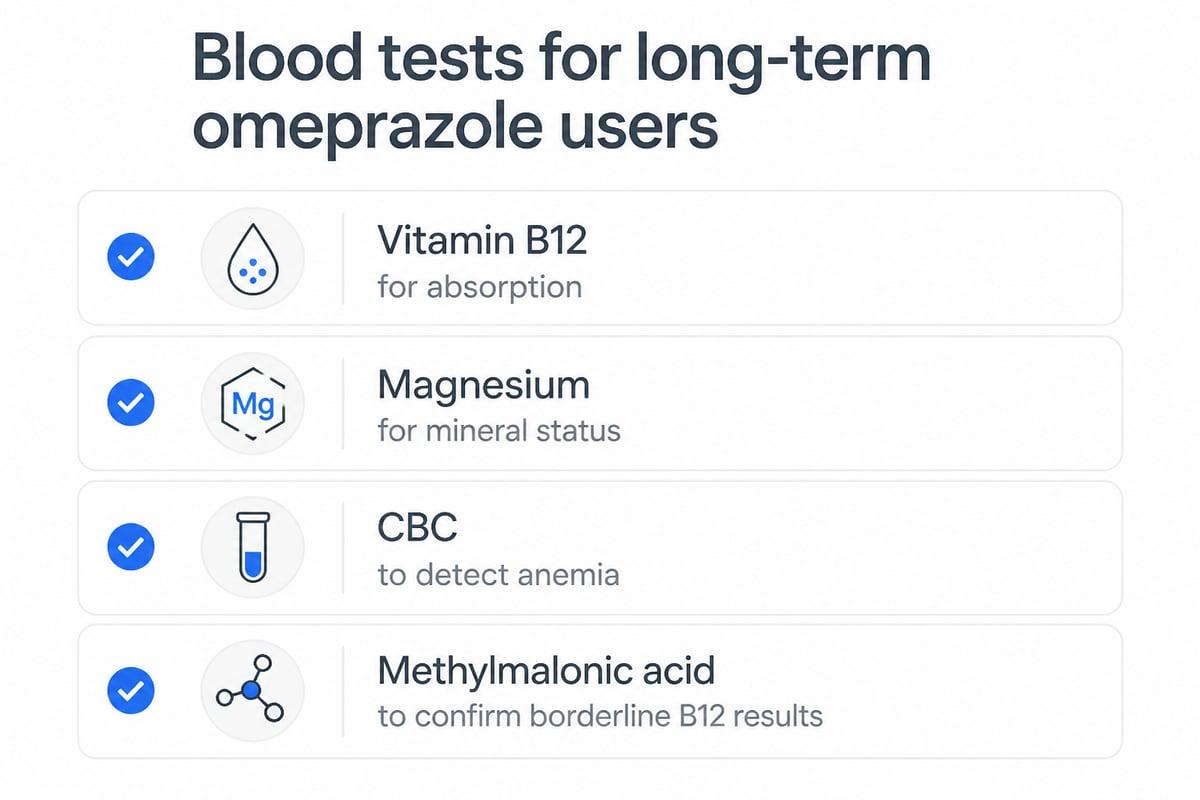
The most useful tests are a serum vitamin B12 test and a serum magnesium test, with a CBC and methylmalonic acid (MMA) available as supporting checks. Each answers a slightly different question.
| Test | What it measures | Why it matters for omeprazole users |
|---|---|---|
| Vitamin B12 | B12 level in the blood | Main screen for B12 deficiency |
| Magnesium | Magnesium level in the blood | Main screen for PPI-related low magnesium |
| CBC | Red and white blood cell counts and sizes | Can reveal anemia or enlarged red cells linked to low B12 |
| MMA | A marker that rises when B12 is functionally low | Clarifies borderline B12 results |
A Vitamin B12 Blood Test is the natural starting point because B12 is the nutrient most directly tied to long-term PPI use, and it measures the vitamin that supports nerve function, DNA synthesis, and red blood cell formation. The result comes back with your value and a reference range so you can see where you fall.
On magnesium, the type of test affects interpretation. Serum magnesium is the common version, while a red blood cell magnesium test reflects levels inside cells and can behave differently. Our comparison of the RBC vs serum magnesium test walks through the tradeoffs, and the magnesium test cost guide covers pricing so you can plan before you order.
For people checking several nutrients at once, a broader panel can be more efficient than ordering one test at a time.
Recommended Panel
Vitamin & Mineral Panel
Save $5This panel tests the most commonly deficient nutrients: Vitamin D, B12, Folate, Iron (with complete iron studies), Ferritin, and Magnesium - the building blocks your body needs to function optimally.
Includes 8 biomarkers
$61
Fasting required
If a B12 result lands in a gray zone, MMA can help separate a true shortfall from a borderline reading, and a CBC adds information about how your blood cells are responding.
Recommended Panel
B12 Deficiency Panel
Save $9A B12 blood test on its own can read normal or borderline in someone who is genuinely deficient. This panel adds the methylmalonic acid test and homocysteine, the markers clinicians use to confirm a deficiency at the tissue level, plus folate and a complete blood count to tell B12 and folate problems apart and check for anemia.
Includes 18 biomarkers
$72.70
How do you read your results?
Your results are read against a reference range, and the meaning depends on whether you are low, borderline, or normal. A value alone is not a diagnosis, so the interpretation always includes your symptoms and medication history.
B12 results:
- Clearly low: Suggests deficiency and warrants follow-up with a clinician, who may recommend supplementation or investigate the cause.
- Borderline: A common gray zone. A confirmatory test such as methylmalonic acid (MMA) can clarify whether tissue-level B12 is truly low.
- Normal: Reassuring, though if symptoms persist, other causes deserve attention.
Magnesium results:
- Low: May reflect reduced absorption, increased loss, or inadequate intake. Because the NIH Office of Dietary Supplements notes that supplements did not correct the problem in 25% of FDA-reviewed PPI cases, a persistently low value is worth discussing with the prescriber.
- Normal: Blood magnesium is tightly regulated, so a normal serum level does not rule out low total body stores in every case.
Keep in mind that a normal result today does not guarantee the same result in two years. Trends over time carry more information than a single reading.
What can you do if your levels are low?
If your levels are low, share the results with your prescriber, who can choose the right response based on why the level is low and whether you still need the omeprazole. Self-adjusting your medication is not advised.
Options a clinician may discuss include:
- B12 supplementation. Oral or injectable forms, chosen based on severity and cause.
- Dietary changes. Adding B12-rich foods such as fish, eggs, dairy, or fortified cereals, or fortified plant-based options for those who avoid animal products.
- Magnesium repletion. Supplements or dietary changes, with monitoring to confirm they work.
- Reviewing the PPI. Determining whether the lowest effective dose is being used, whether the medication is still necessary, or whether an alternative is appropriate.
- Investigating other causes. Checking for pernicious anemia, celiac disease, or other conditions if the pattern does not fit PPI use alone.
Retesting after a period of treatment confirms whether the plan is working. Because the nutritional effects of a PPI develop slowly, correction also tends to take weeks to months rather than days.
Key takeaways
- Long-term omeprazole use is associated with lower vitamin B12 and magnesium, usually after more than a year of daily use, though magnesium may begin to fall after 3 months.
- Reduced stomach acid impairs release of food-bound B12, while the magnesium mechanism is less settled.
- Association is not proof of deficiency. Many long-term users stay in the normal range.
- Risk rises with older age, vegan diets, diuretics, metformin, and digestive conditions.
- Symptoms such as numbness, fatigue, cramps, and palpitations overlap with many other conditions, so blood tests are the way to confirm.
- A B12 test, a magnesium test, a CBC, and MMA together give a clear picture.
- Never stop or change prescribed omeprazole without clinical advice. Seek urgent care for severe symptoms.
Related reading
FAQ
What meds should not be taken with vitamin B12?
Few medicines are strictly off-limits with vitamin B12, but several can lower your B12 level over time. Metformin and PPIs such as omeprazole are associated with lower B12. Ask a pharmacist or prescriber to review your full medication list before starting a supplement.
What depletes B12 the most?
The largest contributors are conditions and habits that block absorption, including pernicious anemia, atrophic gastritis, intestinal surgery or disease, and a diet with no animal products or fortified foods. Among medicines, long-term metformin and acid-suppressing drugs are the best-known. Heavy alcohol use and repeated nitrous oxide exposure can also affect B12 status.
Can I take B12 and magnesium supplements while on omeprazole?
Many people do, and clinicians often suggest it when levels run low. Because the right form and dose depend on your results, check your levels first and discuss the plan with your prescriber. Testing again afterward confirms whether the supplement is working.
How often should I test if I take omeprazole long term?
There is no single schedule that fits everyone. A common approach is a baseline check after about a year of daily use, then periodic rechecks guided by results, symptoms, and risk factors. Your prescriber can tailor the interval.
Do over-the-counter and prescription omeprazole carry the same risk?
The active ingredient is the same, so the nutritional concerns relate to dose and duration rather than whether the product is sold over the counter. Taking the over-the-counter version daily for long periods carries a similar pattern of risk to prescription use.
If you take omeprazole daily, gather your medication list and note any symptoms such as tingling or cramps, then check your levels so you have real numbers to discuss with your prescriber. JustLabs lets you order tests online at upfront cash prices with no doctor visit, and the Vitamin B12 Blood Test is a practical place to start. Your blood draw happens at a Quest Diagnostics location, and results are generally delivered online within 1-3 business days with clear values and reference ranges. You can compare B12, magnesium, CBC, and related options, and Browse Tests to pick the ones that fit your situation.
References
Choudhury A, Jena A, Jearth V, Dutta AK, Makharia G, Dutta U, Goenka M, Kochhar R, Sharma V. Vitamin B12 deficiency and use of proton pump inhibitors: a systematic review and meta-analysis. Expert Rev Gastroenterol Hepatol. 2023 May;17(5):479-487. doi: 10.1080/17474124.2023.2204229. PMID: 37060552. https://pubmed.ncbi.nlm.nih.gov/37060552/
Patel H, McGuirk R. Vitamin B12 Deficiency: Common Questions and Answers. Am Fam Physician. 2025 Sep;112(3):294-300. PMID: 40961307. https://pubmed.ncbi.nlm.nih.gov/40961307/
Srinutta T, Chewcharat A, Takkavatakarn K, Praditpornsilpa K, Eiam-Ong S, Jaber BL, Susantitaphong P. Proton pump inhibitors and hypomagnesemia: A meta-analysis of observational studies. Medicine (Baltimore). 2019 Nov;98(44):e17788. doi: 10.1097/MD.0000000000017788. PMID: 31689852. https://pubmed.ncbi.nlm.nih.gov/31689852/
Gommers LMM, Hoenderop JGJ, de Baaij JHF. Mechanisms of proton pump inhibitor-induced hypomagnesemia. Acta Physiol (Oxf). 2022 Aug;235(4):e13846. doi: 10.1111/apha.13846. PMID: 35652564. https://pubmed.ncbi.nlm.nih.gov/35652564/
Freedberg DE, Kim LS, Yang YX. The Risks and Benefits of Long-term Use of Proton Pump Inhibitors: Expert Review and Best Practice Advice From the American Gastroenterological Association. Gastroenterology. 2017 Mar;152(4):706-715. doi: 10.1053/j.gastro.2017.01.031. PMID: 28257716. https://pubmed.ncbi.nlm.nih.gov/28257716/