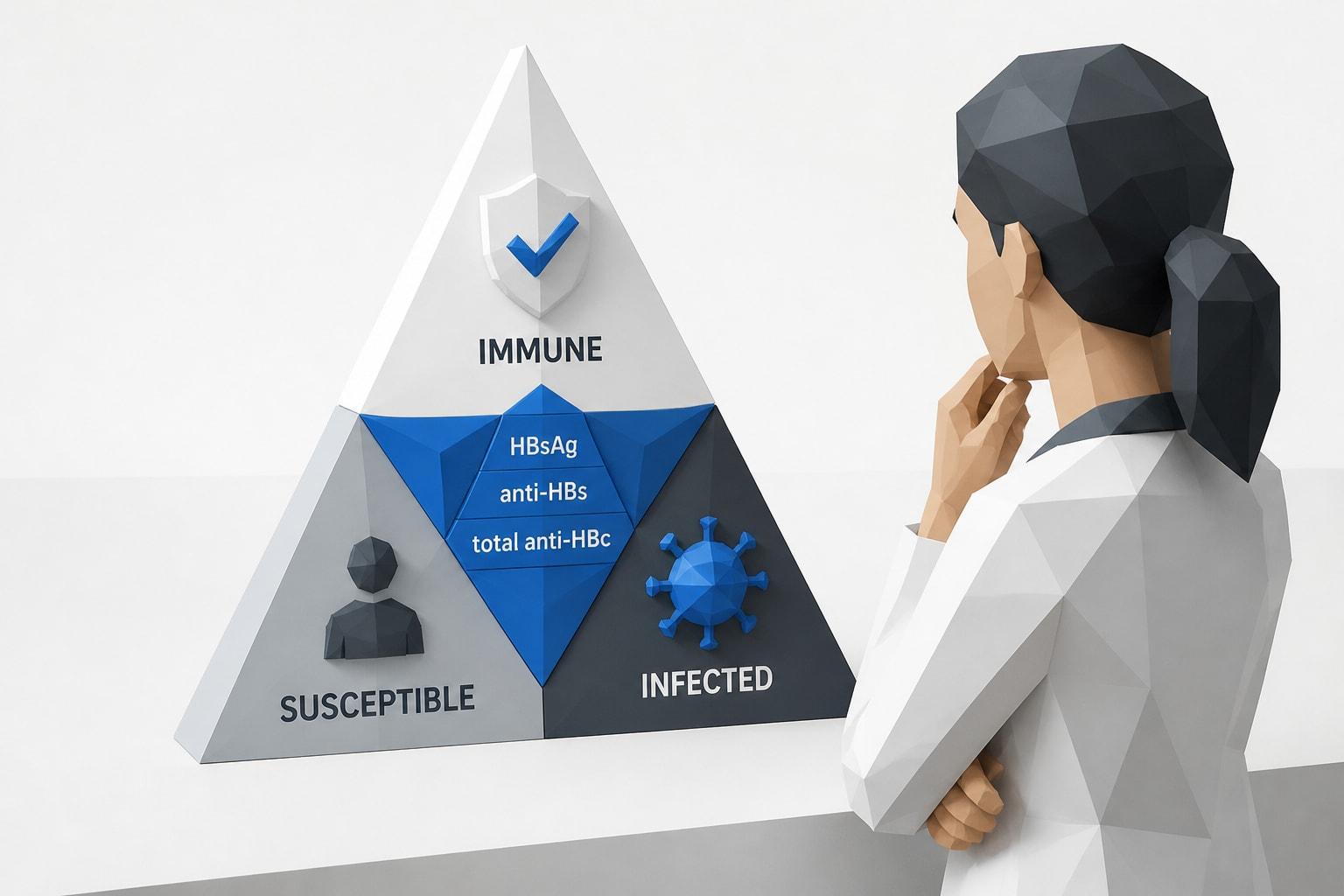
Hepatitis B results explained in one line: your panel measures three markers, and the combination of positive and negative results shows whether you are infected, immune, or still susceptible. Reading them together, rather than one at a time, is what produces an accurate picture.
Big picture
- What it is: A hepatitis B panel checks your blood for viral proteins (antigens) and the antibodies your immune system makes in response. The pattern tells you whether you have never been exposed, were vaccinated, recovered, or carry the virus.
- Why it matters: Hepatitis B can stay silent for years while it affects the liver. A clear result lets you protect your liver and the people around you.
- Who it affects: Any adult who has never been screened, anyone with an unknown vaccination history, and people with known exposure risks.
- Plain-language rule: A positive surface antigen (HBsAg) points to current infection. A positive surface antibody (anti-HBs) points to immunity. A positive core antibody (anti-HBc) points to past or present infection.
- Next step: Match your three results to the table below, then bring any result involving a positive HBsAg or anti-HBc to a licensed clinician for follow-up.
What a hepatitis B panel measures
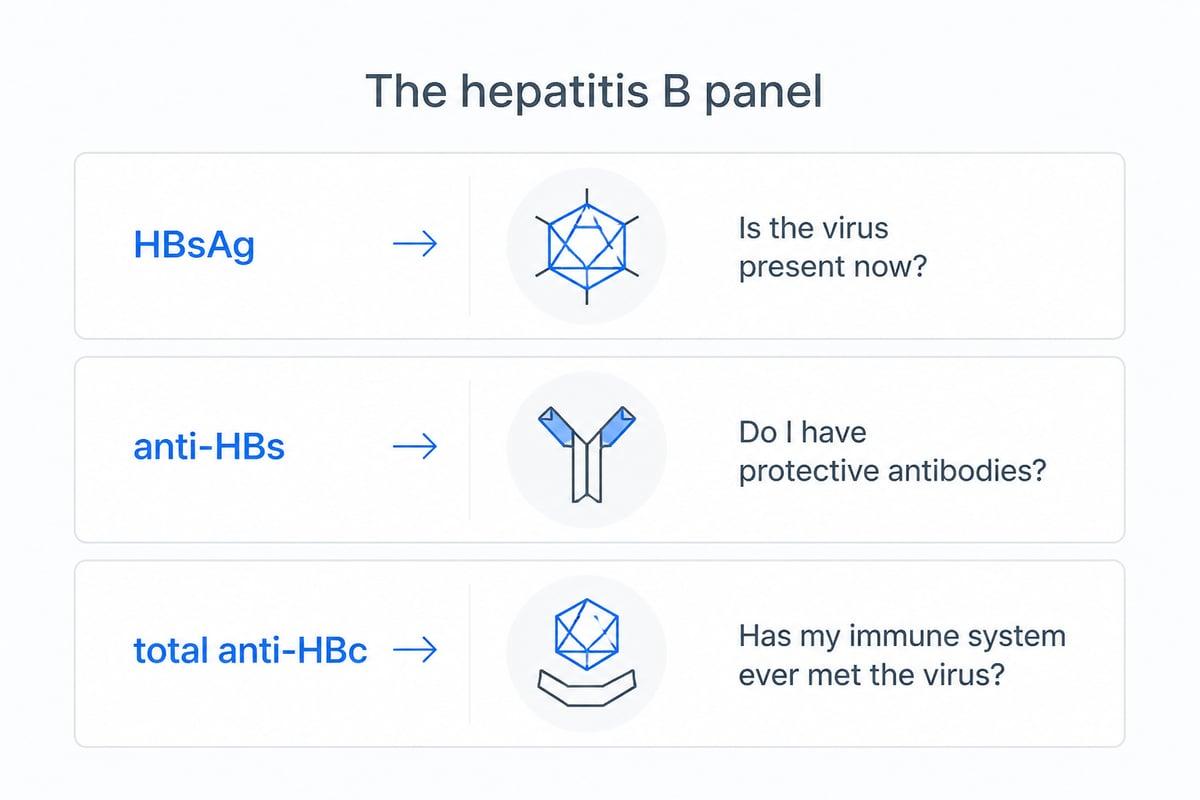
A standard hepatitis B panel measures three markers: hepatitis B surface antigen (HBsAg), hepatitis B surface antibody (anti-HBs), and total hepatitis B core antibody (anti-HBc). The CDC recommends that adults who have never been screened receive this triple panel.
Each marker answers a different question:
- HBsAg asks whether the virus is present now.
- Anti-HBs asks whether you have protective antibodies.
- Total anti-HBc asks whether your immune system has ever encountered the virus.
No single marker tells the whole story. A positive anti-HBs alone, for example, is good news after vaccination but means something different when it appears alongside a positive core antibody.
How to read hepatitis B results: the common patterns
Hepatitis B results explained by pattern fall into a handful of outcomes, and the table below maps the three-marker combinations to their usual meaning. Treat it as a general reference, since final interpretation belongs to a clinician who knows your history.
| HBsAg | Anti-HBs | Total anti-HBc | Usual interpretation |
|---|---|---|---|
| Negative | Negative | Negative | Susceptible: never infected and not vaccinated (or vaccine response has faded) |
| Negative | Positive | Negative | Immune through vaccination |
| Negative | Positive | Positive | Immune through natural infection (recovered) |
| Positive | Negative | Positive | Infected (acute or chronic); needs further testing |
| Negative | Negative | Positive | Unclear; several possible explanations |
If your panel does not match any row exactly, that is a signal to seek interpretation rather than guess. Mixed patterns are uncommon but well documented, and the next sections explain the most frequent ones.
What a positive hepatitis B surface antigen means
A positive hepatitis B surface antigen (HBsAg) result means the virus is probably in your body now. The CDC notes that HBsAg can be detected in acute or chronic infection, that its presence generally indicates current infection and infectiousness, and that it can be transiently positive within 30 days after hepatitis B vaccination.
That last point matters for anyone who received a shot recently. A positive result drawn within a month of a vaccine dose may be a temporary artifact rather than a true infection. Mention your vaccination date to whoever reviews your result.
A positive HBsAg is not a diagnosis of liver damage. It signals that further evaluation is needed. Follow-up usually includes:
- A repeat HBsAg test at least six months later to distinguish acute from chronic infection.
- An IgM anti-HBc test to check for recent infection.
- An HBV DNA test (viral load) and liver enzyme tests, which a clinician orders to judge activity and decide on treatment.
The WHO overview of hepatitis testing describes the same sequence: serology first, then molecular testing for HBV DNA to confirm and stage infection.
What the hepatitis B core antibody means
The hepatitis B core antibody (anti-HBc) is an antibody to the inner protein shell of the virus, and a positive result means your immune system has encountered hepatitis B at some point. According to the CDC, anti-HBc indicates previous or ongoing infection and is not produced by vaccination alone. That makes it a useful dividing line: vaccinated people show anti-HBs without anti-HBc, while people who were infected show both.
There are two forms of core antibody, and the distinction changes the meaning:
- Total anti-HBc includes both IgM and IgG classes. This is what the standard panel reports.
- IgM anti-HBc appears early. The CDC states that IgM positivity indicates recent infection, generally within the previous 6 months, and supports an acute infection interpretation.
An isolated positive core antibody, with negative HBsAg and negative anti-HBs, is the pattern that causes the most confusion. It can reflect a resolved infection where surface antibodies have faded, a false positive, or an uncommon occult infection. A clinician typically repeats the panel and may add HBV DNA testing to sort out which one applies.
What the hepatitis B surface antibody means
A positive hepatitis B surface antibody (anti-HBs, also written HBsAb) means you have protective antibodies, either from vaccination or from clearing a past infection. Protection is generally associated with a higher antibody level, and you should check the reference range printed on your own report to see what your laboratory considers protective.
The key question is which route produced the antibodies. If your core antibody is negative, vaccination is the likely source. If your core antibody is positive, a past infection that your body cleared is the more likely explanation.
A negative anti-HBs with negative everything else means you are susceptible. That can happen to people who were vaccinated in childhood, because antibody levels can decline over the years. Whether a booster is appropriate is a decision for a clinician, and the JustLabs article on whether you are still immune after the surface antibody result covers how immunity and antibody levels relate.

How hepatitis B markers change over time
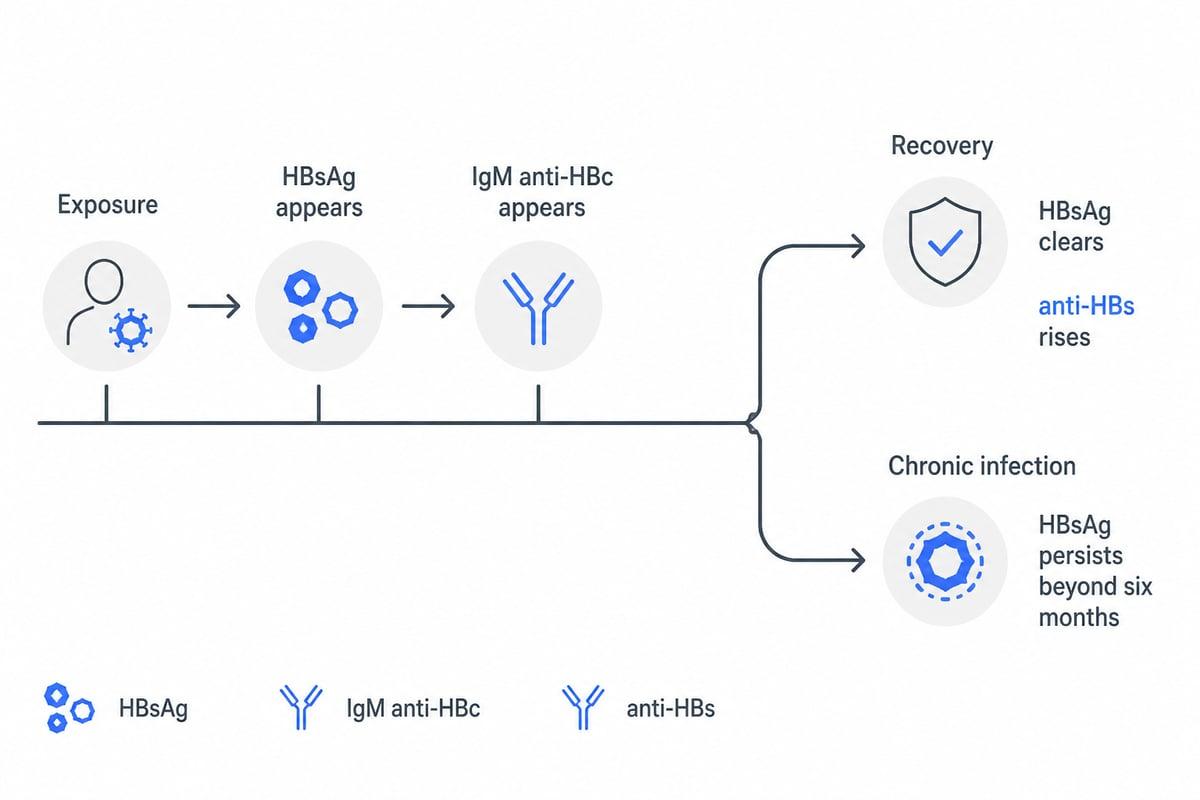
Results are a snapshot of a moving process, so the same person can show different patterns at different stages. Understanding the timeline explains why clinicians sometimes ask for a repeat test.
During acute infection, HBsAg appears first, followed by IgM anti-HBc. In people who recover, HBsAg disappears and anti-HBs rises, leaving a positive total anti-HBc and positive anti-HBs for life.
During chronic infection, HBsAg stays positive for more than six months, IgM anti-HBc fades, and anti-HBs remains absent.
After vaccination, only anti-HBs appears. The CDC's surveillance manual chapter on hepatitis B lays out these marker patterns in detail for readers who want the full serologic reference.
The window between exposure and a detectable result is the reason timing matters. If you believe you were exposed recently, an early negative panel may not be final, and repeating it later gives a more reliable answer.
What a negative result means for you
A fully negative panel (HBsAg, anti-HBs, and anti-HBc all negative) means you have no current infection and no evidence of past exposure or immunity. For most adults, that is reassuring but incomplete, because it also means you have no protection.
The practical next step is vaccination, which is widely available and recommended for adults who are not immune. Ask a pharmacist or clinician about the schedule that applies to you.
If you also want to check for the other common viral hepatitis, hepatitis C is screened with a separate hepatitis C antibody test, covered in the JustLabs guide to hepatitis C screening and what it means. A negative anti-HCV result generally means no hepatitis C antibodies were detected, which suggests no past or current infection, with the caveat that very recent exposure can be missed.
Getting tested without insurance or a doctor visit
Adults without insurance, or with a high deductible, can order a hepatitis B panel online and have blood drawn at a Quest Diagnostics location. JustLabs offers this self-pay route with upfront cash prices, blood draws at Quest Diagnostics locations, and results delivered securely online, generally within 1-3 business days, with values and reference ranges shown clearly. Testing runs through the same certified labs that doctors and hospitals use.
This route is suited to routine screening and to checking your immunity status. It is not a substitute for medical care. If your results show a positive HBsAg or an unexplained positive core antibody, you will need a clinician to order confirmatory tests and discuss treatment, and no online lab order can replace that. JustLabs availability varies by state, so check availability before ordering.
Recommended Panel
Hepatitis B Screening Panel
Save $5Since 2023 the CDC has recommended that every adult be screened for hepatitis B at least once using three markers together. Read side by side, they show whether you have hepatitis B now, had it in the past, are protected by vaccination, or still need the vaccine.
Includes 4 biomarkers
$52
When your results arrive, the JustLabs resource on reading your lab results without a doctor explains how to interpret reference ranges and flagged values, and the understanding lab results hub collects related guides. If a value sits close to a cutoff, the article on what to do when your results are borderline is a useful companion.
When to involve a clinician
Involve a clinician promptly if your HBsAg is positive, if your core antibody is positive without a clear explanation, or if you have symptoms such as persistent fatigue, dark urine, yellowing of the skin or eyes, or abdominal pain. These warrant medical evaluation, and severe symptoms need urgent care, not an online lab order.
Treatment decisions, including antiviral therapy, depend on viral load, liver enzymes, and sometimes imaging, none of which a screening panel settles on its own. The CDC clinical overview of hepatitis B outlines how clinicians approach screening, diagnosis, and management.
Key takeaways
- Read the three markers together: HBsAg (infection now), anti-HBs (immunity), and total anti-HBc (exposure at any time).
- Positive HBsAg generally means current infection and needs clinician follow-up, with a repeat test after six months to separate acute from chronic.
- Positive anti-HBs with negative anti-HBc points to vaccination; positive for both points to recovery from past infection.
- An isolated positive core antibody is ambiguous and usually calls for repeat testing and HBV DNA.
- A fully negative panel means you are susceptible, and vaccination is the usual next step.
- Recent vaccination or very recent exposure can affect results, so share timing with whoever reviews them.
FAQ
How can I test for hepatitis B and C?
Both are detected with blood tests. Hepatitis B is screened with the three-marker panel (HBsAg, anti-HBs, total anti-HBc), and hepatitis C is screened with an anti-HCV antibody test, followed by an RNA test if the antibody result is positive. You can order these yourself online and give a blood sample at a lab location.
How long does hepatitis B last?
Acute hepatitis B typically clears within about six months in most healthy adults, and HBsAg disappears as antibodies develop. If HBsAg remains positive beyond six months, the infection is classified as chronic and can persist for life without treatment or monitoring. A clinician tracks chronic infection with periodic blood tests.
What is hepatitis B core antibody?
Hepatitis B core antibody (anti-HBc) is an antibody to the virus's inner core protein. A positive result means your body has encountered the virus, either currently or in the past, and it is not produced by vaccination. Doctors distinguish recent infection (IgM anti-HBc) from older exposure by testing the IgM form separately.
If you have never been screened, the simplest next step is to get a baseline hepatitis B panel so you know where you stand. JustLabs lets you order tests online with no insurance and no doctor visit, with clear cash prices and a blood draw at a nearby Quest Diagnostics location. You can Browse Tests to find the hepatitis panel and have your results delivered securely online, generally within 1-3 business days.
Related reading

References
Conners EE, Panagiotakopoulos L, Hofmeister MG, Spradling PR, Hagan LM, Harris AM, Rogers-Brown JS, Wester C, Nelson NP, Contributors. Screening and Testing for Hepatitis B Virus Infection: CDC Recommendations - United States, 2023. MMWR Recomm Rep. 2023 Mar 10;72(1):1-25. doi: 10.15585/mmwr.rr7201a1. PMID: 36893044. https://pubmed.ncbi.nlm.nih.gov/36893044/
Jeng WJ, Yip TC, Lok AS. Hepatitis B: A Review. JAMA. 2026 Jun 2;335(21):1879-1892. doi: 10.1001/jama.2026.6070. PMID: 42081318. https://pubmed.ncbi.nlm.nih.gov/42081318/
Trépo C, Chan HL, Lok A. Hepatitis B virus infection. Lancet. 2014 Dec 6;384(9959):2053-63. doi: 10.1016/S0140-6736(14)60220-8. PMID: 24954675. https://pubmed.ncbi.nlm.nih.gov/24954675/
Moretto F, Catherine FX, Esteve C, Blot M, Piroth L. Isolated Anti-HBc: Significance and Management. J Clin Med. 2020 Jan 11;9(1). doi: 10.3390/jcm9010202. PMID: 31940817. https://pubmed.ncbi.nlm.nih.gov/31940817/
Schillie S, Vellozzi C, Reingold A, Harris A, Haber P, Ward JW, Nelson NP. Prevention of Hepatitis B Virus Infection in the United States: Recommendations of the Advisory Committee on Immunization Practices. MMWR Recomm Rep. 2018 Jan 12;67(1):1-31. doi: 10.15585/mmwr.rr6701a1. PMID: 29939980. https://pubmed.ncbi.nlm.nih.gov/29939980/