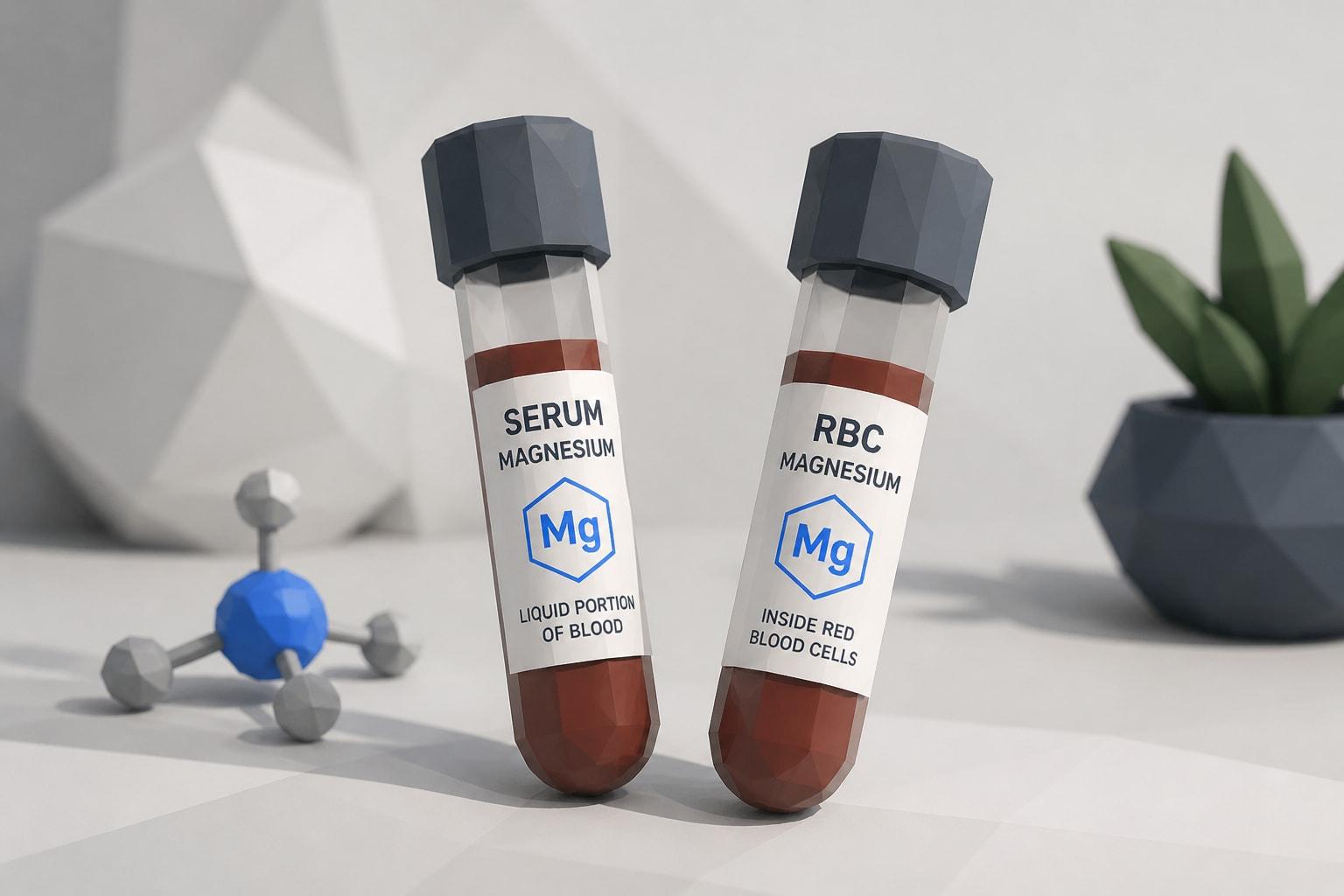
In the debate over RBC vs serum magnesium, neither test is proven to be universally more accurate: serum magnesium is the standard first-line test, while RBC magnesium measures what sits inside red blood cells and may catch low levels that serum misses. For most adults ordering routine bloodwork themselves, serum is the practical starting point, and RBC is a reasonable add-on when symptoms persist despite a normal serum result.
Big picture
- What it is: Two blood tests estimate magnesium status. Serum magnesium measures the mineral in the liquid part of blood. RBC magnesium measures it inside red blood cells.
- Why it matters: Only a small share of the body's magnesium circulates in blood, so a single number can be an imperfect snapshot of total stores.
- Who it affects: Adults with muscle cramps, fatigue, irregular heartbeat sensations, poor sleep, or risk factors such as long-term acid-reducer use, diuretic use, heavy alcohol intake, or digestive conditions.
- Where the evidence stands: Neither test is established as the single best measure of magnesium status, and results should be read alongside symptoms and other labs.
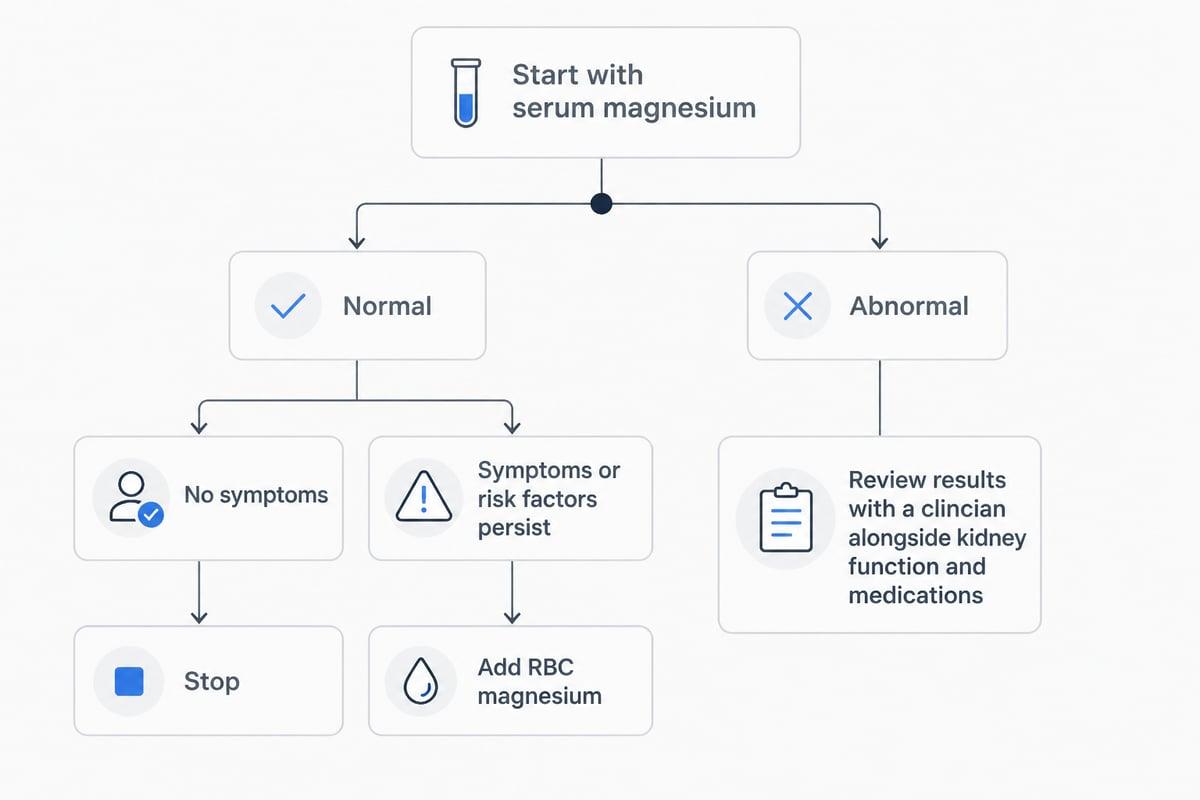
- Next step: Start with a serum test. If the result is normal but symptoms and risk factors remain, discuss adding an RBC test with your own clinician when interpreting results.
What does each magnesium test measure?
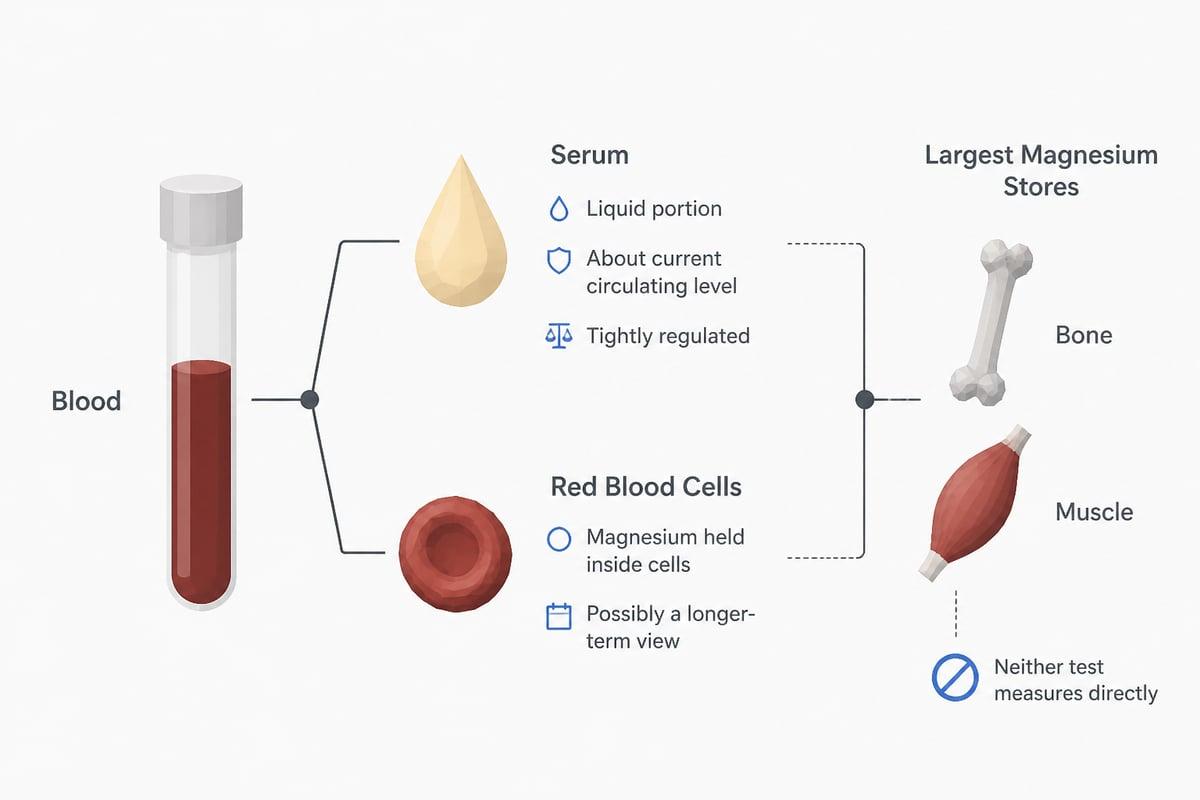
Serum magnesium measures the magnesium dissolved in the liquid portion of your blood, while RBC magnesium measures the magnesium held inside your red blood cells.
That difference sounds small but it changes what each number represents. Most of the body's magnesium sits in bone, muscle, and soft tissue. According to the NIH Office of Dietary Supplements, serum magnesium is the most commonly used assessment method, yet serum levels do not accurately reflect total-body magnesium or concentrations in specific tissues. The body also defends the serum level tightly, pulling magnesium from bone and tissue to keep blood values in range. A person can have depleted stores and still show a normal serum value.
RBC magnesium looks at a different compartment. MedlinePlus notes that a magnesium RBC test may be better than a regular blood test at finding low magnesium levels. Because the result reflects magnesium held inside cells rather than in the liquid part of blood, it may differ from the serum value.
RBC vs serum magnesium: side-by-side comparison
The table below summarizes how the two tests differ in what they measure, when each makes sense, and whether fasting is required.
| Feature | Serum magnesium | RBC magnesium |
|---|---|---|
| What it measures | Magnesium in the liquid part of blood | Magnesium inside red blood cells |
| When to order it | First-line screening, routine panels, monitoring after a change in medication or kidney status | Persistent symptoms with a normal serum result, or risk factors for long-term depletion |
| Fasting needed | Not required | Not required |
| Sample | Venous blood draw | Venous blood draw |
| Typical turnaround | Varies by provider | Varies by provider |
| Strength | Widely available, well understood, low cost | May reflect cellular levels more closely |
| Limitation | Can look normal while body stores are low | Reference ranges vary by lab, and it is not established as universally superior |
Turnaround varies by provider, so confirm timing on the ordering page before you purchase.
Limitations of each test
Both tests have real limitations, which is why neither should be treated as a verdict on its own.
Serum magnesium
- Reflects the circulating level, which the body regulates closely, so it can miss tissue depletion.
- Can shift with hydration status, recent intake, and acute illness.
- Does not tell you how long a low or high level has persisted.
RBC magnesium
- Not established as a universally superior measure of magnesium status. Evidence that it outperforms serum across populations is limited.
- Reference ranges differ between laboratories, so a result must be compared against the range printed on your own report.
- Conditions that change red blood cell populations may influence results.
- Less widely used, which means fewer clinical benchmarks to lean on.
Testing.com states that reference ranges differ between laboratories and that results should be interpreted with symptoms and other laboratory findings, not alone. That principle applies to both tests.
How kidney function, medications, and symptoms change the picture
Kidney function, medications, and symptoms can each push magnesium results in directions that make a single number misleading.
Kidney function. The kidneys control how much magnesium the body excretes. Reduced kidney function can raise serum magnesium, while certain kidney conditions can cause magnesium to be lost in urine. A creatinine and eGFR result gives context, which is why a kidney-related panel often accompanies a magnesium test. The Comprehensive Metabolic Panel (CMP) reports kidney markers, electrolytes, blood sugar, and liver enzymes in one draw, and it is a practical companion to either magnesium test. This test is useful for context only, not for deciding treatment.
Medications. Several drug classes are associated with lower magnesium, including some acid-reducing medications and diuretics. If you take one of these long term, the relationship is worth understanding. JustLabs has a piece on whether omeprazole lowers B12 and magnesium. Do not change any prescribed medication on the basis of a home-ordered lab result; take the report to a clinician.
Symptoms. Muscle cramps, twitching, fatigue, and palpitations are nonspecific. They overlap with low potassium, low calcium, thyroid problems that a TSH test can screen for, dehydration, and poor sleep. A normal magnesium result does not rule out a problem, and a low one does not by itself explain symptoms.
Which magnesium test should I order?
Order a serum magnesium test first if you want a standard, affordable screening result, and add RBC magnesium if symptoms or risk factors persist despite a normal serum value.
Use this as a practical decision guide:
- Routine check, no clear risk factors: Serum magnesium is sufficient as a starting point.
- Taking a medication associated with low magnesium, or have digestive absorption concerns: Serum first, then consider RBC if the result is normal but symptoms continue.
- Persistent symptoms with a normal serum result: RBC magnesium adds a second angle.
- Known kidney disease: Serum alone can be hard to interpret; discuss testing choices with the clinician managing your kidney care rather than self-selecting.
You can order either test directly through JustLabs, and both are drawn at a Quest Diagnostics location, and results are generally delivered online within 1 to 3 business days with values and reference ranges. For current pricing, check each test page or the magnesium test cost guide.
Recommended Test
Magnesium, Serum
Serum magnesium measures the level of magnesium in your blood. While useful for detecting severe deficiency, it may not reflect your true magnesium status since most magnesium is stored in cells and bones.
Includes 1 biomarkers
$6.50
Recommended Test
Magnesium, RBC
RBC (red blood cell) magnesium measures magnesium within red blood cells and may provide complementary information to serum magnesium in selected assessments. No single blood measurement reliably establishes total-body magnesium status.
Includes 1 biomarkers
$13.50
When do you need both tests?
Ordering both tests together makes sense when a single result would leave you guessing, particularly when symptoms and risk factors point one way while serum points the other.
Common situations include:
- Long-term use of a medication linked to magnesium loss, with a serum value near the low end of the reference range.
- Ongoing cramps or fatigue with an unremarkable serum result and otherwise normal basic labs.
- A desire to compare a baseline serum value against a cellular value before and after a lifestyle or diet change you are making on your own.
Reading the two results side by side shows whether they agree. If both are in range, magnesium is less likely to be the explanation. If serum is normal and RBC is low, that pattern supports the idea that circulating levels are masking a lower cellular value, though it does not by itself establish a diagnosis.

How the available RBC and serum options compare on price and specs
Prices for magnesium tests vary widely across self-pay sellers, so check each seller's listing for current pricing.
| Test | Seller | Approx. price | Key specs | Best for |
|---|---|---|---|---|
| Magnesium, Blood Serum Test | Testing.com | $28 | 1 biomarker, blood draw, no fasting, results in 2 to 4 business days | The commonly used serum test |
| Magnesium, RBC | Testing.com | $79 | Measures magnesium inside red blood cells, venous draw, results typically 1 to 3 business days | An RBC measurement with upfront pricing |
| Magnesium Blood Test (Serum) | TestWell | $18.49 | Standard serum magnesium test | A lower-cost conventional serum test |
| RBC Magnesium Test | TestWell | From $25.49, plus lab processing fee | Price depends on draw site, no fasting, results listed in 5 to 9 business days | Comparing lower-cost RBC options and draw sites |
TestWell lists an RBC magnesium test with a price that depends on the draw site, plus a lab processing fee, and lists a serum magnesium test for $18.49. When comparing, add the processing fee to the sticker price, check the stated turnaround, and confirm where the draw takes place and which lab runs the sample. A lower price with a longer wait or an extra fee may not be the better deal.
Sample requirements and realistic turnaround
Both tests require a standard venous blood draw at a lab location, and fasting is generally not required for either.
On the practical side:
- Sample: A blood draw from a vein, typically completed in a few minutes at a collection site.
- Preparation: Fasting is not listed as required for either test in the sources reviewed. Follow any instructions printed on your order, and ask the draw site if you are unsure.
- Supplements: Magnesium supplements taken shortly before a draw may affect a serum result. Check the instructions on your test page and consider keeping a note of what you took and when.
- Turnaround: Expect results in roughly 1 to 3 business days at JustLabs. Other sellers list different timelines, so timing depends on the provider.
JustLabs customers pick a location from more than 2,200 Quest Diagnostics sites nationwide.
What color tube is used for a magnesium blood test?
Magnesium testing uses a venous blood sample, and the tube used depends on the laboratory's collection requirements.
Serum tests are generally run on a sample that has been separated from the cells, while RBC testing requires a sample that preserves the red blood cells. You do not need to select or bring a tube yourself. The phlebotomist at the collection site uses whatever tube the lab specifies for the test on your order.
Key takeaways
- Serum magnesium measures the circulating level and is the standard, most widely used test, but it can look normal when body stores are low.
- RBC magnesium measures magnesium inside red blood cells and may detect low levels that serum misses, but it is not established as universally superior.
- Reference ranges differ between labs, so compare your result only to the range printed on your own report.
- Kidney function, medications, and symptoms all affect how a magnesium number should be read.
- Start with serum for most routine checks. Add RBC when symptoms and risk factors persist, or order both to compare.
FAQ
Is there a blood test for magnesium deficiency?
Yes. Serum magnesium and RBC magnesium are the two blood tests used to assess magnesium status. Neither is a perfect diagnostic on its own, so results are read together with symptoms, kidney function, and other labs.
How do you check magnesium levels?
Magnesium levels are checked with a blood draw from a vein at a lab collection site. You can order a test online and complete the draw at a participating location, and results are delivered electronically.
Can magnesium increase red blood cells?
Magnesium is not a treatment for raising red blood cell counts. The RBC magnesium test measures the magnesium inside red blood cells; it does not measure or change how many cells you have. Questions about red blood cell counts belong with a clinician.
Does RBC magnesium replace the serum test?
Not necessarily. They answer slightly different questions, and many people use serum as the baseline and RBC as a follow-up when serum does not explain symptoms.
Should I stop taking my medication if my magnesium is low?
No. Do not stop or change prescribed medication based on a home-ordered lab result. Bring the report to the clinician who manages your prescriptions. JustLabs is not a substitute for medical care, and anyone with urgent symptoms should seek immediate medical attention.
Check your most recent bloodwork or medication list for risk factors, then decide whether a serum test alone is enough or whether a cellular view would help. If you want a baseline you can pull yourself, you can order the JustLabs RBC magnesium test or the serum magnesium test online with no insurance or doctor visit required, and browse the full menu of more than 130 individual tests when you are ready to Browse Tests and compare options.
Related reading

References
de Baaij JH, Hoenderop JG, Bindels RJ. Magnesium in man: implications for health and disease. Physiol Rev. 2015 Jan;95(1):1-46. doi: 10.1152/physrev.00012.2014. PMID: 25540137. https://pubmed.ncbi.nlm.nih.gov/25540137/
Fiorentini D, Cappadone C, Farruggia G, Prata C. Magnesium: Biochemistry, Nutrition, Detection, and Social Impact of Diseases Linked to Its Deficiency. Nutrients. 2021 Mar 30;13(4). doi: 10.3390/nu13041136. PMID: 33808247. https://pubmed.ncbi.nlm.nih.gov/33808247/
Kröse JL, de Baaij JHF. Magnesium biology. Nephrol Dial Transplant. 2024 Nov 27;39(12):1965-1975. doi: 10.1093/ndt/gfae134. PMID: 38871680. https://pubmed.ncbi.nlm.nih.gov/38871680/
Gommers LMM, Hoenderop JGJ, de Baaij JHF. Mechanisms of proton pump inhibitor-induced hypomagnesemia. Acta Physiol (Oxf). 2022 Aug;235(4):e13846. doi: 10.1111/apha.13846. PMID: 35652564. https://pubmed.ncbi.nlm.nih.gov/35652564/
Liamis G, Hoorn EJ, Florentin M, Milionis H. An overview of diagnosis and management of drug-induced hypomagnesemia. Pharmacol Res Perspect. 2021 Aug;9(4):e00829. doi: 10.1002/prp2.829. PMID: 34278747. https://pubmed.ncbi.nlm.nih.gov/34278747/