How soon after exposure chlamydia gonorrhea can be detected is generally about 2 weeks for people without symptoms, because tests need time to pick up the infection. Testing sooner can return a false negative, while waiting much longer is unnecessary if you have symptoms or a known exposure, in which case you should seek medical evaluation right away.
Big picture
- What it is: Chlamydia and gonorrhea are common bacterial infections, often with no symptoms, that are found with a lab test called a NAAT.
- Why timing matters: A test taken too soon after exposure can miss an infection that is still too small to detect.
- Who it affects: Any sexually active adult, including people who feel perfectly healthy.
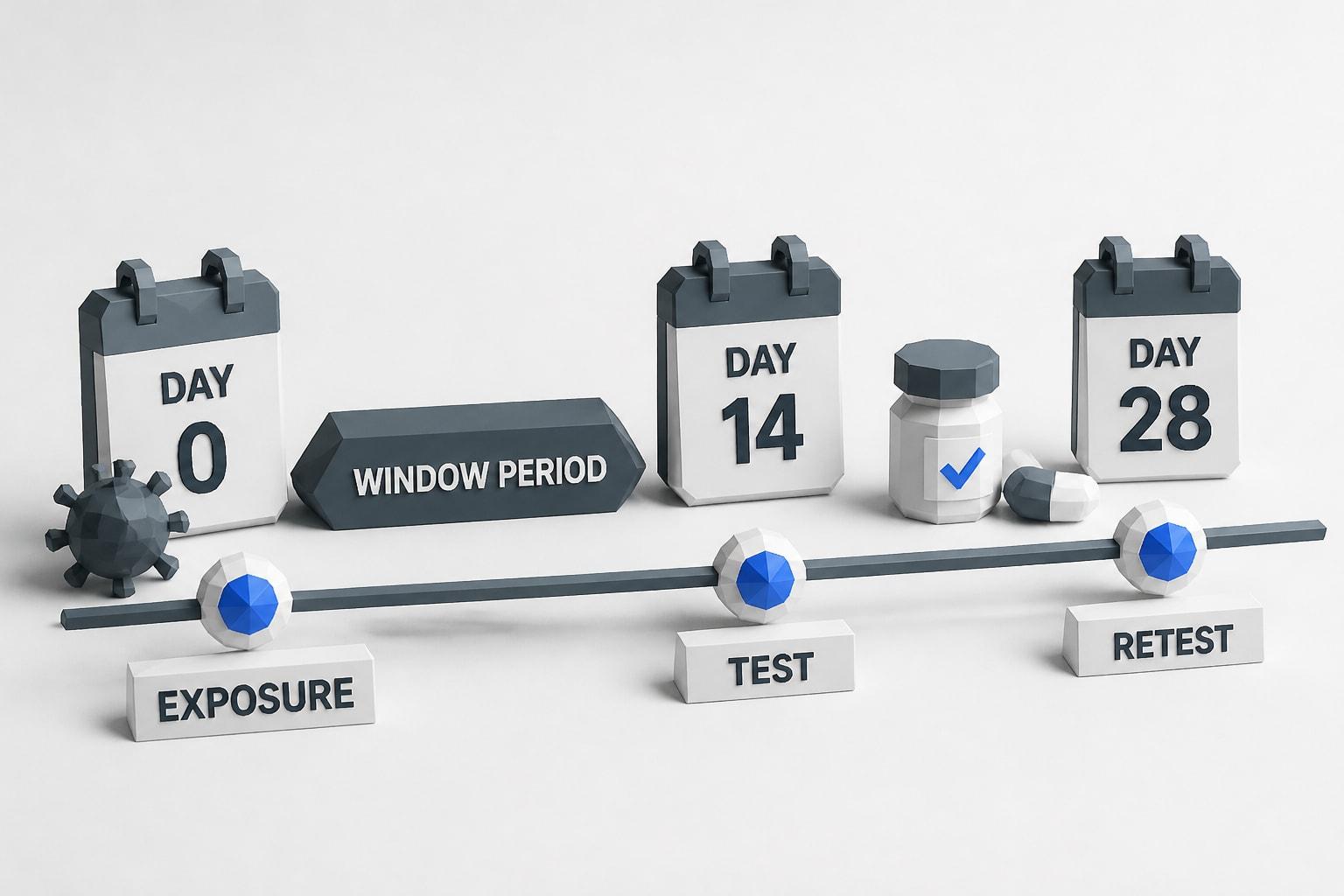
- Typical timing: For people without symptoms, about 2 weeks after possible exposure is the commonly advised point to test.
- Next step: Note the date of your exposure, count forward 14 days, and test then. If you have symptoms or a known partner with an infection, get evaluated promptly instead of waiting.
- After treatment: Do not test again right away. Retesting too soon can show a positive result from leftover genetic material.
How soon after exposure can chlamydia and gonorrhea be detected?
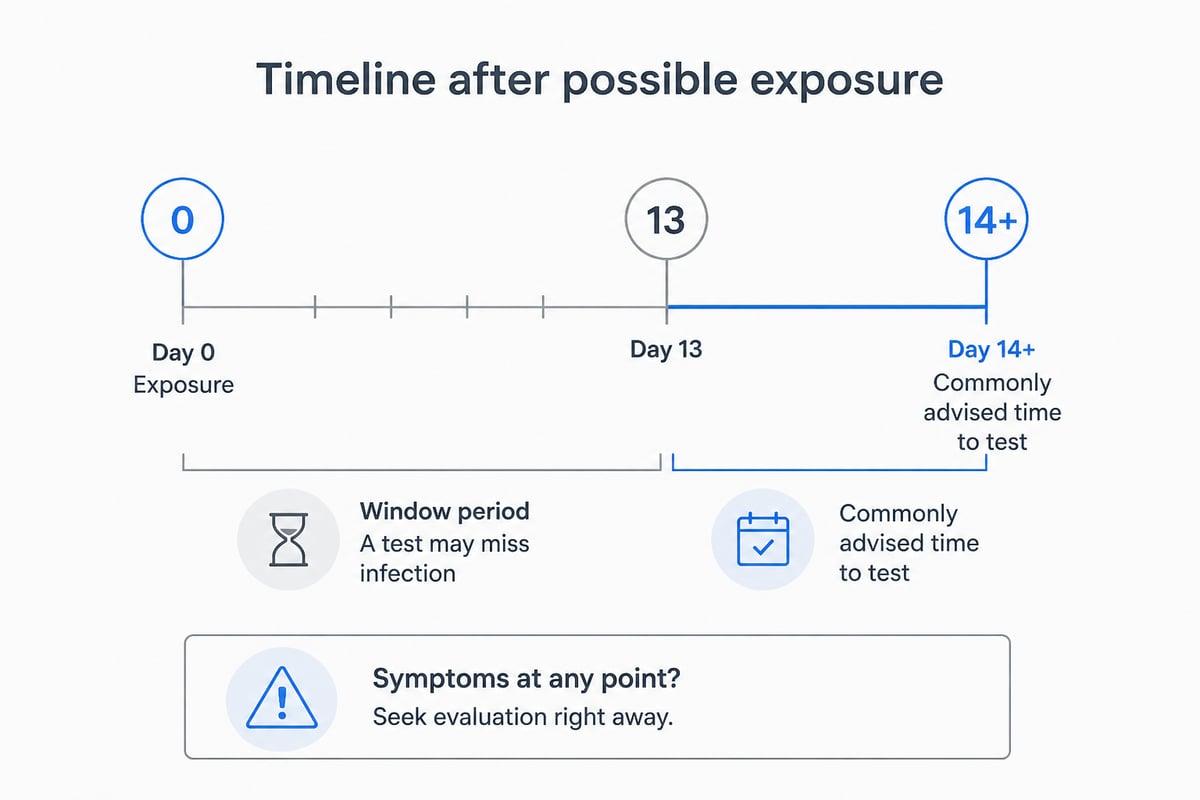
Most health services advise waiting about 2 weeks after a possible exposure before testing for chlamydia and gonorrhea if you have no symptoms. Sexual Health Oxfordshire recommends waiting 2 weeks for a more reliable result, and the Maidstone and Tunbridge Wells NHS Trust gives the same advice for people without symptoms, adding that testing can happen sooner if symptoms appear.
That 2-week figure is a practical guideline, not a hard line. Individual bodies and infections vary, and the number is chosen to balance two goals: catching infections as early as possible while keeping the chance of a missed infection low.
Here is a simple way to apply it:
- Write down the date of the most recent unprotected sexual contact.
- Add 14 days to that date.
- Schedule your test on or after that day.
- If symptoms begin before then, do not wait. Seek evaluation promptly.
What is the difference between incubation and the test window period?
Incubation is the time between exposure and the first symptoms, while the window period is the time between exposure and the point when a test can detect the infection. The two overlap but are not the same, and mixing them up is a common source of confusion.
Many people with chlamydia or gonorrhea never develop symptoms at all, so the incubation period tells them very little. The window period is what matters for testing. Devon Sexual Health describes the 2-week wait as the window period: the time between exposure and an infection becoming detectable by a test.
Put plainly:
- Incubation period: Based on when symptoms might appear. Some people never get symptoms.
- Window period: Based on when a lab test can reliably find the bacteria.
- Practical result: You can feel fine and still be infected, and you can have a negative result on day 3 that would turn positive on day 14.
How does NAAT testing work?
A NAAT, or nucleic acid amplification test, detects the genetic material of chlamydia and gonorrhea bacteria and copies it many times so even a small amount becomes measurable. This is why it is the standard method for both infections and why it is more sensitive than older culture-based approaches.
Because a NAAT looks for bacterial DNA or RNA rather than your immune response, it does not depend on your body having produced antibodies. That is a meaningful difference from tests for some other infections, where the body needs weeks to respond. For chlamydia and gonorrhea, the limiting factor is whether enough bacteria are present in the sampled area to amplify.
Early after exposure, bacterial numbers may be too low in the tested site. The test is working correctly in that case; the sample simply does not yet contain enough material. This is the core reason a negative result at day 2 or day 5 does not clear you.
What happens if you test too early?
Testing too soon after exposure can produce a false negative, meaning the result says no infection when one is actually present. A false negative can feel reassuring, and that is exactly the risk: you may skip treatment, continue to pass the infection to partners, and leave an untreated infection in place.
Untreated infections can lead to complications, including pelvic inflammatory disease in women. Chlamydia can go unnoticed for a long time, which is why an infection may only be found during a routine screen.
If you test early because you are worried, the safest approach is to treat that first result as provisional. Test again at the 2-week point or later, and take any symptoms seriously regardless of what the first result says.
What are the signs of gonorrhea and chlamydia?
Common signs include unusual discharge, burning during urination, and pelvic or testicular discomfort, but many infections cause no symptoms at all. Because symptoms are unreliable, they should prompt evaluation but should never be the only reason you test.
Possible signs include:
- Burning or pain when urinating
- Unusual discharge from the vagina, penis, or rectum
- Pain or swelling in the testicles
- Lower abdominal or pelvic pain
- Bleeding between periods or after sex
- Sore throat, if the throat was exposed (often silent)
The Royal United Hospitals Bath sexual health service summarizes the symptoms, transmission routes, and recommended wait before testing for both infections. Anyone with symptoms should be evaluated promptly rather than waiting out the 2-week window.
When should you test if you have symptoms or a known exposure?
If you have symptoms or a partner has been diagnosed, do not wait for the 2-week mark. Seek medical evaluation promptly, because treatment decisions after a known exposure belong with a clinician and should not be delayed by ordering a test.
This is an important distinction. Home or self-ordered testing is well suited to routine screening and to checking after the standard waiting period. It is not a substitute for care when you know you were exposed, when symptoms are present, or when you may need treatment right away. A test should never hold up an evaluation or treatment after a known exposure. Clinicians sometimes treat presumptively in these situations, which is a decision a self-ordered lab result cannot make for you.

Urine test or swab: which sample is right?
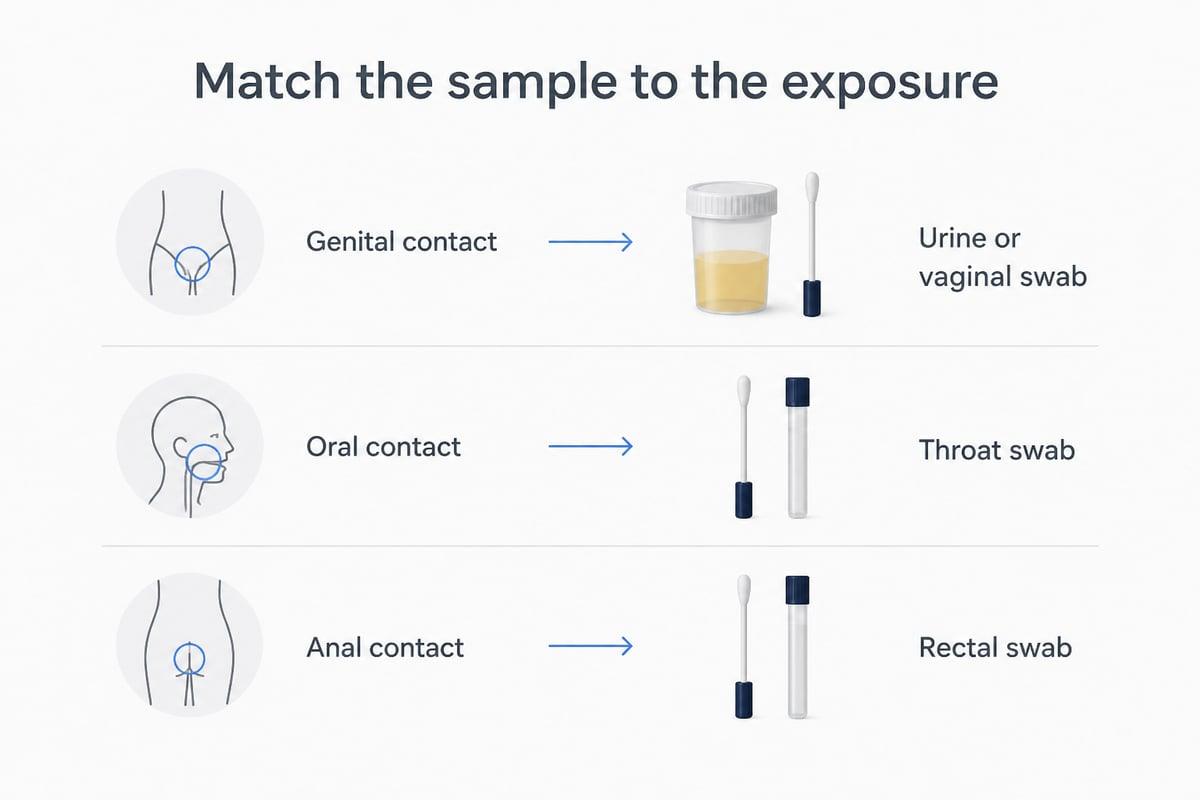
A urine sample is a reliable option for detecting genital infection in many people, while swabs are collected from the specific site that may be infected, such as the throat or rectum. The right choice depends on the type of sexual contact you had, because bacteria can live in sites that a urine test does not sample.
| Sample type | What it checks | When it is typically used |
|---|---|---|
| Urine | Genital infection | Routine screening, especially when no site-specific concern exists |
| Vaginal swab | Genital infection in women | Often preferred for accuracy in women |
| Throat swab | Throat infection | After oral sexual contact |
| Rectal swab | Rectal infection | After anal sexual contact |
Guidance on preparation matters here. Planned Parenthood notes that urine testing for chlamydia and gonorrhea should be done 2 weeks after possible exposure. For urine tests, many labs also ask you not to urinate for an hour or two beforehand so bacteria are not washed away, though the exact instructions come with your collection kit or lab order.
If you had contact that involved the throat or rectum, a urine-only test may miss infection at those sites. Make sure the sample type matches the exposure, and ask a clinician if you are unsure.
When is repeat testing recommended?
Repeat testing is recommended if your first test was taken before the 2-week point, if you have a new exposure, or if you have ongoing risk. It is also recommended some time after treatment, but the timing is different and should not be rushed.
A retest makes sense in these situations:
- Early first test: You tested within the window period and got a negative result. Test again once 2 weeks have passed.
- New or continuing exposure: A new partner or a partner who was not treated can reinfect you.
- Ongoing risk: People with multiple partners are commonly advised to screen on a regular schedule. Our guide on how often to retest explains how to think about retest intervals for routine screening.
How is testing after treatment different from initial testing?
Testing after treatment is a different question from testing after exposure: the goal is to confirm the infection cleared, and testing too soon can give a misleading positive. NHS inform advises that chlamydia and gonorrhea tests can remain positive for up to 6 weeks after treatment, even when the infection has cleared, because the test may still detect leftover genetic material from dead bacteria.
So the two scenarios work in opposite directions:
- Initial test too early: Risk of a false negative, because bacteria are not yet detectable.
- Follow-up test too early: Risk of a false positive, because remnants of the infection are still present.
If your clinician advises a follow-up test, follow their timing. Many people are also advised to retest several months after treatment to catch reinfection, which is separate from confirming the cure.
Can gonorrhea and chlamydia be cured?
Both infections are curable with the right antibiotics, but treatment must be prescribed by a clinician, and finishing the full course and treating partners matters. Cure does not make you immune, so reinfection is possible if a partner remains untreated or you have a new exposure.
Gonorrhea deserves a note: some strains have become resistant to certain antibiotics, which is one reason treatment choices are made by a doctor and why follow-up guidance from your clinician should be followed closely. If you test positive, you will need a prescription and treatment plan from a healthcare provider. A self-ordered lab test can tell you a result, but it cannot prescribe treatment.
Ordering a chlamydia and gonorrhea test through JustLabs
If you are past the 2-week point, have no symptoms, and want to screen on your own schedule, you can order the chlamydia and gonorrhea test through JustLabs without insurance or a doctor visit. JustLabs lists clear cash prices, and you can see the details on the chlamydia and gonorrhea cost page before you order.
Results are delivered securely online, generally within 1 to 3 business days, with clear values and reference ranges, and the work is done at CLIA-certified labs also used by doctors and hospitals. To see how ordering and sample collection work, visit the how it works page. JustLabs is not available in New York, New Jersey, Rhode Island, or Hawaii.
Remember the limits of self-ordered testing. It is not the right path for urgent symptoms, for a known exposure that needs prompt evaluation, or for anyone who needs a doctor to decide on treatment. In those cases, see a clinician first.
Key takeaways
- For people without symptoms, test about 2 weeks after possible exposure for a more reliable result.
- The window period is the time before a test can detect infection, and it differs from the incubation period.
- A NAAT detects bacterial genetic material, so very early samples may not contain enough to detect.
- A negative result before the 2-week point may be a false negative, so retest after 2 weeks.
- Match the sample to the exposure: urine or vaginal swab for genital contact, throat or rectal swabs for those sites.
- After treatment, tests can stay positive for up to 6 weeks, so follow your clinician's timing.
- Symptoms or a known exposure call for prompt medical evaluation, and testing should never delay care or treatment.
FAQ
Had chlamydia for 2 years and didn't know. Is that possible?
Yes, it is possible. Chlamydia often causes no symptoms, so an infection can go unnoticed until a routine screen finds it. If you receive a positive result, see a clinician promptly for treatment and ask whether your partners should be treated as well.
Can gonorrhea be 100% cured?
Gonorrhea is curable with appropriate antibiotics prescribed by a clinician, but cure does not prevent reinfection. Treatment choice and any follow-up testing should be directed by a healthcare provider, and partners should be treated too to avoid passing it back.
How soon after exposure can a test show chlamydia or gonorrhea?
For people without symptoms, about 2 weeks after exposure is the commonly advised time to test. Testing earlier may miss an infection that is not yet detectable.
Can I test sooner if I have symptoms?
Yes. If you have symptoms such as discharge or burning during urination, seek medical evaluation right away rather than waiting 2 weeks. A clinician can test you and decide whether treatment should start immediately.
Your next step is to mark the date of your last possible exposure and count forward 14 days, then plan your test for that day or later. If you have symptoms or a known exposure, see a clinician first so nothing delays your care. When you are ready to screen on your own schedule without insurance, you can compare self-pay options and choose a test by using JustLabs to browse tests, order online, and receive results in generally 1 to 3 business days.