You can find out your blood type without a doctor by checking records you already have, such as blood donor cards or past hospital paperwork, or by ordering a blood typing test yourself at a laboratory. Home kits and old documents can be informative, but only a laboratory result can serve as confirmation for medical decisions.
Big picture
- What it is: Blood type is your ABO group (A, B, AB or O) plus your Rh factor (positive or negative), which together give eight common types.
- Why it matters: It affects transfusion compatibility, pregnancy care and blood donation.
- Who it affects: Everyone has a blood type, yet many adults have never been told theirs.
- Where to look first: Donor records, old medical paperwork and patient portals may already hold your result.
- Next step: If nothing turns up, order a lab-based ABO/Rh test online and have the sample drawn at a nearby lab.
What is a blood type, and how does ABO and Rh typing work?
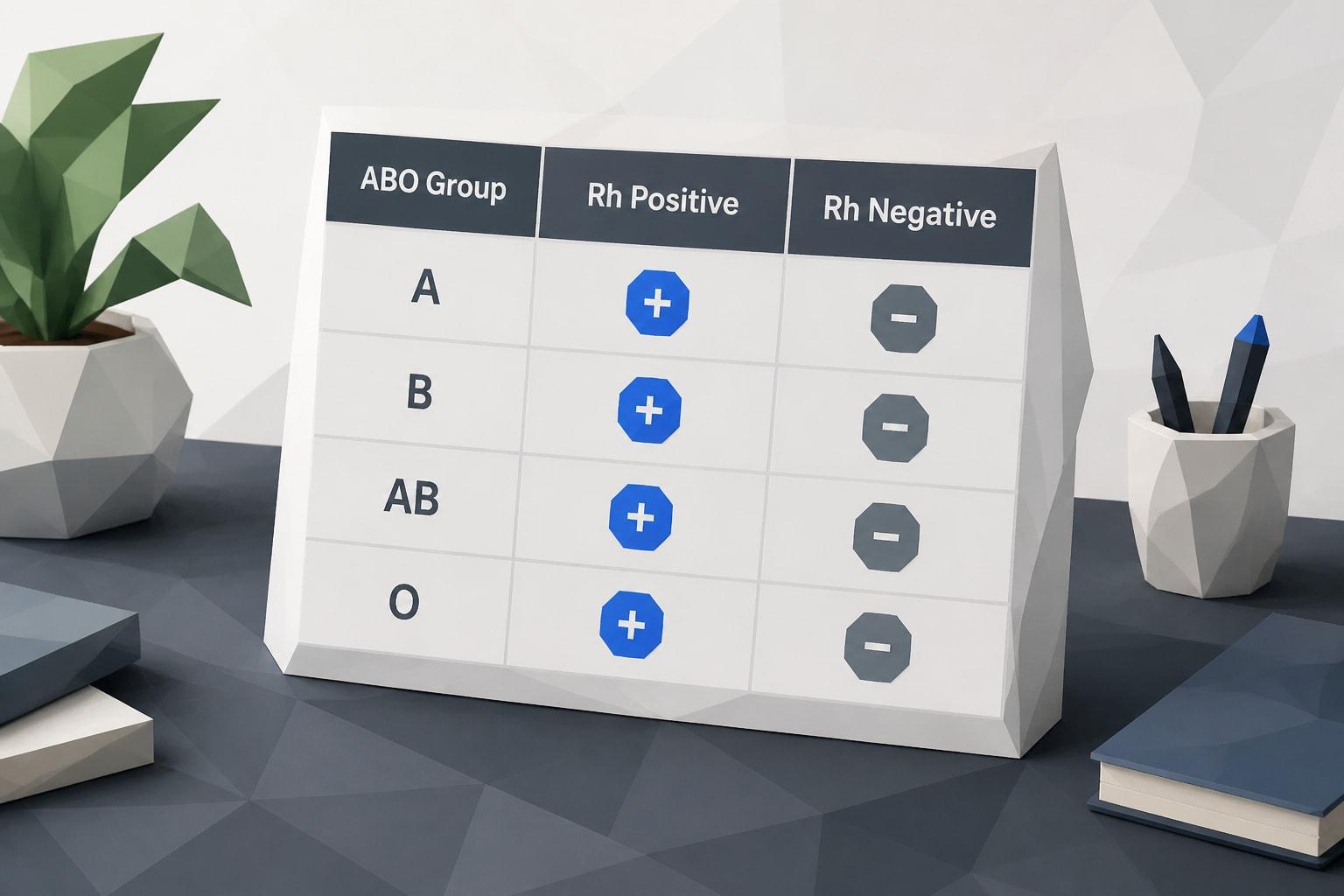
A blood type is a classification of your red blood cells based on the presence or absence of specific markers called antigens. The ABO system has four main groups (A, B, AB and O), and the RhD antigen determines whether a type is positive or negative, which yields eight common types, according to the NHS.
Laboratories identify your type by mixing a small blood sample with reagents that react to the A, B and RhD antigens, and they typically run a second check to confirm the result.
The eight common types and what they mean in plain terms:
| Blood type | ABO group | Rh factor |
|---|---|---|
| A+ | A | Positive |
| A- | A | Negative |
| B+ | B | Positive |
| B- | B | Negative |
| AB+ | AB | Positive |
| AB- | AB | Negative |
| O+ | O | Positive |
| O- | O | Negative |
Why is it worth knowing your blood type?
Knowing your blood type is practical for planning and for conversations with care providers, even though it is not something most people check regularly.
- Pregnancy: Rh status matters for prenatal care, so many people want to know theirs early.
- Blood donation: Donation centers use your type to match supply to demand.
- Emergencies: Having a result on file can help you answer questions quickly, though hospitals always run their own testing before a transfusion.
- General awareness: Some people simply want a complete record of their baseline health information.
Type O-negative red cells can be given to patients of all blood types, according to the American Red Cross. About 45% of people in the U.S. have type O-positive or O-negative blood, and 7% have O-negative.
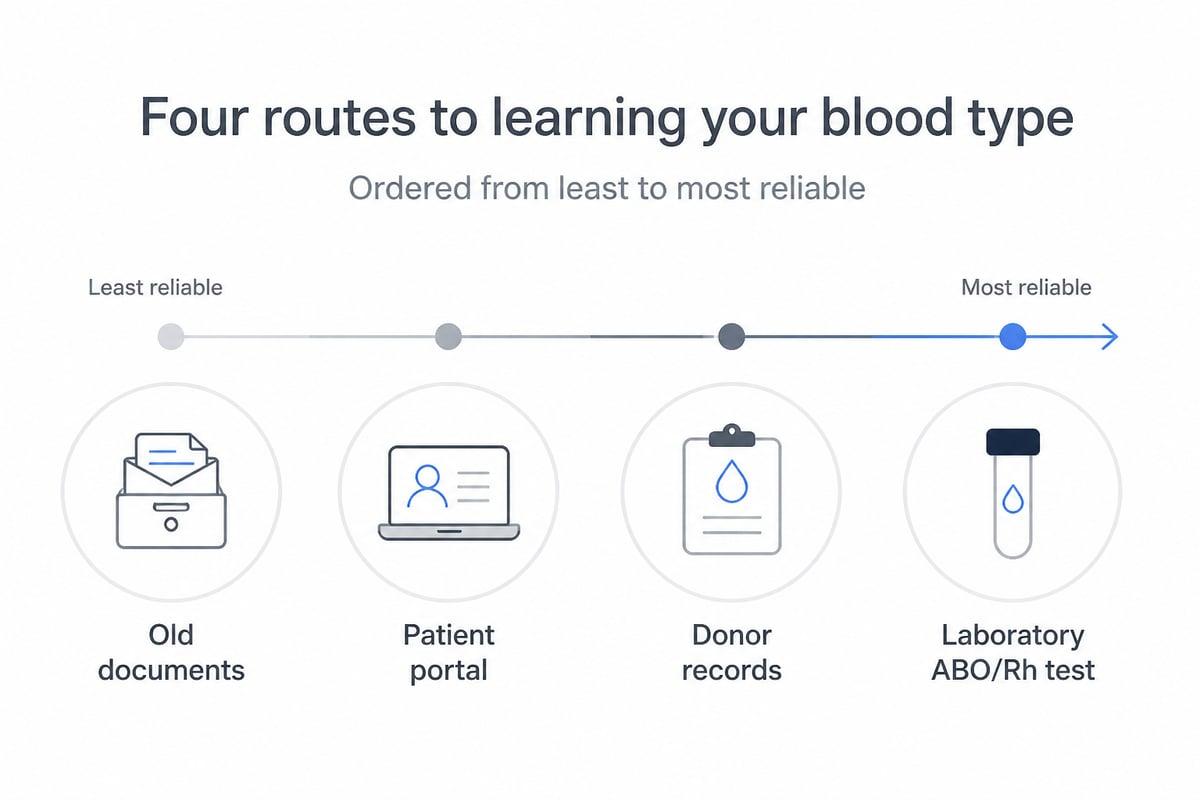
Can existing documents show your blood type?
Some documents may list your blood type, but most everyday identification does not. Passports, driver's licenses and insurance cards generally do not carry blood type, so checking them is rarely productive.
Records that may contain it include:
- Blood donor cards or donor account summaries
- Birth records or newborn screening paperwork from the hospital
- Military service records, which often list blood type
- Prenatal records from a past pregnancy
- Surgical or hospital discharge paperwork
- Lab reports from earlier testing
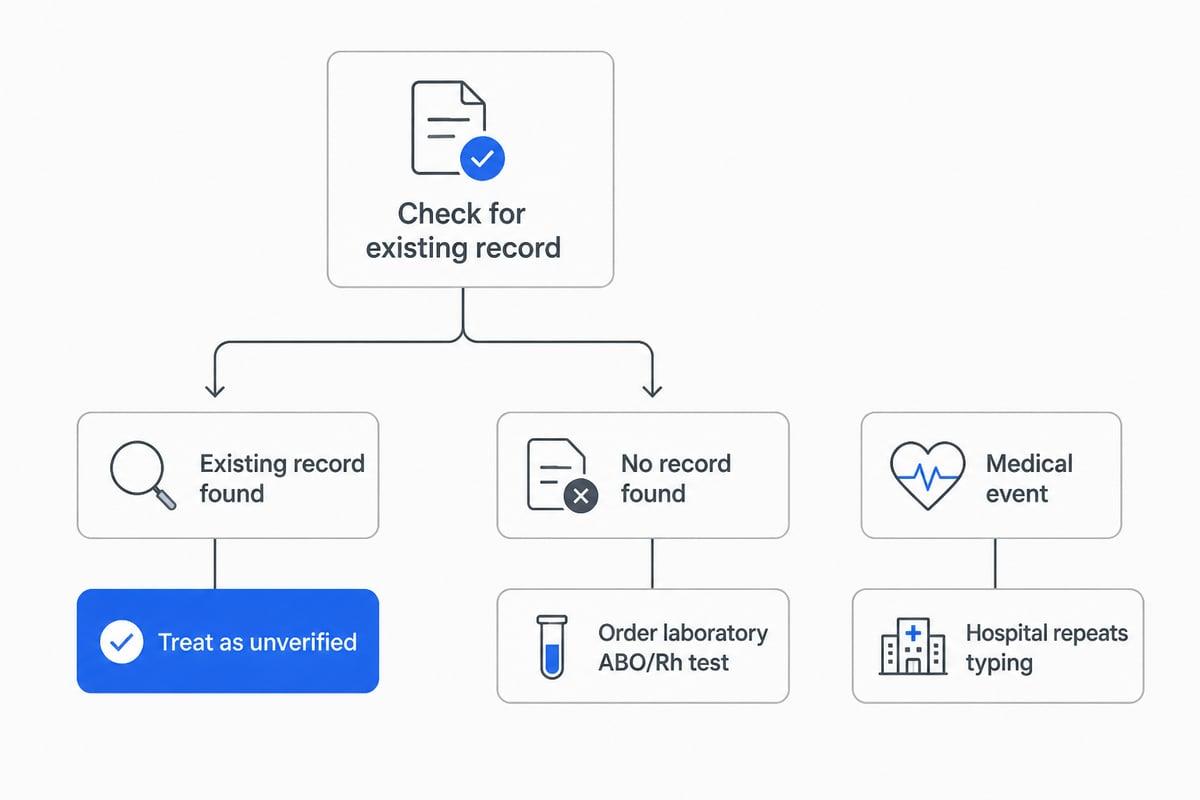
If you find a result, treat it as a clue to your type, not as a verified fact. Handwriting errors, transcription mistakes and outdated records are real possibilities, and a printed label on an old card cannot be traced back to the lab that produced it.
Is your blood type in a patient portal like MyChart?
Your blood type may appear in a patient portal like MyChart, but only if a prior test was run and the result was published to your account. Many portals do not show it by default, because hospitals do not routinely type every patient.
To check, open the test results or lab history section and search for terms such as "ABO," "Rh," "type and screen" or "blood bank." If you were pregnant or had surgery at that health system, a type-and-screen result may be listed. If nothing appears, that usually means the test was never performed or was not released to the portal, not that the portal is hiding anything.

Can donating blood help you find out your blood type?
Donating blood is one of the most common ways to learn your type without ordering anything. The NHS notes that GPs do not routinely check people's blood groups, and donating blood is one way to find out. In the U.S., the American Red Cross says blood type and Rh testing are included in post-donation testing, with results available in the donor account and app within a few days.
There are trade-offs to weigh:
- Eligibility: You must meet donor requirements for health, weight, travel history and medications, so not everyone can donate.
- Timing: Results arrive after your donation, not on demand.
- Purpose: A donation center types your blood to manage supply, and it is not offering a clinical report intended for your own medical decisions.
Donation also serves a wider need, since only a small share of eligible people in the U.S. donate each year, according to the American Red Cross. If you are eligible, you help others while learning your type. For background on the eight types and why some are especially needed, see the Red Cross blood types overview.
Do at-home blood typing kits work?
At-home kits can give a rough indication of your type, but they are not reliable enough for medical decisions. Most use a card with dried reagents: you prick a finger, place drops of blood on the card and watch for clumping that points to the A, B or Rh antigens.
The limitations are significant:
- Interpretation errors: Judging clumping by eye is subjective, especially with weak or ambiguous reactions.
- Technique sensitivity: Too little blood, uneven mixing or reading the card too late can change the pattern.
- No confirmation step: Laboratories cross-check with a second method, while a card typically offers a single reading.
- Variable quality: Kits differ in manufacturing standards and storage conditions before they reach you.
Blood donation events show the same caution. At one NHS blood-type campaign, the test takes about five minutes and uses a few drops of blood from a finger, but the type is confirmed when the person donates in the future. Even a fast finger-prick screen is treated as provisional until a formal sample is tested.
Use a home kit for curiosity if you wish. Do not rely on it for pregnancy planning, surgery preparation or anything involving a transfusion.
What is the best way to find out your blood type without a doctor?
The most dependable way to find out your blood type without a doctor is to order an ABO/Rh test yourself and have the sample drawn and analyzed in a certified laboratory. You do not need a physician's visit for that route, and the result comes from the same kind of testing that doctors and hospitals rely on.
With JustLabs, you can order an ABO/Rh blood type test online, pay a transparent cash price with no insurance involved, and have your blood drawn at one of more than 2,200 Quest Diagnostics locations nationwide. Results are delivered securely online, generally within 1-3 business days, with clear values and reference ranges. JustLabs uses the same CLIA-certified labs used by doctors and hospitals. For current availability and pricing, check the test page directly.
A typical sequence looks like this:
- Confirm that no verified result already exists in your records or donor account.
- Order the ABO/Rh test online.
- Visit a participating lab location for a brief blood draw.
- Review your results online and save a copy for your personal records.
Recommended Test
ABO Group and Rh Type (Blood Type)
Learn your blood type: your ABO group (A, B, AB or O) and whether you are Rh-positive or Rh-negative. No fasting or preparation is needed, and the result is for your personal knowledge.
Includes 2 biomarkers
$13
JustLabs does not currently serve New York, New Jersey, Rhode Island or Hawaii. If you live in one of those states, a blood donation center may be your practical option.
When is official lab confirmation required?
Official laboratory confirmation is required whenever your blood type will inform a medical decision, and hospitals will always run their own testing regardless of what you bring. Before a transfusion, surgery or delivery, a hospital blood bank performs its own typing and crossmatching on a fresh sample. A donor card, a portal entry or a self-ordered result does not replace that process.
This is why an unverified historical result is not sufficient for transfusion decisions. Records can contain errors, and a mistaken type carries real risk. Think of a result you find or order yourself as useful personal information that should never stand in for hospital testing. If you are pregnant or planning surgery, your care team will confirm your type as part of standard procedures.
Anyone with an urgent medical situation should seek emergency care rather than trying to confirm a blood type on their own.
How do you read and store your blood type result?
You read a blood type result by locating two pieces of information: the ABO group and the Rh status. A result such as "A POS" means group A, Rh positive, while "O NEG" means group O, Rh negative. Some reports separate the two lines, so check both.
Once you have a verified result:
- Save a digital copy in a secure folder or health app.
- Record the testing laboratory and the date.
- Share it with your care team at your next routine visit so it enters your chart.
If you want help making sense of other values on a lab report, JustLabs explains how to read your lab results without a doctor. If you are weighing the different ways to get tested on your own, the comparison of ordering lab tests without a doctor outlines the options. Readers tracking other markers may also like the guide to an A1C test without a doctor.
Key takeaways
- Your blood type has two parts, an ABO group and an Rh factor, which combine into eight common types.
- Passports and most everyday IDs do not show blood type, so check donor records, hospital paperwork and patient portals instead.
- Donating blood can reveal your type, but results depend on eligibility and timing.
- Home kits are unreliable for decisions that matter, because they rely on visual interpretation of clumping.
- A laboratory ABO/Rh test is the dependable self-directed option, and hospitals will still retype your blood before any transfusion.
FAQ
What are the top 3 rarest blood types?
O-negative is a minority type in the U.S., and rarity varies by population and region. Rare types matter most to donation centers, which work to keep a supply of them available.
Can I find my blood type in my passport?
No. Passports in the U.S. do not record blood type, and neither do most driver's licenses or insurance cards. Check donor records, hospital paperwork or a patient portal instead.
Is a result from an old document good enough for medical use?
No. An old record is a helpful lead, but it cannot be verified and may contain errors. Hospitals perform their own typing before any transfusion, so treat old documents as personal reference only.
How long does a blood type test take?
Laboratory typing itself is quick, but turnaround depends on the provider. With JustLabs, results are generally delivered online within 1-3 business days after your blood draw.
Do I need a prescription or an insurance plan to get tested?
Not with a self-pay service. JustLabs lets you order online without insurance or a doctor visit, and the draw takes place at a participating lab location.
If you do not have a verified result yet, check your donor account and patient portal this week, and if nothing turns up, move on to a lab test. JustLabs offers transparent self-pay pricing, draws at more than 2,200 Quest Diagnostics locations and results online generally within 1-3 business days, so you can browse tests and order the one you need without an insurance claim or a doctor visit.
Related reading


References
Li HY, Guo K. Blood Group Testing. Front Med (Lausanne). 2022;9:827619. doi: 10.3389/fmed.2022.827619. PMID: 35223922. https://pubmed.ncbi.nlm.nih.gov/35223922/
Pratt VM, Scott SA, Pirmohamed M, Esquivel B, Kattman BL, Malheiro AJ, Dean L. ABO Blood Group. 2012. PMID: 28520352. https://pubmed.ncbi.nlm.nih.gov/28520352/
de Haas M, Finning K, Massey E, Roberts DJ. Anti-D prophylaxis: past, present and future. Transfus Med. 2014 Feb;24(1):1-7. doi: 10.1111/tme.12099. PMID: 25121157. https://pubmed.ncbi.nlm.nih.gov/25121157/
Bienek DR, Charlton DG. Accuracy of user-friendly blood typing kits tested under simulated military field conditions. Mil Med. 2011 Apr;176(4):454-60. doi: 10.7205/milmed-d-10-00339. PMID: 21539170. https://pubmed.ncbi.nlm.nih.gov/21539170/
Oyekan F, McAleese H, Ahmed M, Booth C, Bowles L, Murphy MF, Tomini F, Green L, McCullagh J. Quantifying Harms Associated With Red Cell ABO Incompatible Blood Transfusion: A Systematic Review of the UK SHOT Literature. Transfus Med Rev. 2025 Jul;39(3):150906. doi: 10.1016/j.tmrv.2025.150906. PMID: 40628158. https://pubmed.ncbi.nlm.nih.gov/40628158/