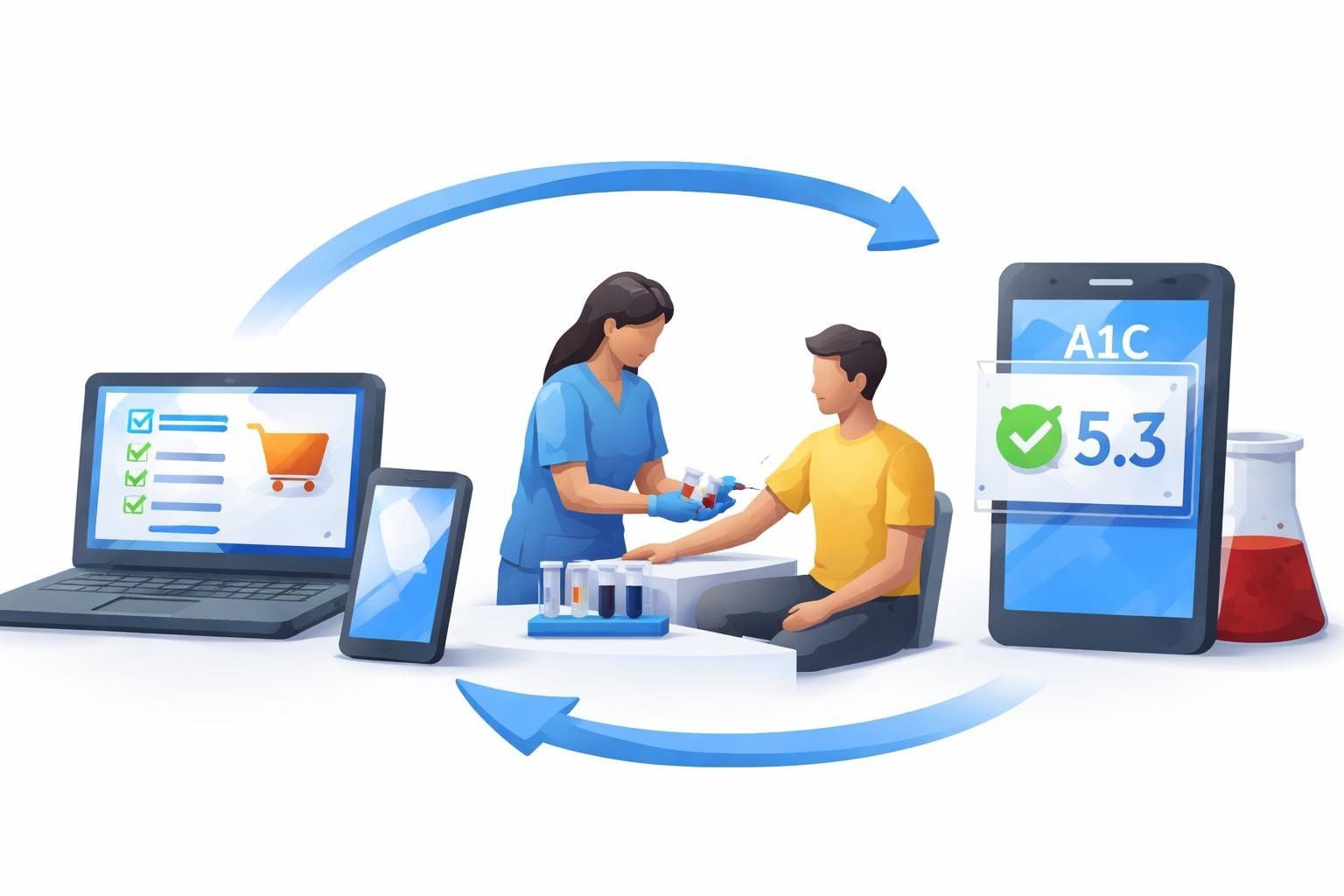
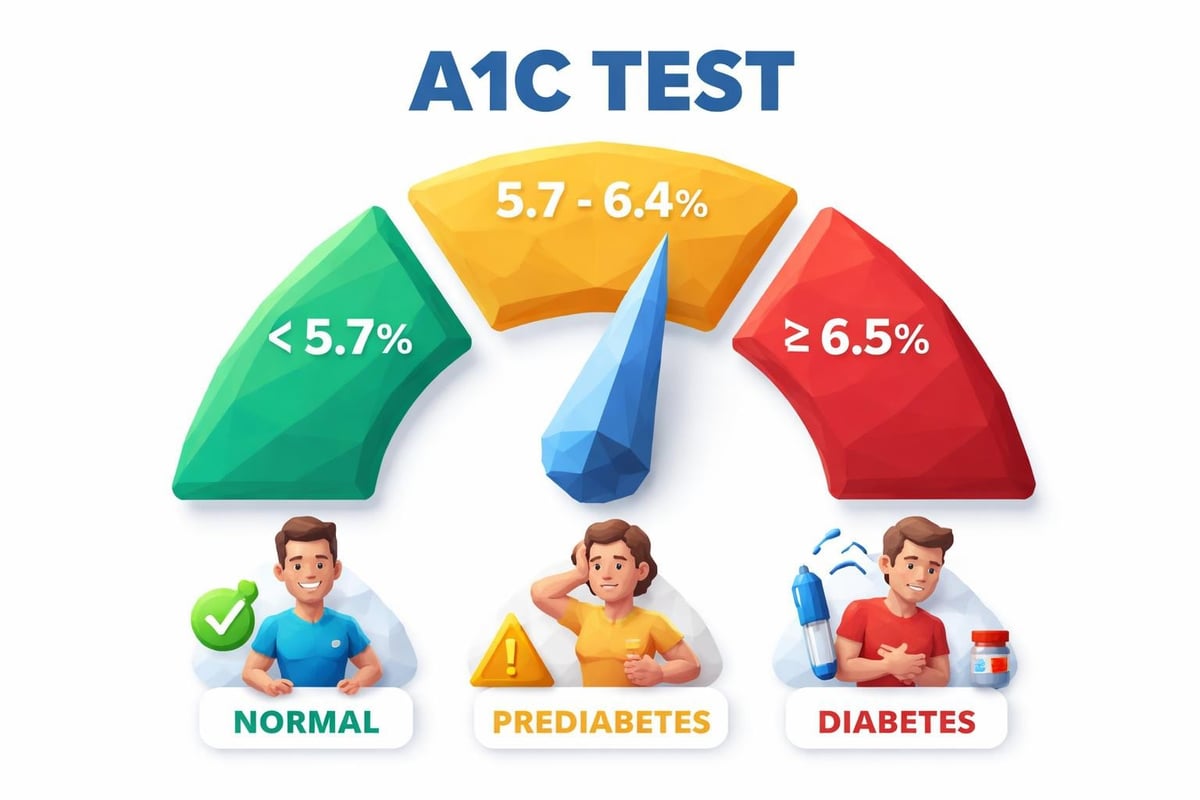
The A1C test (also called hemoglobin A1c or HbA1c) measures the percentage of your hemoglobin that has glucose attached to it, which reflects your average blood sugar over roughly the past 2 to 3 months. An A1C below 5.7% is normal, 5.7% to 6.4% is prediabetes, and 6.5% or higher is in the diabetes range. You don't need to fast, and at JustLabs you can order the test yourself, without a doctor visit, for $7 plus the one $18 order fee ($25 all-in).
A1C Levels Chart: Normal, Prediabetes, and Diabetes
| A1C Result | What It Means | Estimated Average Glucose (eAG) |
|---|---|---|
| Below 5.7% | Normal | Below about 117 mg/dL |
| 5.7% - 6.4% | Prediabetes | About 117 - 137 mg/dL |
| 6.5% or higher | Diabetes range | About 140 mg/dL or higher |
These cutoffs are the ones used in the American Diabetes Association's Standards of Care and in recent clinical reviews: prediabetes is defined as an A1C of 5.7% to 6.4%, and diabetes is diagnosed at an A1C of 6.5% or higher. They are also the ranges printed on Quest Diagnostics reports, which flag results of 5.7% and above. Reference ranges can vary slightly between labs, so always read your result against the range on your own report.
A single result in the diabetes range is not a diagnosis on its own. Diagnosis normally requires a confirming test, and only a clinician can make it.
What Does the A1C Test Measure?
When glucose circulates in your blood, some of it sticks to hemoglobin, the oxygen-carrying protein inside red blood cells. The more glucose in your blood over time, the more hemoglobin becomes "glycated." Because red blood cells live for a few months, the share of glycated hemoglobin works as a running average: reviews describe A1C as a measure of glucose control over roughly 8 to 12 weeks.
That is what makes the A1C test different from a fasting glucose or a finger-stick reading. A glucose test is a snapshot of one moment and shifts with your last meal, exercise, and stress. A1C smooths those swings out into one long-term number.
The JustLabs Hemoglobin A1c test is a standard venous blood draw processed by Quest Diagnostics.
Recommended Test
Hemoglobin A1c (HbA1c)
The HbA1c test shows your average blood sugar over the past 2-3 months - like a "blood sugar GPA" that reveals your overall glucose control.
Includes 2 biomarkers
$7
A1C to Average Blood Sugar Conversion (eAG Chart)
Many lab reports, including Quest's "Hemoglobin A1c with eAG," also show an estimated average glucose (eAG) in mg/dL, the same units a glucose meter uses. The conversion comes from the A1c-Derived Average Glucose study, which compared A1C with about 2,700 glucose readings per person over 3 months and found:
eAG (mg/dL) = 28.7 × A1C − 46.7
| A1C | Estimated Average Glucose |
|---|---|
| 5.0% | 97 mg/dL |
| 5.5% | 111 mg/dL |
| 5.7% | 117 mg/dL |
| 6.0% | 126 mg/dL |
| 6.5% | 140 mg/dL |
| 7.0% | 154 mg/dL |
| 7.5% | 169 mg/dL |
| 8.0% | 183 mg/dL |
| 9.0% | 212 mg/dL |
| 10.0% | 240 mg/dL |
| 11.0% | 269 mg/dL |
| 12.0% | 298 mg/dL |
Values are calculated from the formula and rounded. The study found the relationship held across age, sex, diabetes type, race/ethnicity, and smoking status, but eAG is still an estimate. Two people with the same A1C can have different day-to-day glucose patterns. Abbott's guide to understanding A1C has more on what each step means in everyday blood sugar terms.
What Is a Normal A1C?
For adults without diabetes, a normal A1C is below 5.7%. Quest flags results from 5.7% upward, so a result such as 5.4% or 5.6% falls in the normal range on your report.
A few points help put a "normal" number in context:
- Normal is a range, not a target to chase. A result of 5.2% and one of 5.5% are both normal.
- Trends matter. A result that creeps from 5.3% to 5.6% over a few years is worth watching even though both are normal.
- A1C is one marker. It doesn't show short spikes or lows, which is why it is often paired with a fasting glucose.
For people already diagnosed with diabetes, the A1C goal is a different question. Goals are individualized and set with a clinician, so this article doesn't suggest one.
What Does Prediabetes on an A1C Mean?
An A1C of 5.7% to 6.4% falls in the prediabetes range. Prediabetes is common: a JAMA review estimates it affects 1 in 3 US adults, and about 10% of people with prediabetes in the US progress to diabetes each year. The same review notes that a fasting glucose of 100 to 125 mg/dL also defines prediabetes, which is why the two tests are often ordered together.
Prediabetes is a risk signal, not a diagnosis of diabetes. The useful next step is a conversation with a healthcare provider about what the result means for you and how often to recheck it.
Do You Need to Fast for an A1C Test?
No. Because A1C reflects months of glucose exposure, what you ate this morning doesn't change it in any meaningful way. You can have your blood drawn at any time of day.
The catch: if you add a fasting glucose, fasting insulin, or lipid panel to the same order, those tests usually do call for fasting. If you're bundling, plan the draw for the morning after an overnight fast.
What Can Make an A1C Result Misleading?
A1C depends on two things: how much glucose is in your blood and how long your red blood cells survive. Anything that changes red blood cell lifespan or hemoglobin structure can push A1C away from your true average glucose. A review in Experimental and Therapeutic Medicine puts it plainly: A1C is "strongly influenced by changes in red blood cell lifespan and globin chain structure."
| Factor | Typical Effect on A1C | What the Research Says |
|---|---|---|
| Iron deficiency (with or without anemia) | Can read falsely higher | A systematic review found higher A1C with no matching rise in glucose |
| Other anemias (non-iron-deficiency) | May read lower | Data are limited, but point toward lower A1C values |
| Inherited hemoglobin variants | Higher or lower, depending on the lab method | Some variants interfere with several common A1C assay methods |
| Other conditions that change red blood cell lifespan | Higher or lower | A1C assumes a normal red blood cell lifespan, so results need caution |
A systematic review in Diabetologia found that iron deficiency, with or without anemia, led to higher A1C values with no matching rise in glucose, while other forms of anemia may lower A1C. A separate review notes that genetic hemoglobin variants can interfere with several common A1C methods. Not every variant matters, though: a meta-analysis of people without diabetes found that the effect of sickle cell trait (HbAS) on A1C was within normal individual variation and should not affect diagnosis.
If any of these apply to you, tell the clinician who reviews your results. They may weigh your A1C alongside a fasting glucose or another glucose measure.
How Often Should You Get an A1C Test?
There's no single schedule for everyone. The main guideposts:
- Adults 35 to 70 with overweight or obesity: the US Preventive Services Task Force recommends screening for prediabetes and type 2 diabetes in this group.
- Other risk factors: older age, family history, physical inactivity, a history of gestational diabetes, and Hispanic, American Indian or Alaska Native, Asian, or Black ancestry are all listed as type 2 diabetes risk factors and are reasons to discuss earlier or more frequent screening.
- Prediabetes or diabetes: the right interval is a decision for you and your clinician. People with diabetes usually test more often; how often is set with their clinician.
Because A1C reflects about 3 months of blood sugar, retesting much sooner than that mostly measures overlapping time periods.
How to Get an A1C Test Without a Doctor
You don't need a doctor visit or insurance to get an A1C test. Through JustLabs you can order lab tests without a doctor appointment, and the blood draw happens at a Quest Diagnostics patient service center (Sonora Quest in Arizona).
How It Works
- Order online. Choose the Hemoglobin A1c test and pay upfront. An independent physician order is included, so no doctor visit is needed.
- Pick a lab. Find a nearby Quest location, then book your visit online through JustLabs or walk in.
- Get your blood drawn. A quick draw, no fasting needed for A1C on its own.
- See your results. Results are usually ready in 1 to 2 business days in your online dashboard, with the Quest reference range printed next to your value.
More detail on each step is on the how it works page. JustLabs orders are not available in New York, New Jersey, Rhode Island, or Hawaii.
Is a Self-Ordered A1C Test as Accurate?
Yes. A self-ordered test goes to the same Quest Diagnostics laboratories that process doctor-ordered tests, uses the same methods, and is reported against the same reference ranges. The American Diabetes Association and the CDC both describe lab A1C testing as a standard way to check for prediabetes and diabetes. The difference with direct access isn't the test; it's that interpretation and any follow-up are up to you and the clinician you choose to share results with.
Lab Draw vs. At-Home A1C Kit
At-home finger-prick kits are convenient, but they rely on a small capillary sample and a home device rather than a full laboratory analyzer. A venous lab draw processed by a national laboratory gives you a result on the same footing as the one your doctor would order.
How Much Does an A1C Test Cost Without Insurance?
At JustLabs, the Hemoglobin A1c test is $7 plus the one $18 order fee, $25 all-in. The $18 fee covers the Quest blood draw and the independent physician order, and it's charged once per order no matter how many tests you add. A1C plus a fasting glucose ($6) on the same order comes to $31 all-in.
- No insurance needed, and no surprise bills afterward
- HSA/FSA eligible (see eligible tests)
- Prices shown before checkout (full lab test pricing)
If you have a high-deductible plan, self-pay testing can be simpler than running a low-cost test through insurance. More options are covered in our guide to labs without insurance and where to get lab tests.
Tests to Pair With an A1C
A1C answers "what has my average been?" Other markers fill in the rest of the picture:
- Fasting glucose: a single-moment reading. A fasting glucose of 126 mg/dL or higher is also a diabetes criterion, and 100 to 125 mg/dL is the prediabetes range.
- Fasting insulin: how much insulin your body needs to keep glucose where it is.
- Lipid panel: cholesterol and triglycerides, which are often looked at alongside blood sugar.
The Comprehensive Diabetes Panel bundles A1C, fasting glucose, fasting insulin, and a lipid panel in one order. Plan to fast for this panel because of the glucose, insulin, and lipid tests.
Recommended Panel
Comprehensive Diabetes Panel
This panel detects diabetes and prediabetes at every stage. Includes lipids because diabetes dramatically increases heart disease risk.
Includes 10 biomarkers
$35
Fasting required
What to Do With Your A1C Result
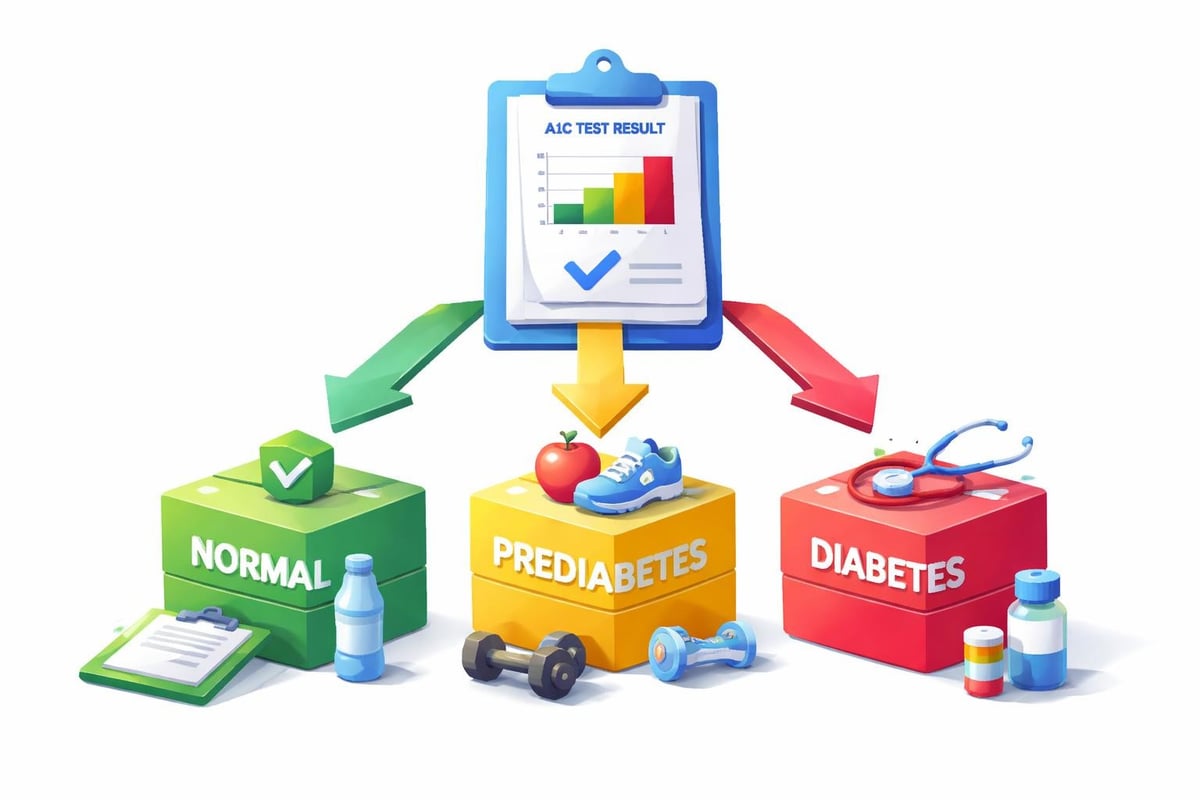
Your result is information, not a diagnosis. Share it with a healthcare provider, especially if:
- Your A1C is 6.5% or higher, or in the prediabetes range
- Your result has risen noticeably since a previous test
- You have symptoms such as excessive thirst, frequent urination, or unexplained weight loss
- You have one of the conditions above that can make A1C misleading
Bringing a dated lab report to an appointment gives your clinician a head start, and many people use direct-access testing to track their numbers between visits. JustLabs results are educational and don't replace medical advice, diagnosis, or treatment.
FAQ
What is a normal A1C level?
A normal A1C is below 5.7%. Results from 5.7% to 6.4% fall in the prediabetes range, and 6.5% or higher is in the diabetes range. Quest Diagnostics reports flag results of 5.7% and above. Ranges can vary slightly by lab, so check the range printed on your report.
Do I need to fast before an A1C test?
No. A1C reflects your average blood sugar over about 2 to 3 months, so a recent meal doesn't meaningfully change it, and you can test at any time of day. If you add fasting glucose, fasting insulin, or a lipid panel to the same order, fast for those.
What is the average blood sugar for an A1C of 6.5% or 7%?
Using the standard formula (eAG = 28.7 × A1C − 46.7), an A1C of 6.5% corresponds to an estimated average glucose of about 140 mg/dL, and 7% to about 154 mg/dL. An A1C of 5.7%, the top of the normal range, is about 117 mg/dL.
Can I get an A1C test without a doctor?
Yes. At JustLabs you order the test online with no doctor visit or insurance, then get your blood drawn at a Quest Diagnostics location (Sonora Quest in Arizona). Results usually arrive in 1 to 2 business days. JustLabs orders are not available in New York, New Jersey, Rhode Island, or Hawaii.
How much does an A1C test cost without insurance?
At JustLabs, the Hemoglobin A1c test is $7 plus the one $18 order fee, for $25 all-in. The order fee is charged once per order, so adding a fasting glucose ($6) brings the total to $31. Tests are HSA/FSA eligible.
Can anemia or other conditions affect my A1C?
Yes. Iron deficiency, with or without anemia, can make A1C read falsely high, while other anemias may lower it. Some inherited hemoglobin variants interfere with certain lab methods, and conditions that change how long red blood cells survive can also skew results. Tell your clinician if any of these apply.
How often should I check my A1C?
It depends on your risk and history. The USPSTF recommends screening adults 35 to 70 who have overweight or obesity. People with diabetes usually test more often; how often is set with their clinician. Since A1C reflects about 3 months, testing more often than that adds little.
Is a self-ordered A1C test as accurate as one my doctor orders?
Yes. JustLabs orders are processed by Quest Diagnostics, the same national laboratory network many doctors use, with the same methods and reference ranges. The difference is that interpretation and follow-up are up to you and the clinician you share results with.
Whether you're checking a baseline, keeping an eye on a prediabetes result, or tracking your numbers between appointments, an A1C test is one of the simplest, most informative blood tests available. JustLabs lets you order it directly, for $25 all-in, with results usually in 1 to 2 business days.
References
American Diabetes Association Professional Practice Committee for Diabetes*. 2. Diagnosis and Classification of Diabetes: Standards of Care in Diabetes-2026. Diabetes Care. 2026 Jan 1;49(Supplement_1):S27-S49. doi: 10.2337/dc26-S002. PMID: 41358893. https://pubmed.ncbi.nlm.nih.gov/41358893/
Kalyani RR, Neumiller JJ, Maruthur NM, Wexler DJ. Diagnosis and Treatment of Type 2 Diabetes in Adults: A Review. JAMA. 2025 Sep 16;334(11):984-1002. doi: 10.1001/jama.2025.5956. PMID: 40549398. https://pubmed.ncbi.nlm.nih.gov/40549398/
Echouffo-Tcheugui JB, Perreault L, Ji L, Dagogo-Jack S. Diagnosis and Management of Prediabetes: A Review. JAMA. 2023 Apr 11;329(14):1206-1216. doi: 10.1001/jama.2023.4063. PMID: 37039787. https://pubmed.ncbi.nlm.nih.gov/37039787/
Nathan DM, Kuenen J, Borg R, Zheng H, Schoenfeld D, Heine RJ, A1c-Derived Average Glucose Study Group. Translating the A1C assay into estimated average glucose values. Diabetes Care. 2008 Aug;31(8):1473-8. doi: 10.2337/dc08-0545. PMID: 18540046. https://pubmed.ncbi.nlm.nih.gov/18540046/
English E, Idris I, Smith G, Dhatariya K, Kilpatrick ES, John WG. The effect of anaemia and abnormalities of erythrocyte indices on HbA1c analysis: a systematic review. Diabetologia. 2015 Jul;58(7):1409-21. doi: 10.1007/s00125-015-3599-3. PMID: 25994072. https://pubmed.ncbi.nlm.nih.gov/25994072/
Cavagnolli G, Pimentel AL, Freitas PA, Gross JL, Camargo JL. Factors affecting A1C in non-diabetic individuals: Review and meta-analysis. Clin Chim Acta. 2015 May 20;445:107-14. doi: 10.1016/j.cca.2015.03.024. PMID: 25818244. https://pubmed.ncbi.nlm.nih.gov/25818244/
Chen Z, Shao L, Jiang M, Ba X, Ma B, Zhou T. Interpretation of HbA1c lies at the intersection of analytical methodology, clinical biochemistry and hematology (Review). Exp Ther Med. 2022 Dec;24(6):707. doi: 10.3892/etm.2022.11643. PMID: 36382101. https://pubmed.ncbi.nlm.nih.gov/36382101/
Yadav N, Kumar Mandal A. Interference of hemoglobin variants in HbA(1c) quantification. Clin Chim Acta. 2023 Jan 15;539:55-65. doi: 10.1016/j.cca.2022.11.031. PMID: 36476843. https://pubmed.ncbi.nlm.nih.gov/36476843/
US Preventive Services Task Force, Davidson KW, Barry MJ, Mangione CM, Cabana M, Caughey AB, Davis EM, Donahue KE, Doubeni CA, Krist AH, Kubik M, Li L, Ogedegbe G, Owens DK, Pbert L, Silverstein M, Stevermer J, Tseng CW, Wong JB. Screening for Prediabetes and Type 2 Diabetes: US Preventive Services Task Force Recommendation Statement. JAMA. 2021 Aug 24;326(8):736-743. doi: 10.1001/jama.2021.12531. PMID: 34427594. https://pubmed.ncbi.nlm.nih.gov/34427594/
American Diabetes Association Professional Practice Committee for Diabetes*. 6. Glycemic Goals, Hypoglycemia, and Hyperglycemic Crises: Standards of Care in Diabetes-2026. Diabetes Care. 2026 Jan 1;49(Supplement_1):S132-S149. doi: 10.2337/dc26-S006. PMID: 41358894. https://pubmed.ncbi.nlm.nih.gov/41358894/