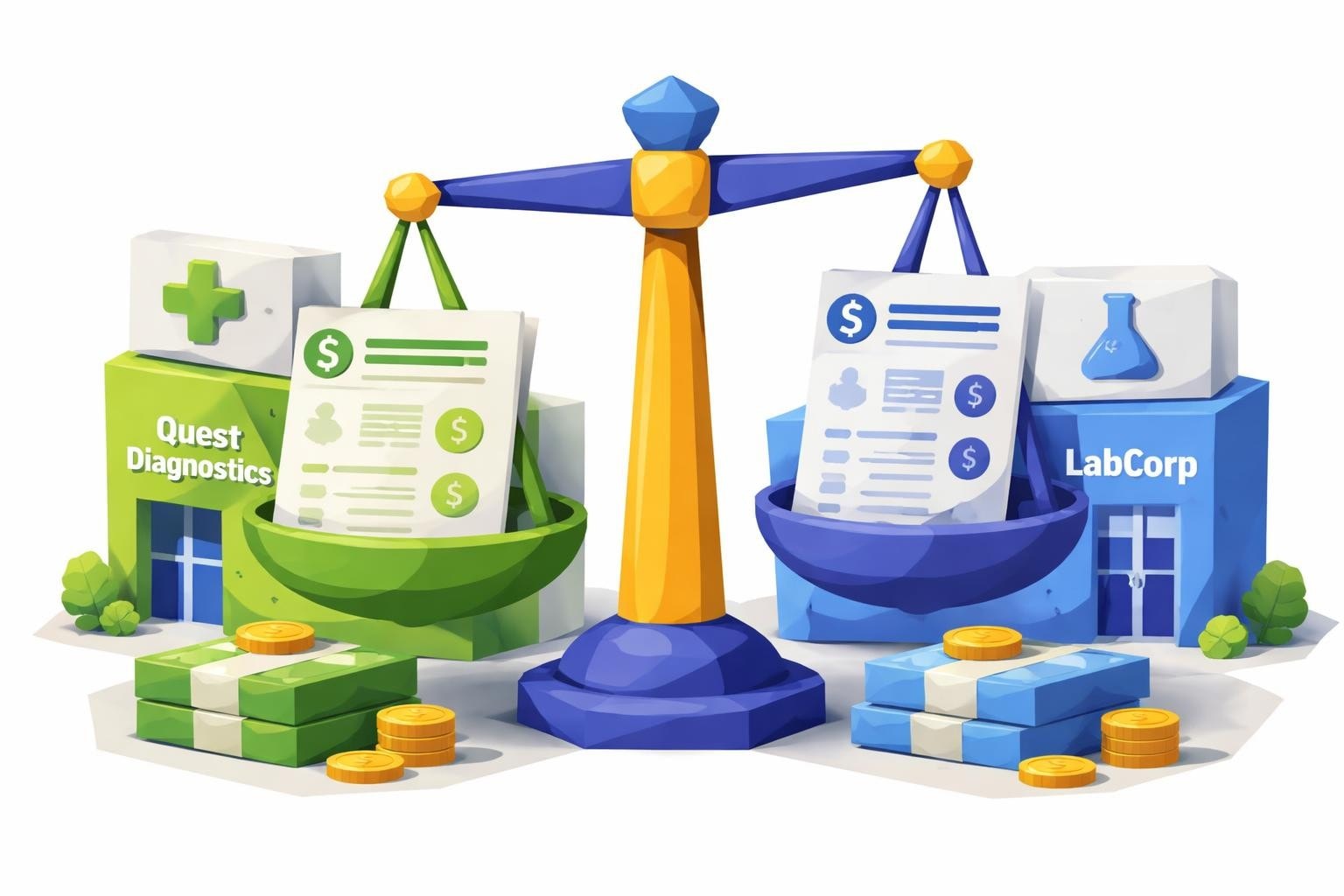
When evaluating healthcare options, understanding lab testing costs becomes a crucial factor in making informed decisions. The quest diagnostics vs labcorp prices debate affects millions of Americans seeking diagnostic services, whether through insurance networks or self-pay options.
Big picture
- Quest Diagnostics and LabCorp are the two largest clinical laboratory companies in the United States, collectively processing billions of test results annually and operating thousands of patient service centers nationwide.
- Pricing varies significantly between these providers depending on test type, payment method (insurance vs. self-pay), geographic location, and whether you have negotiated rates through a healthcare network.
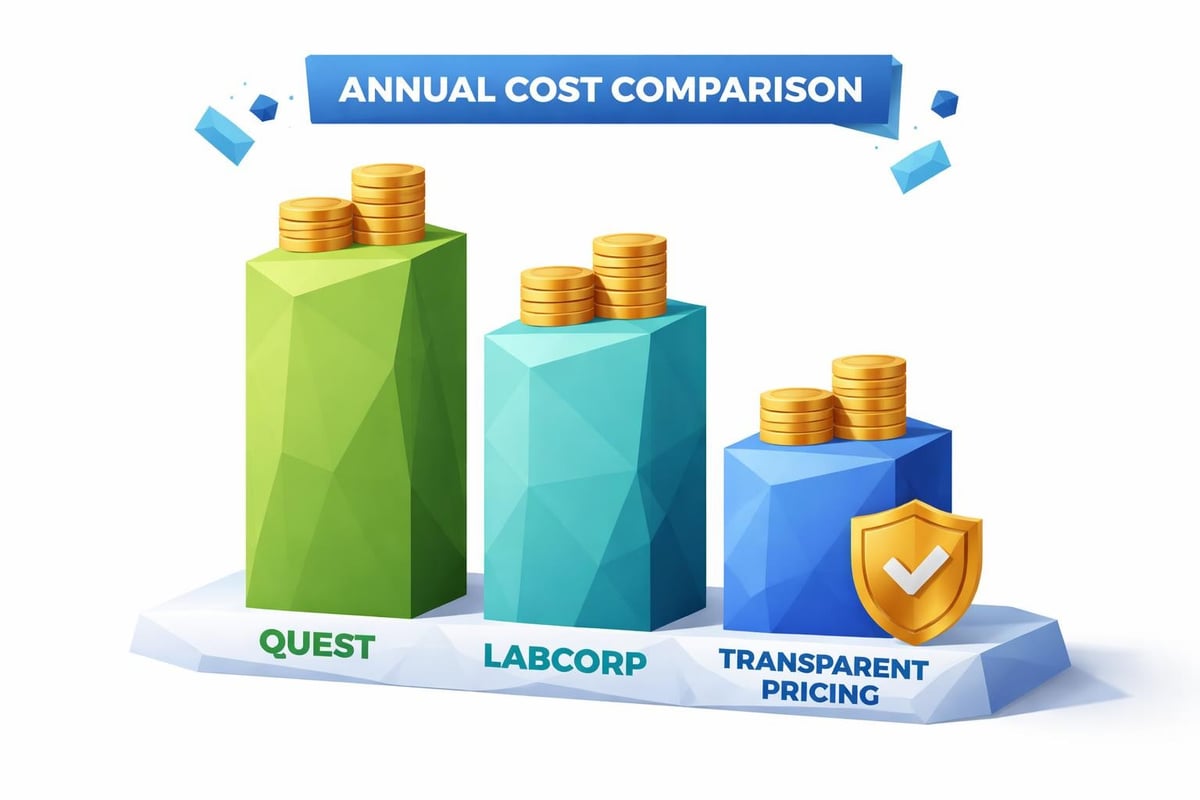
- Self-pay patients often face the highest prices at traditional labs, with individual tests sometimes costing hundreds of dollars more than transparent alternatives.
- Understanding the cost structure helps patients make strategic decisions about where to get tested, potentially saving hundreds or thousands annually on routine health monitoring.
- Take action by comparing specific test prices from both providers, exploring self-pay lab testing options, and requesting itemized pricing before committing to any laboratory service.
Understanding the Pricing Landscape
Quest Diagnostics and LabCorp dominate the clinical laboratory market, yet their pricing structures remain surprisingly opaque to most consumers. Both companies process everything from routine blood work to specialized genetic testing, but the cost for identical tests can differ substantially.
Several factors drive these price variations:
- Insurance contracts that negotiate different reimbursement rates
- Geographic location and regional market competition
- Test complexity and equipment requirements
- Volume discounts for physicians ordering multiple tests
- Self-pay pricing tiers that often lack transparency

The challenge for consumers lies in obtaining accurate pricing information before services are rendered. Neither company prominently displays comprehensive price lists on their websites, and costs can vary dramatically from one location to another. According to research comparing LabCorp and Quest pricing, the same basic metabolic panel might cost $29 at one facility and $150 at another.
Insurance Network Considerations
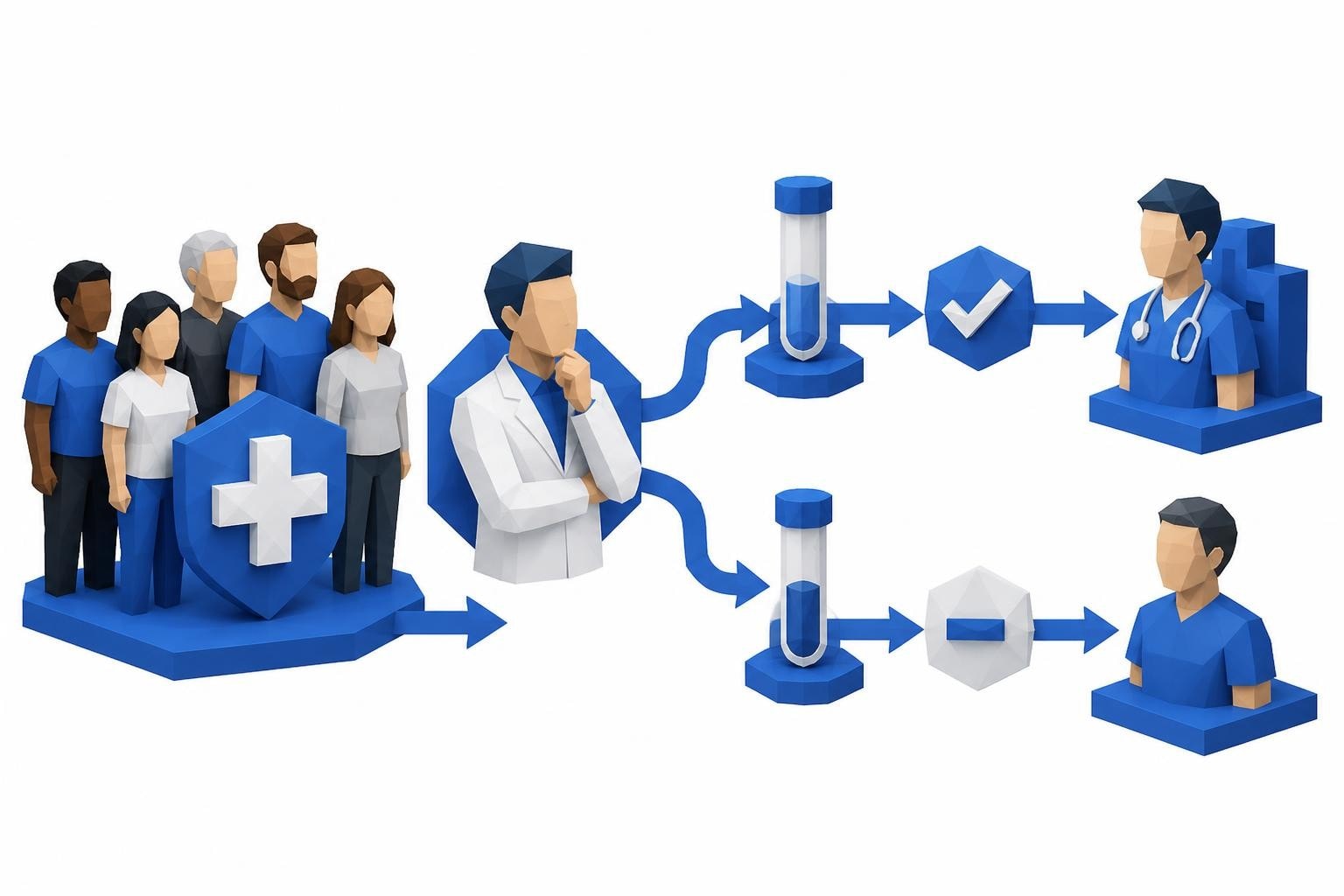
Most insured patients encounter quest diagnostics vs labcorp prices through their health plan's preferred provider network. Insurance companies negotiate contracted rates that determine your out-of-pocket costs, including copays, coinsurance, and deductible contributions.
Network status significantly impacts what you pay:
- In-network labs typically charge your insurance company pre-negotiated rates
- Out-of-network facilities may bill higher amounts, leaving you with balance billing
- Some insurance plans exclusively cover one lab company over the other
- High-deductible health plans require you to pay full contracted rates until meeting your deductible
Cigna Healthcare, for instance, has demonstrated that using in-network labs can generate savings up to 85% compared to out-of-network alternatives.
Common Test Price Comparisons
Breaking down quest diagnostics vs labcorp prices for frequently ordered tests reveals interesting patterns. Both companies offer similar test menus, but individual pricing can surprise consumers unfamiliar with healthcare billing practices.
| Test Type | Quest Diagnostics (Approx.) | LabCorp (Approx.) | Price Difference |
|---|---|---|---|
| Basic Metabolic Panel | $30-$150 | $25-$145 | Minimal |
| Lipid Panel | $40-$200 | $35-$195 | Minimal |
| Complete Blood Count | $25-$120 | $20-$115 | Slight LabCorp advantage |
| Thyroid Panel (TSH) | $50-$180 | $45-$175 | Minimal |
| Hemoglobin A1C | $40-$150 | $35-$145 | Minimal |
| Comprehensive Metabolic Panel | $45-$175 | $40-$170 | Minimal |
These ranges reflect self-pay pricing reported by various sources and can fluctuate based on location and current pricing policies. The practical price comparison between these providers shows that neither consistently undercuts the other across all test categories.
Thyroid Testing Costs
Thyroid function tests represent one of the most commonly ordered lab panels, making them a relevant benchmark for comparing providers. A basic TSH test might cost anywhere from $50 to $180 depending on payment method and location.
More comprehensive thyroid testing increases costs substantially. A complete thyroid panel including
Recommended Test
TSH (Thyroid Stimulating Hormone)
The TSH test is the gold standard for evaluating thyroid function. It's the first test doctors order when thyroid problems are suspected.
Includes 1 biomarkers
$9
,
Recommended Test
Free T4 (Thyroxine)
Free T4 measures the unbound, active form of thyroxine - the main hormone produced by your thyroid gland. Unlike total T4, free T4 is not affected by protein levels and gives a more accurate picture of thyroid function.
Includes 1 biomarkers
$9
,
Recommended Test
Free T3 (Triiodothyronine)
Free T3 measures the unbound, most active form of thyroid hormone. T3 is 3-4 times more potent than T4 and directly affects metabolism, heart rate, body temperature, and energy levels.
Includes 1 biomarkers
$14
, and antibody testing can run $300-$600 at traditional labs for self-pay patients.
For those needing regular thyroid monitoring, these costs accumulate quickly. Patients with Hashimoto's thyroiditis or hyperthyroidism may require quarterly testing, translating to $1,200-$2,400 annually just for monitoring.
Self-Pay Patient Considerations
The quest diagnostics vs labcorp prices debate becomes particularly significant for self-pay patients without insurance coverage. Both companies maintain separate pricing structures for cash-paying customers, often substantially higher than insurance-negotiated rates.
Self-pay challenges include:
- Lack of upfront price transparency
- Higher "retail" rates compared to insurance contracts
- Difficulty obtaining itemized quotes before service
- Limited price negotiation opportunities
- Unexpected bills arriving weeks after testing
Many self-pay patients discover that ordering lab tests without going through a doctor and traditional labs can provide more predictable, affordable pricing. Direct-to-consumer lab testing services have emerged specifically to address these pain points.
Alternative Pricing Models
The traditional lab testing model, where doctors order tests through Quest or LabCorp and patients receive bills later, increasingly frustrates consumers seeking cost transparency. Modern alternatives offer several advantages:
- Upfront pricing displayed before ordering
- Bundled panels at fixed rates regardless of location
- No insurance billing complications or surprise charges
- Comparable accuracy using the same CLIA-certified laboratories
- Faster results with online portal access
For example, understanding transparent lab test pricing helps consumers budget accurately for healthcare expenses without navigating complex insurance explanations of benefits.
Specialized Testing Price Variations
Beyond routine blood work, quest diagnostics vs labcorp prices diverge more noticeably in specialized testing categories. Genetic testing, toxicology panels, allergy testing, and advanced diagnostic procedures each carry unique pricing considerations.
Hormone and Fertility Testing
Hormone panels for fertility evaluation or hormone replacement therapy monitoring can become expensive quickly. A comprehensive female hormone panel might include:
- Estradiol
- Progesterone
- FSH and LH
- Testosterone
- DHEA-S
- Prolactin
At traditional labs, this combination could cost $400-$800 for self-pay patients. Male hormone testing, including total and free testosterone, often runs $200-$500 depending on the comprehensiveness of the panel.
The
Recommended Panel
Female Hormone Panel
Save $7This comprehensive panel measures all major female hormones: estrogen, progesterone, reproductive hormones (FSH/LH), and androgens (testosterone/DHEA-S) - essential for understanding hormonal balance.
Includes 7 biomarkers
$105
and
Recommended Panel
Male Hormone Panel
Save $4This comprehensive panel measures testosterone (free and total), plus the supporting hormones that affect how testosterone works in your body: SHBG, estradiol sensitive, DHEA-S, and cortisol.
Includes 6 biomarkers
$105.50
options through transparent providers can offer significant savings compared to traditional lab billing.
Wellness and Preventive Panels
Comprehensive wellness testing packages combine multiple individual tests into bundled panels. These typically include metabolic markers, lipid profiles, blood cell counts, and organ function indicators.
| Panel Components | Quest/LabCorp Self-Pay | JustLabs Bundled Price (all-in) |
|---|---|---|
| Basic Wellness (8-12 markers) | $150-$350 | $48 |
| Comprehensive Wellness (30+ markers) | $400-$800 | $112 |
| Longevity Panel (advanced markers) | $600-$1,200 | $173 |
According to analysis of top lab companies, bundled pricing through direct-to-consumer services frequently undercuts traditional providers by 40-70% for identical test combinations.
Geographic Price Variations
Quest diagnostics vs labcorp prices shift based on regional markets and local competition. Urban areas with multiple lab options often see more competitive pricing than rural regions with limited access to testing facilities.
Regional factors affecting costs:
- Local cost of living and commercial real estate expenses
- State healthcare regulations and licensing requirements
- Regional insurance contract negotiations
- Competition from hospital-based laboratories
- Population density affecting operational efficiency
A lipid panel in Manhattan might cost differently than the same test in rural Montana, even from the same provider. These variations complicate direct price comparisons and emphasize the importance of obtaining location-specific quotes.

Finding Convenient Testing Locations
Both Quest Diagnostics and LabCorp operate thousands of patient service centers nationwide, making access relatively convenient for most Americans. However, finding nearby lab locations that accept your chosen payment method or service provider requires research.
Service center hours, appointment availability, and wait times also vary by location. Some facilities accept walk-ins while others require appointments, affecting the overall convenience factor beyond just pricing considerations.
Insurance Billing Complexity
Understanding quest diagnostics vs labcorp prices becomes exponentially more complicated when insurance enters the equation. The amount you ultimately pay depends on multiple variables often unclear until after service delivery.
Deductibles and Cost-Sharing
If you haven't met your annual deductible, you'll pay the insurance-negotiated rate rather than your typical copay. This "contracted rate" sits between retail self-pay pricing and the final cost after insurance coverage kicks in.
Cost-sharing progression typically works as follows:
- You pay full contracted rate until meeting your deductible
- After deductible, you pay coinsurance percentage (often 10-20%)
- Copays may apply instead of coinsurance depending on your plan
- Out-of-pocket maximum caps your annual spending
- In-network versus out-of-network status affects all these amounts
Many patients with high-deductible health plans discover that lab testing without using insurance can actually cost less than their insurance-negotiated rates, particularly for routine monitoring tests.
Value Beyond Price Alone
While comparing quest diagnostics vs labcorp prices provides important financial insights, other factors contribute to overall value. Test accuracy, result turnaround time, customer service quality, and convenience all matter when selecting a laboratory provider.
Quality considerations include:
- CLIA certification and CAP accreditation status
- Proficiency testing performance records
- Technology infrastructure and equipment quality
- Phlebotomist training and experience levels
- Medical director oversight and quality control protocols
Both Quest Diagnostics and LabCorp maintain high quality standards and comparable accuracy rates for routine testing. Medical News Today's LabCorp review confirms that both companies deliver reliable results meeting rigorous regulatory requirements.
Result Turnaround Times
Standard blood work typically returns within 1-3 business days from either provider. Specialized testing may require longer processing periods, sometimes 1-2 weeks depending on test complexity and whether samples must be sent to reference laboratories.
Direct-to-consumer lab services often promise similar turnaround times, with results delivered through secure online portals. Understanding how to interpret lab results becomes equally important as obtaining them quickly.
Maximizing Healthcare Savings
Strategic approaches to laboratory testing can generate substantial savings without compromising quality or convenience. Informed consumers employ several tactics to minimize expenses while maintaining appropriate health monitoring.
Cost-saving strategies include:
- Comparing prices between Quest, LabCorp, and alternative providers before committing
- Bundling tests into comprehensive panels rather than ordering individually
- Timing tests strategically relative to insurance deductibles and out-of-pocket maximums
- Using FSA/HSA funds to pay for testing with pre-tax dollars
- Exploring direct-to-consumer options that bypass traditional billing complexity
For those with flexible spending accounts or health savings accounts, FSA and HSA eligible tests can effectively reduce costs by 25-40% through tax savings alone.
When to Choose Each Provider
Neither Quest Diagnostics nor LabCorp consistently offers superior pricing across all scenarios. The optimal choice depends on your specific situation:
Choose Quest Diagnostics when:
- Your insurance plan designates them as preferred in-network provider
- They maintain more convenient locations in your area
- Your employer health plan has negotiated favorable Quest contracts
Choose LabCorp when:
- Insurance contracts favor LabCorp as preferred provider
- Specific specialty testing requires their unique capabilities
- Location and hours better suit your schedule
Consider transparent alternatives when:
- You're paying out-of-pocket without insurance coverage
- Your insurance deductible hasn't been met
- You want predictable, upfront pricing without billing surprises
- Convenience and speed matter more than traditional provider relationships
Key Takeaways
Understanding quest diagnostics vs labcorp prices empowers consumers to make informed healthcare decisions. Neither provider consistently undercuts the other across all test categories and geographic markets. Self-pay patients often face the highest costs at traditional labs, while insurance complexity can obscure true out-of-pocket expenses. Direct-to-consumer lab testing services increasingly provide transparent alternatives with comparable quality and faster results. Strategic test timing, bundling, and payment method selection can reduce annual laboratory expenses by hundreds or thousands of dollars. The optimal provider choice depends on your insurance network status, specific testing needs, location, and whether you prioritize upfront price transparency over traditional provider relationships.
See also: Looking for Quest pricing specifically? Read our Quest Self Pay Prices guide or Quest No Insurance guide.
FAQ
Which is cheaper overall, Quest Diagnostics or LabCorp?
Neither provider consistently offers lower prices across all tests and locations. Pricing depends on insurance contracts, geographic markets, test types, and payment methods. For self-pay patients, both typically charge similar rates that exceed transparent alternative providers. The detailed comparison of Quest versus LabCorp shows minimal consistent price advantages for either company.
How much does a basic metabolic panel cost at Quest and LabCorp?
Basic metabolic panels typically range from $30-$150 at both Quest Diagnostics and LabCorp for self-pay patients, depending on location. Insurance-negotiated rates vary by carrier but generally fall between $15-$75. At JustLabs, a basic metabolic panel is $6 plus the one $18 order fee ($24 all-in), the same price regardless of location.
Can I negotiate lab test prices with Quest or LabCorp?
Traditional labs rarely negotiate individual test pricing, particularly for established tests with set fee schedules. However, financial assistance programs may be available for qualifying patients. Self-pay patients typically receive a "self-pay discount" that's automatically applied but still exceeds insurance-negotiated rates. For true price negotiation, exploring where to get lab tests through transparent providers offers more flexibility.
Do Quest and LabCorp accept FSA and HSA payments?
Yes, both Quest Diagnostics and LabCorp accept flexible spending account (FSA) and health savings account (HSA) payments for eligible medical testing. Using pre-tax dollars through these accounts effectively reduces testing costs by your marginal tax rate, typically 25-40%. Keep itemized receipts for tax documentation purposes.
How long do results take from Quest versus LabCorp?
Both providers deliver routine blood work results within 1-3 business days for standard tests. Specialized testing may require 1-2 weeks depending on complexity. Result delivery methods include patient portals, physician offices, or mail. Turnaround times are comparable between the two companies for most common tests.
Are Quest and LabCorp equally accurate?
Both Quest Diagnostics and LabCorp maintain CLIA certification and CAP accreditation, meeting rigorous federal quality standards. Proficiency testing demonstrates comparable accuracy rates for routine clinical testing. Either provider delivers reliable results suitable for medical decision-making when proper protocols are followed.
What happens if I use an out-of-network lab?
Using out-of-network laboratories often results in higher out-of-pocket costs due to lack of negotiated insurance rates. You may face balance billing for amounts exceeding your insurance company's allowed charges. Some plans provide no coverage for out-of-network labs, making you responsible for full charges. Always verify network status before testing.
Can I order my own lab tests without a doctor?
Yes, most states allow direct-access laboratory testing without physician orders. Quest and LabCorp offer limited direct-to-consumer services in eligible states, though availability varies. How lab testing works through modern self-service platforms provides broader access to comprehensive testing panels without requiring doctor visits or insurance involvement.
Navigating quest diagnostics vs labcorp prices requires understanding multiple pricing factors, from insurance networks to geographic variations and payment methods. Neither traditional provider consistently offers superior value across all scenarios, and self-pay patients particularly benefit from exploring transparent alternatives. When you need affordable, convenient access to quality laboratory testing with upfront pricing and fast results, JustLabs delivers comprehensive testing panels at prices that eliminate billing surprises and unnecessary complexity.