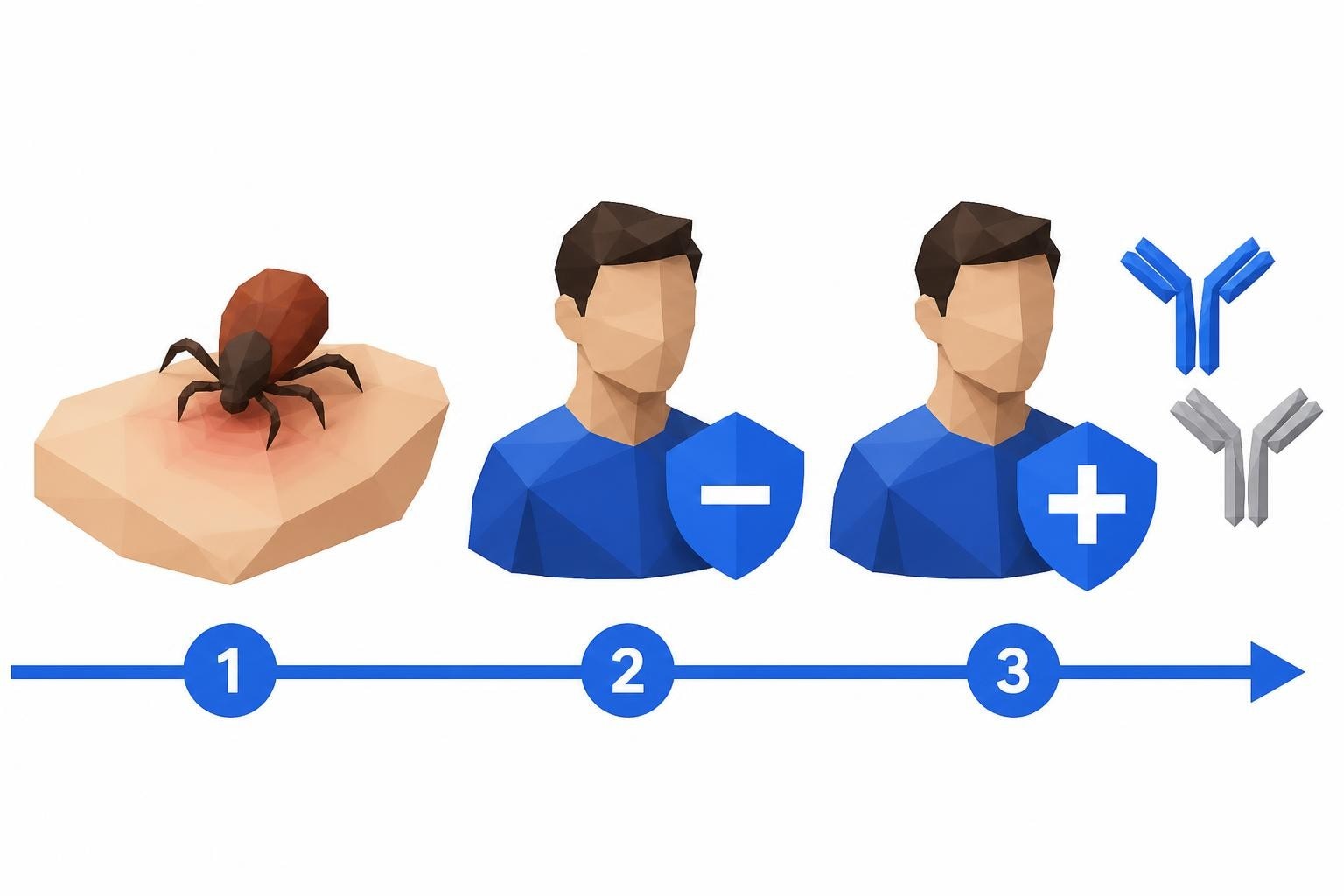
Understanding when to get tested for Lyme disease after discovering a tick bite can be confusing, especially when you're concerned about infection. The timing of a lyme disease blood test when after bite matters significantly because your body needs time to produce detectable antibodies, and testing too early often leads to false negative results that provide false reassurance.
Big picture
- Antibody tests need time to work: Blood tests for Lyme disease detect antibodies your immune system produces in response to the bacteria, not the bacteria itself, which means testing immediately after a tick bite is almost always negative even if you're infected.
- The 4-6 week window is critical: Most people don't develop detectable IgM antibodies until 3-6 weeks after infection, so a lyme disease blood test when after bite should typically wait at least 4 weeks for meaningful results.
- Symptoms matter more than test timing: If you develop the characteristic bull's-eye rash (erythema migrans) or other early Lyme symptoms, treatment should begin immediately based on clinical signs rather than waiting for blood test confirmation.
- Not everyone needs testing: According to clinical guidelines on when to test for Lyme disease, asymptomatic individuals who simply found a tick should not routinely be tested, as the pre-test probability is low and false positives become problematic.
- Two-tier testing is standard: The recommended approach uses an initial ELISA screening followed by Western blot confirmation, which improves accuracy but requires understanding the timeline of antibody development.
- Take action if you're in an endemic area: If you live in or visited a region with high Lyme prevalence and found an attached tick, photograph the tick, document the bite location, and monitor for symptoms over the following month.
Understanding the Immune Response Timeline
When considering a lyme disease blood test when after bite, you must first understand how your immune system responds to Borrelia burgdorferi, the bacterium that causes Lyme disease. The infection doesn't trigger immediate antibody production-your body needs time to recognize the foreign invader and mount a response.
The Antibody Development Process
The immune response to Borrelia infection follows a predictable pattern that directly impacts test accuracy. Initially, the bacteria multiply in your skin at the bite site, spreading slowly through surrounding tissue. During this early phase, which can last two to three weeks, antibody levels remain below the detection threshold of standard blood tests.
IgM antibodies typically appear first, usually becoming detectable around 3-4 weeks post-infection:
- These are the body's initial "first responder" antibodies
- Peak concentration occurs at 4-6 weeks after the bite
- Can persist for months even after successful treatment
- May cause false positives in some non-Lyme infections
IgG antibodies develop more slowly but provide longer-lasting immunity:
- Usually become detectable at 4-6 weeks post-infection
- Continue rising for several weeks to months
- Remain elevated indefinitely in many treated patients
- Indicate established or past infection
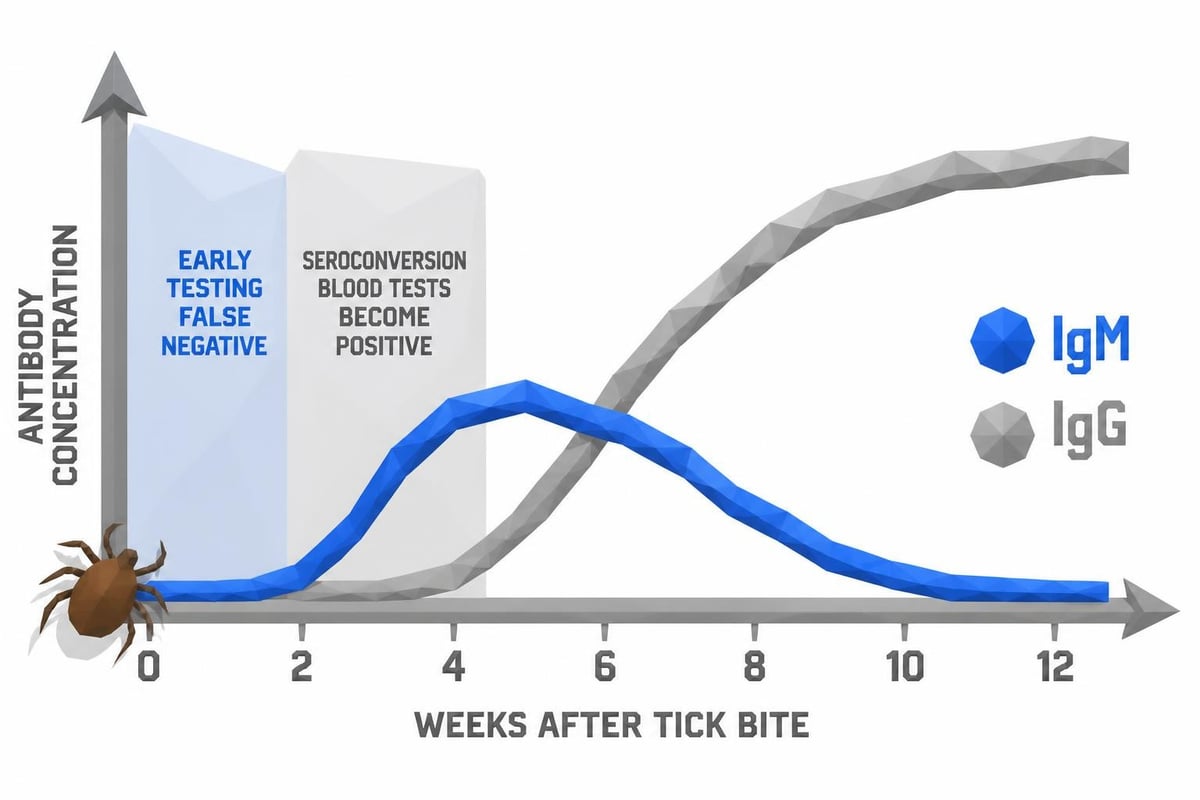
This timeline explains why a lyme disease blood test when after bite should wait a minimum of 4 weeks to avoid false negative results. Testing at one or two weeks post-bite provides virtually no useful information and may create dangerous false reassurance.
When Blood Testing Makes Sense
Not every tick bite warrants laboratory testing. Understanding the appropriate scenarios for ordering a lyme disease blood test when after bite helps avoid unnecessary costs and false results.
Situations Where Testing Is Recommended
| Scenario | Testing Recommendation | Timing |
|---|---|---|
| Erythema migrans rash present | Treatment without testing | Immediate (clinical diagnosis) |
| Flu-like symptoms 1-4 weeks post-bite | ELISA screening | At symptom onset |
| Neurologic or cardiac symptoms | Two-tier testing plus specific antibody testing | Immediate |
| Arthritis 2+ months post-bite | Two-tier serology | At presentation |
| Asymptomatic, tick removed <36 hours | No testing recommended | N/A |
| Asymptomatic, tick attached >36 hours in endemic area | Consider testing if concerned | 4-6 weeks post-bite |
The IDSA guidelines on Lyme disease diagnosis emphasize that testing should be reserved for patients with compatible clinical findings or significant exposure risk. Testing low-probability cases leads to more false positives than true positives, creating unnecessary anxiety and inappropriate antibiotic use.
When NOT to Test
Several situations don't warrant immediate blood testing:
- Finding a tick that was attached for less than 24-36 hours
- Living in a non-endemic area with minimal Lyme prevalence
- Having no symptoms four weeks after tick removal
- Routine screening without exposure history
- Immediate testing within days of a tick bite
These scenarios either carry minimal infection risk or fall outside the window where antibody testing provides reliable information. For those who order labs without insurance, understanding when testing adds value versus when it wastes resources becomes especially important.
The Two-Tier Testing Protocol
When you do proceed with a lyme disease blood test when after bite, understanding the standard testing protocol helps you interpret your results and plan next steps.
First Tier: ELISA or Immunofluorescence Assay
The initial screening test uses enzyme immunoassay (EIA/ELISA) or immunofluorescence assay (IFA) to detect antibodies against Lyme disease bacteria. This highly sensitive test casts a wide net to avoid missing infections.
Advantages of first-tier testing:
- High sensitivity (few false negatives in established infection)
- Relatively affordable and widely available
- Quick turnaround time (often 24-48 hours)
- Good negative predictive value when timing is appropriate
Limitations to understand:
- Lower specificity (more false positives, especially in low-prevalence populations)
- Cannot distinguish active from past infection
- May cross-react with other spirochetal infections
- Negative results in early disease (<4 weeks)
If your first-tier test comes back negative and you tested at least 4-6 weeks post-bite, Lyme disease is unlikely. However, if symptoms developed recently or you tested within the first month of exposure, the NICE guidelines recommend repeating ELISA testing after the appropriate interval has passed.
Second Tier: Western Blot Confirmation
Positive or equivocal ELISA results require confirmation with Western blot (immunoblot) testing. This more specific test identifies antibodies against individual Borrelia proteins, reducing false positives.
The Western blot uses strict interpretation criteria based on the number and identity of antibody bands present. For a positive result, you need:
IgM Western blot (for early infection):
- At least 2 of 3 specific bands (23, 39, 41 kDa)
- Only interpreted if symptoms present <30 days
- Higher false positive rate than IgG
IgG Western blot (for established infection):
- At least 5 of 10 specific bands
- More reliable indicator of true infection
- Becomes positive 4-8 weeks after infection
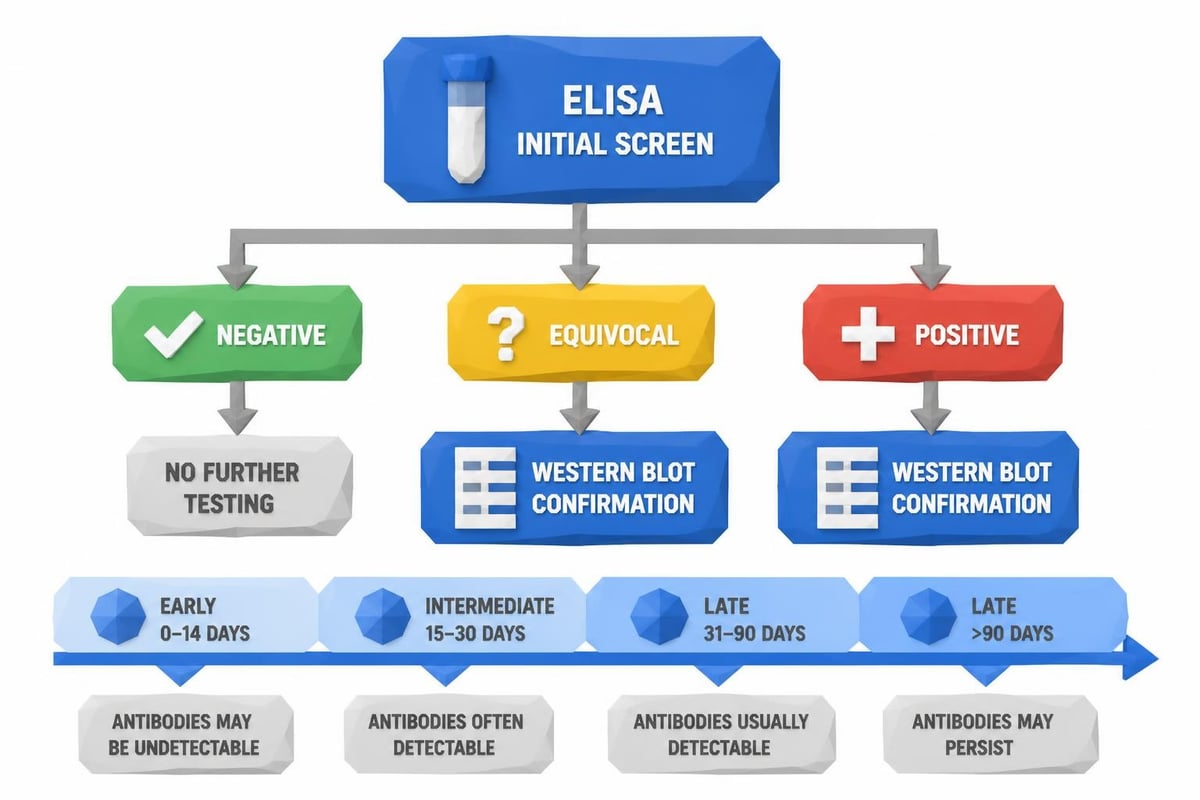
The APHL guidance on Lyme serologic testing provides technical details on these interpretation criteria and emphasizes that laboratories must use FDA-cleared tests validated for two-tier testing protocols. Understanding this process helps you evaluate whether a testing service offers legitimate, guideline-concordant Lyme testing.
Alternative and Emerging Testing Methods
While two-tier serology remains the diagnostic standard, researchers continue developing methods to address the limitations of a lyme disease blood test when after bite timing creates challenges.
Modified Two-Tier Testing (MTTT)
This newer approach replaces the Western blot with a second, different immunoassay. The laboratory diagnosis guidelines for infectious diseases note that MTTT offers comparable sensitivity and specificity to conventional two-tier testing with several advantages:
- Faster results (no manual Western blot reading)
- Better standardization between laboratories
- Reduced interpretation variability
- Equivalent or improved accuracy
However, MTTT doesn't solve the fundamental timing problem. Like conventional serology, it requires sufficient time for antibody development and produces negative results in early infection.
Tests That Don't Work
Several non-standard tests are marketed for Lyme disease but lack scientific validation:
- Urine antigen tests (not validated or recommended)
- CD57 counts (no proven role in diagnosis)
- "Lyme-specific" PCR on blood (very low sensitivity)
- IgM or IgG Western blots alone (requires two-tier approach)
- Tests from non-certified laboratories
Stick with established two-tier testing from certified laboratories. Services that explain how lab testing works should clearly describe their testing methodology and use standard, validated assays.
Timing Strategies for Different Scenarios
The optimal timing for a lyme disease blood test when after bite varies based on your specific situation and symptoms.
Strategy 1: Asymptomatic with Known Tick Bite
If you removed a tick but feel fine:
- Document the bite date, tick appearance (if you saved it), and attachment duration
- Monitor for symptoms for 30 days (particularly the characteristic rash)
- If you develop fever, fatigue, headache, or joint pain, seek medical evaluation immediately
- If you remain asymptomatic but want testing for peace of mind, wait 4-6 weeks from the bite date
- One negative test at 6+ weeks post-bite effectively rules out infection in asymptomatic individuals
Strategy 2: Early Symptoms Without Rash
For flu-like illness 1-4 weeks after tick exposure without the characteristic rash:
- Initial testing may be appropriate but could be negative if performed <4 weeks post-bite
- Clinical judgment may support empiric treatment before test results return
- If initial test is negative but symptoms persist, repeat testing at 4-6 weeks post-exposure
- Document all symptoms as clinical context influences interpretation
Strategy 3: Erythema Migrans Present
The bull's-eye rash is pathognomonic (uniquely characteristic) of Lyme disease:
- Begin antibiotic treatment immediately-don't wait for testing
- Testing is optional and may be negative in early infection
- Treatment success doesn't depend on positive serology
- Testing may help document infection for medical records but shouldn't delay therapy
Strategy 4: Late-Stage Symptoms
For arthritis, neurologic symptoms, or cardiac involvement weeks to months after potential exposure:
- Two-tier serology at presentation (no need to delay)
- Very high sensitivity at this stage (antibodies well-developed)
- Additional testing (CSF analysis, cardiac evaluation) may be needed
- Nearly all patients with late Lyme disease have positive IgG antibodies
Interpreting Your Results
Once you receive results from a lyme disease blood test when after bite, understanding what they mean in the context of timing and symptoms is crucial.
Understanding Negative Results
| Time Since Bite | Negative Result Interpretation |
|---|---|
| <2 weeks | Expected-too early for antibodies; doesn't rule out infection |
| 2-4 weeks | Possible false negative; repeat at 6 weeks if concern persists |
| 4-6 weeks | Increasingly reliable; infection less likely but not impossible |
| >6 weeks (no symptoms) | Very reassuring; infection unlikely |
| >6 weeks (with compatible symptoms) | Consider repeat testing, alternative diagnoses, or specialist consultation |
A negative test doesn't guarantee you're infection-free if tested too early. This is why symptom monitoring remains critical regardless of test results.
Understanding Positive Results
Positive two-tier testing (positive ELISA confirmed by positive Western blot) indicates:
- Antibody response to Borrelia burgdorferi exposure
- Possible current infection requiring treatment
- OR past infection (antibodies persist indefinitely)
Determining whether positive serology represents active versus past infection requires clinical correlation. The presence of compatible symptoms suggests active disease, while positive serology in an asymptomatic individual likely represents past exposure.
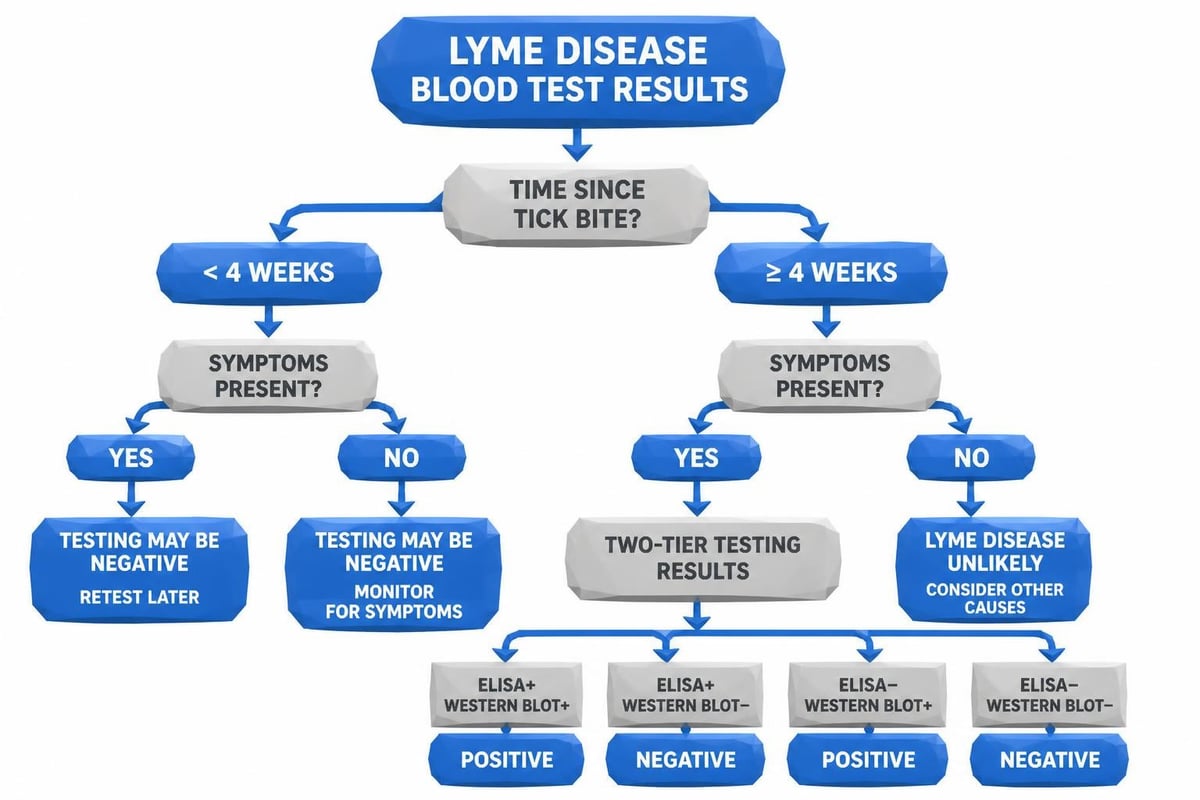
Understanding these nuances is part of what makes interpreting lab results challenging without clinical context. While direct-access testing provides convenience, discussing results with a healthcare provider ensures proper interpretation.
Common Testing Mistakes to Avoid
When planning a lyme disease blood test when after bite, avoid these frequent errors that lead to confusion and misdiagnosis.
Testing Too Early
The most common mistake is testing within days or the first 2-3 weeks after tick removal. This virtually guarantees a negative result regardless of infection status, providing false reassurance that may delay diagnosis when symptoms later develop.
Treating Negative Results as Absolute
Negative serology doesn't exclude Lyme disease if:
- Testing occurred before antibody development
- The patient has erythema migrans (clinical diagnosis trumps serology)
- Symptoms are consistent despite negative testing
- Early antibiotic treatment suppressed antibody response
Over-Testing After Treatment
Successfully treated Lyme disease leaves you with persistent antibodies, sometimes for life. Testing weeks or months after completing antibiotics provides no useful information-positive serology is expected and doesn't indicate treatment failure or ongoing infection.
Using Non-Standard Tests
Unvalidated tests from non-certified laboratories waste money and generate unreliable results. Stick with two-tier testing from CLIA-certified laboratories. Services offering transparent lab test pricing should clearly specify their testing methodology and laboratory certifications.
Ignoring Clinical Context
Blood tests supplement but don't replace clinical evaluation. The characteristic rash, exposure history, symptom pattern, and physical examination findings all contribute to diagnosis. A skilled clinician integrates test results with clinical data rather than treating laboratory values in isolation.
Geographic and Seasonal Considerations
Your location significantly impacts both Lyme disease risk and testing decisions. In 2026, Lyme disease remains concentrated in specific geographic regions, though its range continues to expand.
High-prevalence regions in the United States include:
- Northeast corridor (Maine through Maryland)
- Upper Midwest (Wisconsin, Minnesota)
- Northern California and Oregon coast
- Expanding areas of the Mid-Atlantic and Southeast
If you live in or visited these areas during tick season (April through September), the pre-test probability of infection after tick bite is higher, potentially justifying testing even without symptoms. Conversely, tick exposure in low-prevalence regions generally doesn't warrant testing without clinical signs.
Seasonal timing also matters. Nymphal ticks (most responsible for human infection) are most active in late spring and early summer. An adult deer tick found in winter carries lower transmission risk than a nymphal tick in May or June.
Key Takeaways
Understanding when to pursue a lyme disease blood test when after bite requires balancing the timeline of antibody development, your risk factors, and the presence or absence of symptoms. Testing too early produces falsely negative results that provide dangerous reassurance, while testing at the appropriate 4-6 week interval offers meaningful information.
Remember that the characteristic bull's-eye rash warrants immediate treatment without waiting for blood test confirmation. For asymptomatic individuals who simply found a tick, testing is often unnecessary-especially if the tick was removed within 24-36 hours or exposure occurred outside endemic regions.
When testing is appropriate, insist on standard two-tier serology from certified laboratories rather than unvalidated alternative tests. The combination of timing, clinical context, and proper test selection yields the most accurate diagnosis and guides appropriate treatment decisions.
FAQ
How long after a tick bite should I wait to get tested for Lyme disease?
Wait at least 4-6 weeks after the tick bite before getting a lyme disease blood test when after bite to allow sufficient time for antibody development. Testing earlier almost always produces false negative results because your immune system hasn't yet produced detectable levels of IgM or IgG antibodies against the Lyme bacteria.
Can a blood test detect Lyme disease immediately after a tick bite?
No, blood tests cannot detect Lyme disease immediately after a tick bite. The standard antibody tests require 3-6 weeks to become positive because they detect your immune response, not the bacteria itself. Testing in the first two weeks is essentially useless and may create false reassurance.
What should I do if my Lyme test is negative but I have symptoms?
If your Lyme test is negative but you have compatible symptoms, consider the timing of your test-if you tested within the first month after exposure, repeat testing at 6 weeks post-bite. If you have the characteristic bull's-eye rash, treatment should begin immediately regardless of test results since this rash is diagnostic of Lyme disease.
Do I need to get tested if I found a tick on my skin?
Not necessarily. If you removed the tick within 24-36 hours, transmission is unlikely and testing isn't recommended. In endemic areas with prolonged tick attachment, you might choose to get tested at 4-6 weeks post-bite, but asymptomatic individuals without other risk factors generally don't need routine testing according to clinical guidelines.
How accurate are Lyme disease blood tests?
Two-tier testing (ELISA followed by Western blot) is highly accurate when performed at the appropriate time-at least 4-6 weeks after infection. Sensitivity exceeds 95% for late-stage disease but drops to 30-40% in the first few weeks. Specificity is excellent (>95%) with proper two-tier methodology, but false positives increase when testing low-risk populations.
Will antibiotics affect my Lyme disease blood test results?
If you take antibiotics very early in infection (within the first week or two), they may suppress or delay antibody development, potentially causing false negative blood tests. However, if you have clinical signs of Lyme disease, treatment shouldn't be delayed to ensure positive serology-protecting your health takes priority over laboratory confirmation.
Can I have Lyme disease with a negative blood test?
Yes, particularly if tested within the first 4 weeks after infection or if you have the characteristic erythema migrans rash. Early Lyme disease often produces negative serology, which is why clinical diagnosis based on the rash and exposure history is considered sufficient for starting treatment without waiting for positive blood tests.
Timing matters critically when considering a lyme disease blood test when after bite-testing too early wastes resources and provides false reassurance, while waiting 4-6 weeks yields reliable results that actually inform medical decisions. Clinical signs like the bull's-eye rash should prompt immediate treatment without waiting for laboratory confirmation. Whether you need convenient access to testing after the appropriate waiting period or want to understand your options without navigating insurance complexities, JustLabs provides transparent, affordable testing with results in 1-3 days, helping you make informed decisions about your health.