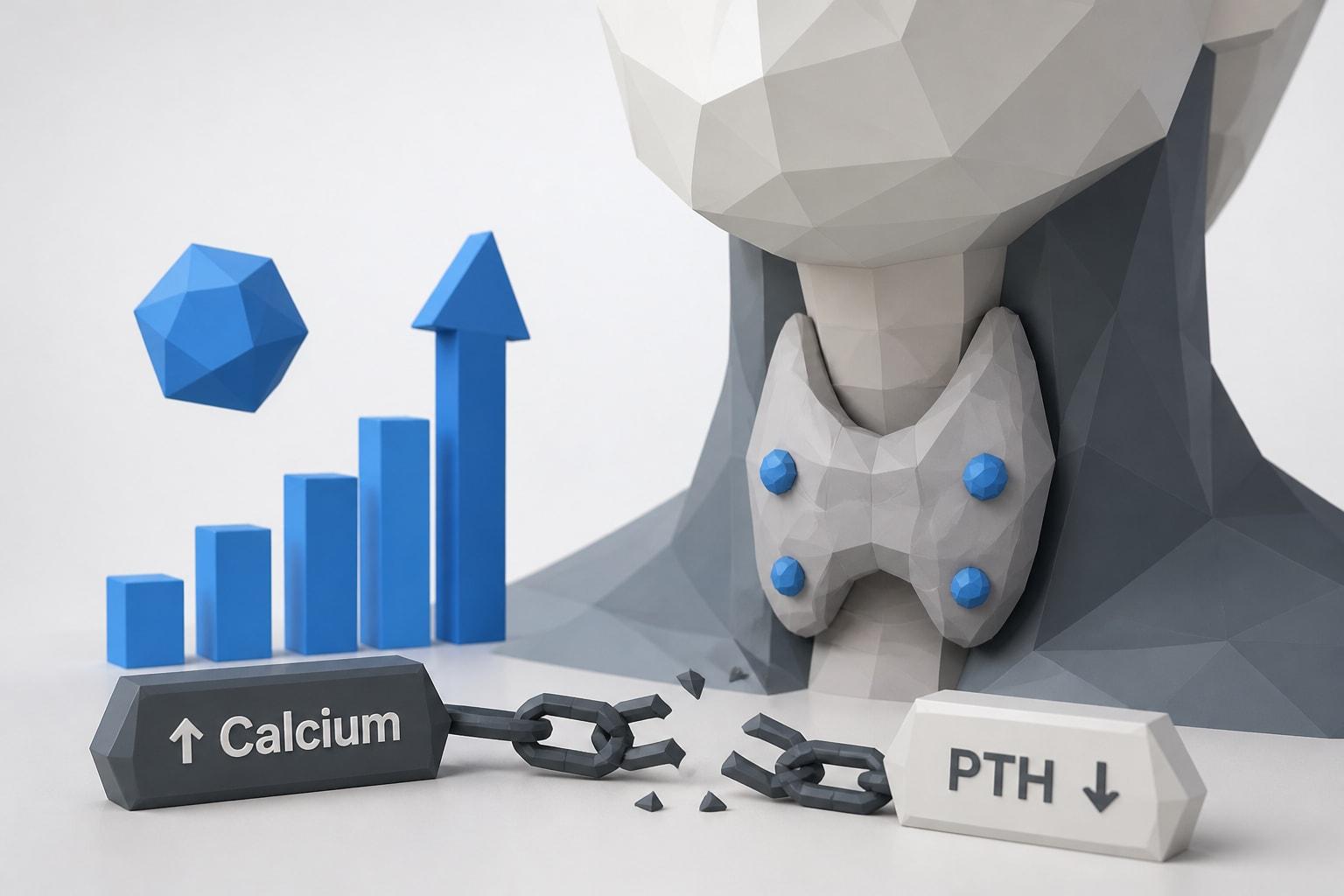
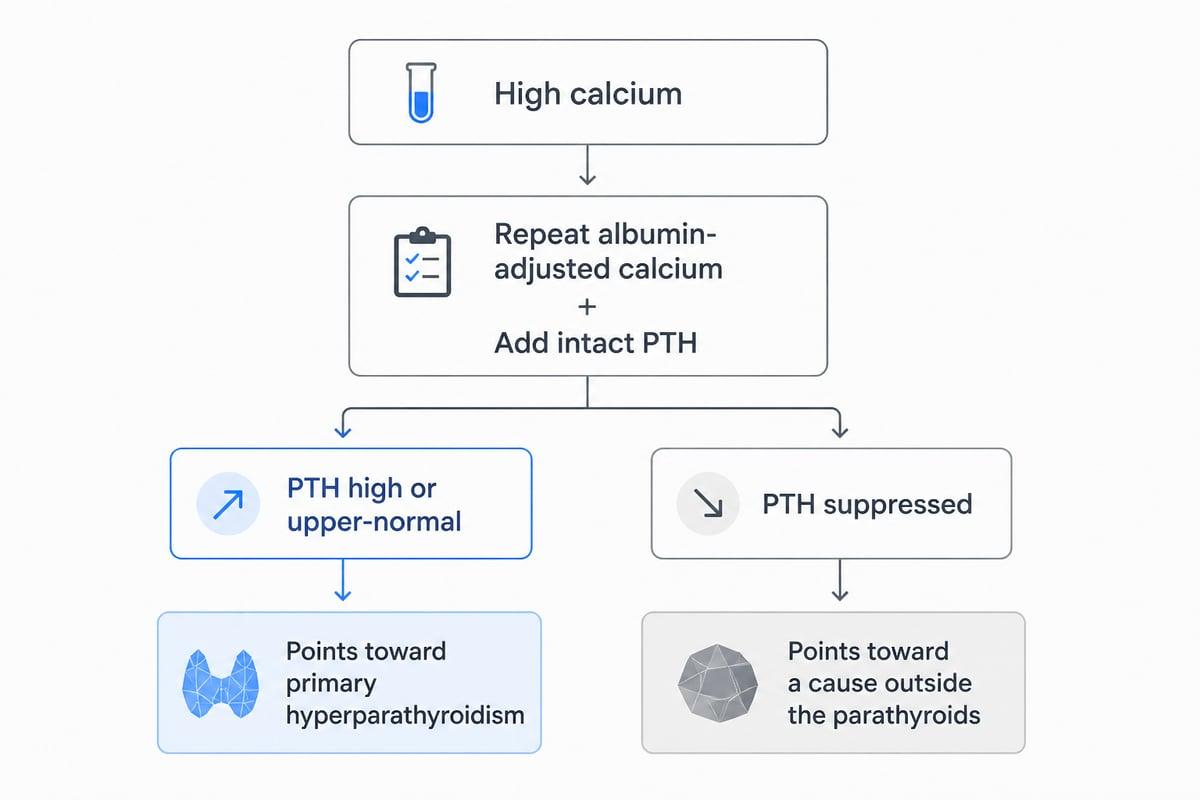
Suspect hyperparathyroidism when a repeated blood calcium result is high and parathyroid hormone (PTH) is elevated, or sits in the upper part of its reference range when high calcium should have suppressed it. That pairing is the core pattern that separates parathyroid disease from other causes of high calcium, and it is the reason knowing when to suspect hyperparathyroidism from high calcium and PTH results matters for anyone reviewing their own lab work.
Big picture
- What it is: Hyperparathyroidism means one or more parathyroid glands release too much PTH, which pushes calcium in the blood too high.
- Why it matters: Long-standing high calcium can affect bones, kidneys and energy, and often causes no obvious symptoms early on.
- Who it affects: It can occur at any adult age, and routine blood work is often how it is first noticed.
- One result is not a diagnosis: A single high calcium value does not confirm hyperparathyroidism. Repeat testing and the PTH result are what give the number meaning.
- Actionable next step: If a calcium result is high, repeat it and add an intact PTH test drawn at the same time, then bring both results to a clinician.
How do calcium and PTH normally work together?
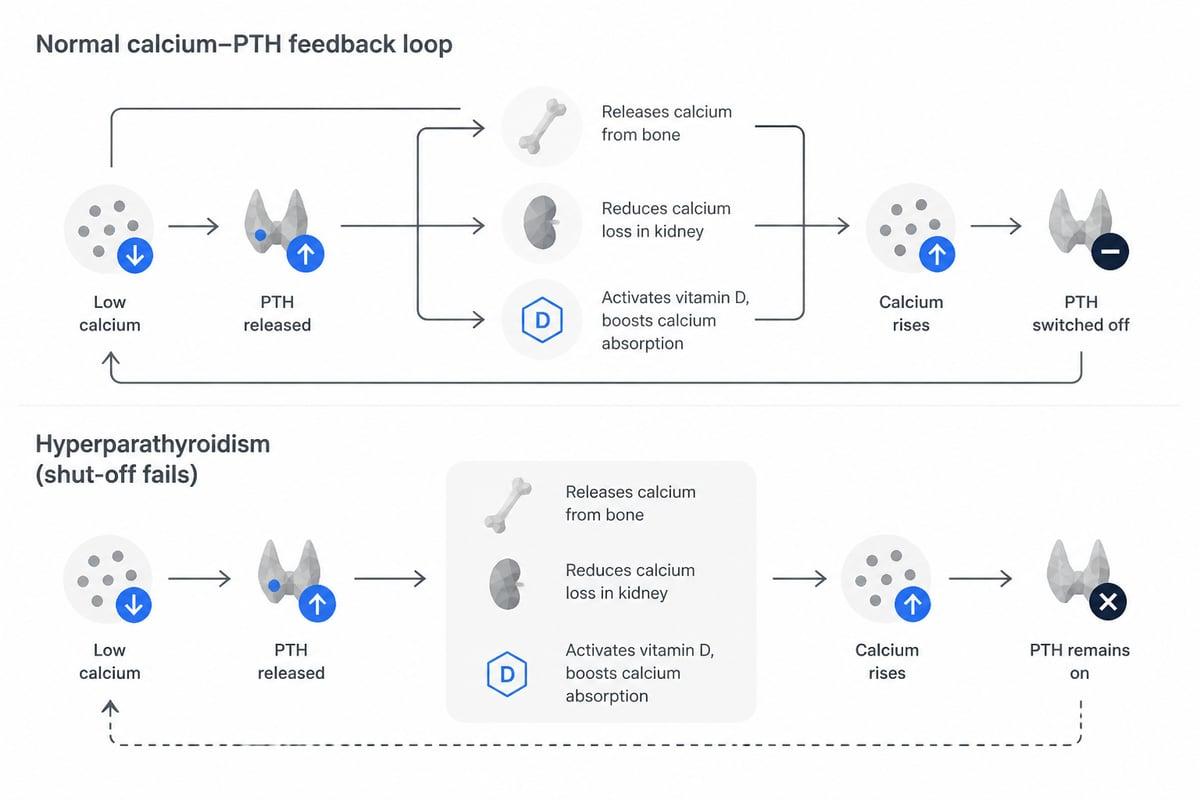
Calcium and PTH work as a feedback loop: when blood calcium drops, the parathyroid glands release PTH, and when calcium rises, PTH output should fall.
Four small parathyroid glands sit behind the thyroid in the neck. They sense calcium in the blood continuously. PTH raises calcium in three ways: it draws calcium out of bone, it reduces calcium lost in urine, and it signals the kidneys to activate vitamin D, which increases calcium absorbed from food.
In a healthy person, a high calcium level shuts PTH down to a low or low-normal value. That suppression is the key idea behind everything that follows. When PTH stays active despite high calcium, the feedback loop is no longer working properly.
Where do phosphorus, vitamin D and the kidneys fit in?
Phosphorus, vitamin D and kidney function all influence PTH, which is why they are interpreted alongside calcium rather than separately.
- Phosphorus: PTH makes the kidneys excrete more phosphorus. In primary hyperparathyroidism, phosphorus is often low or low-normal. In kidney disease, phosphorus tends to rise.
- Vitamin D: The kidneys convert vitamin D into its active form. Low vitamin D reduces calcium absorption, and the parathyroid glands respond by releasing more PTH.
- Kidney function: Healthy kidneys activate vitamin D and clear phosphorus. When they weaken, calcium can fall, phosphorus can rise and PTH climbs to compensate.
These relationships explain why a PTH value alone is hard to read. An elevated PTH might reflect a gland problem, a vitamin D shortfall or reduced kidney function, and the accompanying calcium level helps sort out which one.
What blood pattern should raise suspicion?
The pattern that should raise suspicion is a high calcium level paired with a PTH that is elevated or inappropriately normal.
According to the NIDDK, primary hyperparathyroidism is suspected when blood calcium is high and PTH is elevated, or remains in the upper part of its reference range when high calcium should suppress it. The second scenario is easy to misread. A PTH that looks reassuring on its own may still be inappropriate when calcium is high, because it is not being suppressed as it should be.
Typical patterns look like this:
| Calcium | PTH | Phosphorus | What it may suggest |
|---|---|---|---|
| High | High or upper-normal | Low or low-normal | Primary hyperparathyroidism |
| High | Low or suppressed | Variable | Cause outside the parathyroids |
| Low or normal | High | Often high | Secondary hyperparathyroidism |
This table is a pattern guide, not a diagnostic tool. Interpretation depends on the full clinical picture, which only a clinician can assess.
How many high calcium readings are enough to act on?
Repeat testing is the standard before drawing conclusions, because one elevated calcium reading can come from dehydration, a lab variation or a blood draw taken after a long tourniquet time.
The NICE guideline, published through the National Center for Biotechnology Information, recommends repeating albumin-adjusted calcium at least once if the first result is 2.6 mmol/L or higher, or 2.5 mmol/L or higher when features of primary hyperparathyroidism are present. It further recommends measuring PTH alongside calcium when albumin-adjusted calcium is at or above those thresholds on at least two occasions.
Albumin matters because roughly half of blood calcium travels attached to this protein. A low albumin can make total calcium look lower than it is, and a high albumin can do the opposite. Many results report an adjusted value for this reason.
These thresholds are in mmol/L, the unit used in the NICE guideline. Many U.S. laboratories report calcium in mg/dL, so compare your result against the reference range printed on your own report rather than converting by hand.
What symptoms and findings point toward hyperparathyroidism?
Symptoms are often mild or absent, so the lab pattern frequently comes first, but certain clues strengthen suspicion once calcium and PTH are both out of range.
Clues that clinicians commonly associate with prolonged high calcium include:
- Kidney stones
- Bone thinning or fractures
- Fatigue, low mood or difficulty concentrating
- Frequent urination and excessive thirst
- Constipation or abdominal discomfort
- Muscle weakness or aching
None of these is specific. Each has many other explanations, which is why the combination of laboratory pattern and repeat confirmation carries more weight than any symptom list. If you experience severe symptoms such as confusion, intense abdominal pain or heart palpitations alongside a high calcium result, seek medical care promptly rather than waiting on further self-ordered testing.
What is the difference between primary and secondary hyperparathyroidism?
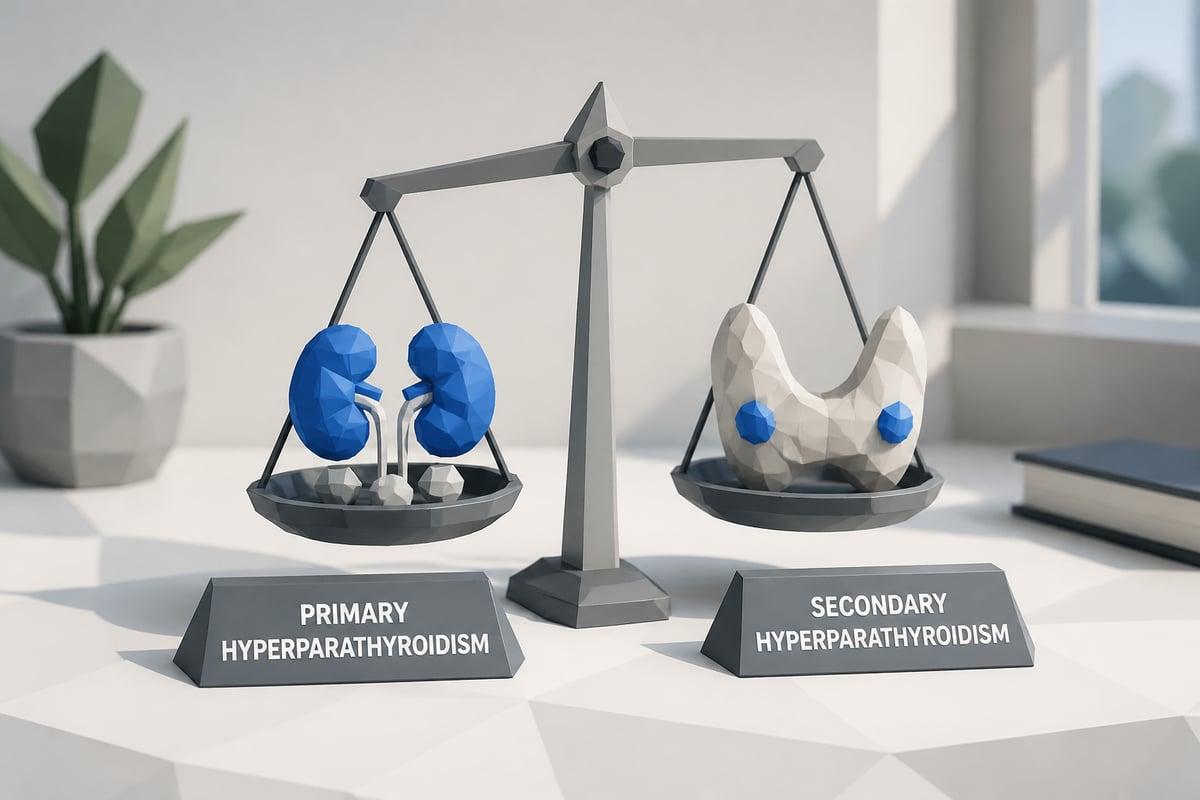
Primary hyperparathyroidism is a problem in the parathyroid glands themselves, while secondary hyperparathyroidism is a normal gland responding to something else that lowers calcium.
Primary hyperparathyroidism: One or more glands produce PTH regardless of calcium level. Calcium is high, PTH is high or inappropriately normal, and phosphorus is often low-normal to low. The most common cause is a benign enlarged gland, called an adenoma.
Secondary hyperparathyroidism: The glands are reacting appropriately to low calcium, vitamin D deficiency or kidney disease. PTH is high, but calcium is low or normal, not high. Correcting the underlying cause often brings PTH down.
A third, less common situation called tertiary hyperparathyroidism can develop after long-standing secondary disease, when the glands become autonomous and calcium turns high. It is mostly seen in people with advanced kidney disease and is managed by specialists.
The practical distinction for someone reading their own results is the calcium value. High calcium with high PTH points toward primary disease. High PTH with low or normal calcium points toward a secondary cause, and vitamin D and kidney tests become the priority.
When suspect hyperparathyroidism high calcium and PTH results call for more testing
When you suspect hyperparathyroidism because calcium and PTH are both abnormal, the next layer of testing focuses on ruling out look-alikes and checking for effects on the kidneys and bones.
A sensible follow-up set usually includes:
- Repeat albumin-adjusted calcium to confirm the elevation is persistent.
- Intact PTH drawn with calcium at the same time, so the two values can be read together.
- Vitamin D (25-hydroxy): Low vitamin D can raise PTH and complicate interpretation.
- Phosphorus: Low or low-normal supports primary disease; high suggests kidney involvement.
- Creatinine and eGFR: These show how well the kidneys are filtering, which affects how PTH is interpreted.
- 24-hour urine calcium and creatinine: The NIDDK notes this collection can help distinguish primary hyperparathyroidism from hyperparathyroidism related to kidney disorders.
A related consideration is that familial conditions can mimic primary disease, so a clinician may ask about family history of high calcium. Imaging of the neck and bone density testing generally come after the biochemical picture is established, and these steps need a clinician's direction.
Which other conditions can cause high calcium?
Several conditions besides parathyroid disease can raise calcium, and the PTH result is what helps separate them.
When calcium is high and PTH is suppressed (low or undetectable), the cause usually lies outside the parathyroid glands. Possibilities include certain cancers, excess vitamin D or vitamin A, high-dose calcium supplementation, some medications such as thiazide diuretics or lithium, and prolonged immobility. Because the body is correctly shutting PTH down, the glands are doing their job and the search shifts elsewhere.
This is also why testing PTH alongside calcium is more informative than either test alone. The same calcium number can mean very different things depending on the hormone value next to it.
How can you order the relevant blood tests yourself?
You can order the key tests directly online if you are paying out of pocket and want results before or alongside a clinician visit.
JustLabs offers a PTH Intact and Calcium test that pairs the two values from the same blood draw, which is the combination needed to read the feedback loop. Blood is drawn at any of 2,200+ Quest Diagnostics locations nationwide, and results are delivered securely online, generally within 1-3 business days, with values shown against reference ranges.
Because thyroid and parathyroid conditions are sometimes investigated together, some people also check thyroid function when they review neck-related hormone results. The TSH Blood Test is a common starting test when thyroid problems are suspected, and it can help separate thyroid symptoms such as fatigue from parathyroid ones.
Recommended Test
TSH (Thyroid Stimulating Hormone)
The TSH test is the gold standard for evaluating thyroid function. It's the first test doctors order when thyroid problems are suspected.
Includes 1 biomarkers
$7.50
Two cautions apply. Self-ordered testing provides information, not a diagnosis, and it does not replace a clinician who can examine you, order imaging and decide on treatment. If calcium is markedly high or you feel unwell, seek medical care promptly.
How should you bring results to a clinician?
Bring a dated set of results so a clinician can see whether the calcium elevation is persistent and how PTH relates to it.
Helpful items to organize before an appointment:
- Every calcium result you have, with dates and the lab's reference range
- PTH drawn at the same time as a calcium value
- Vitamin D, phosphorus and kidney function results if available
- A list of medications and supplements, especially calcium, vitamin D and diuretics
- Any history of kidney stones, fractures or relevant family history
Presenting results as a timeline turns a vague worry into a concrete clinical question: is calcium persistently high, and is PTH suppressed or not? That framing supports a faster, more focused evaluation.
Key takeaways
- Hyperparathyroidism is suspected when calcium is high and PTH is elevated or inappropriately normal.
- One high calcium result is not a diagnosis. Repeat testing is the standard first step.
- Phosphorus, vitamin D and kidney function change how PTH should be read.
- Primary disease shows high calcium; secondary disease shows low or normal calcium with high PTH.
- A suppressed PTH with high calcium points away from the parathyroid glands.
- Results are a starting point for a conversation with a clinician, who decides on imaging and treatment.
FAQ
What calcium and PTH combination suggests primary hyperparathyroidism?
High calcium with an elevated PTH, or a PTH in the upper part of the reference range, is the classic pattern. Low or low-normal phosphorus often accompanies it.
Can PTH be normal and still indicate hyperparathyroidism?
Yes. If calcium is high, a normal PTH can be inappropriate because it should have been suppressed. Reading the two values together is what reveals this.
Does one high calcium result mean I have hyperparathyroidism?
No. Dehydration, lab variation and albumin levels can all affect a single result. Guidelines such as NICE recommend repeating the measurement before drawing conclusions.
Why does vitamin D matter for PTH results?
Low vitamin D reduces calcium absorption, and the parathyroid glands respond by raising PTH. That elevation is a normal response, not necessarily a gland disorder, so vitamin D context is important.
How is secondary hyperparathyroidism different?
PTH is high because something else is lowering calcium, such as vitamin D deficiency or kidney disease. Calcium is typically low or normal, not high.
Should I test calcium and PTH at the same time?
Yes. Drawing them together lets the two values be interpreted as a pair, which is the basis for recognizing an inappropriate PTH response.
When should I seek urgent care instead of ordering tests?
Severe symptoms such as confusion, intense abdominal pain, heart palpitations or marked weakness alongside high calcium need prompt medical attention. Self-ordered testing is not a substitute for emergency care.
If you have a high calcium result, your next step is to repeat it alongside intact PTH from the same draw, then share the dated results with a clinician. JustLabs lets self-pay adults order the PTH Intact and Calcium test online without insurance or a doctor visit, with a blood draw at a nearby Quest Diagnostics location. If you also want to look at thyroid function, the TSH Blood Test is available too, and you can use JustLabs to browse tests and compare transparent cash prices before you order.