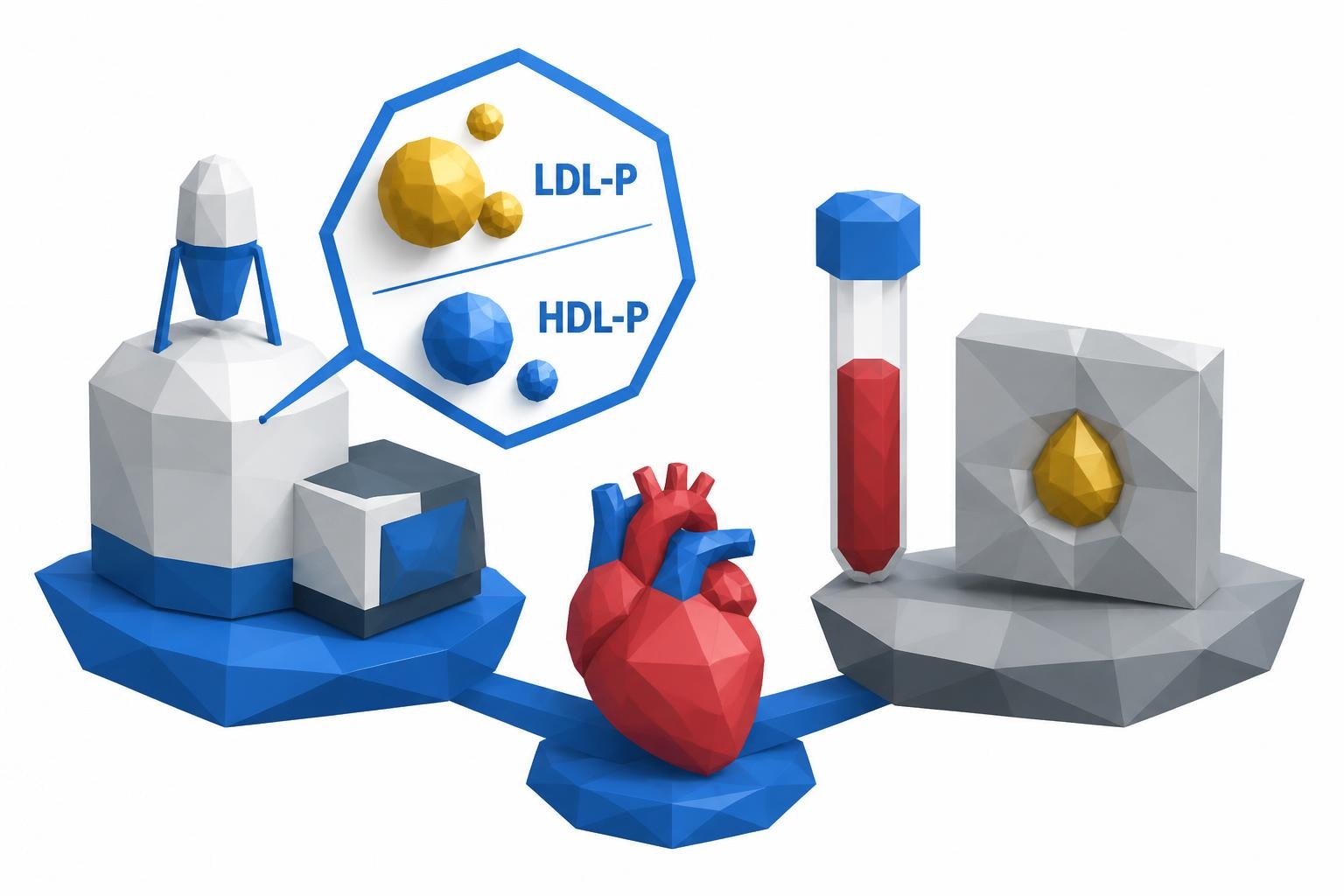
Understanding your cardiovascular health goes beyond knowing your total cholesterol number. Advanced testing methods now measure not just the amount of cholesterol you carry, but the number of particles transporting that cholesterol through your bloodstream. This distinction can reveal critical information about your actual heart disease risk that traditional cholesterol tests might miss entirely.
Big picture
- What it measures: The nmr lipoprofile cholesterol particle count uses nuclear magnetic resonance technology to count and size individual lipoprotein particles in your blood, rather than just measuring cholesterol concentration
- Why it matters: Two people with identical LDL cholesterol levels can have vastly different cardiovascular risk based on whether that cholesterol is carried in many small particles or fewer large ones
- Key difference from standard tests: Traditional lipid panels measure cholesterol concentration in milligrams per deciliter, while NMR counts actual particles and measures their size distribution
- Who should consider it: People with diabetes, metabolic syndrome, family history of early heart disease, or discordant cholesterol and triglyceride values may benefit most from particle count testing
- Actionable step: Discuss with your healthcare provider whether advanced lipoprotein testing could provide additional insights beyond your standard lipid panel results
Understanding Lipoprotein Particles Versus Cholesterol Concentration
Traditional cholesterol testing measures the total amount of cholesterol contained within lipoproteins. The nmr lipoprofile cholesterol particle count takes a fundamentally different approach by counting individual particles and categorizing them by size.
Think of it this way: measuring cholesterol concentration tells you how much cargo is being transported, while particle counting tells you how many trucks are carrying that cargo. This distinction matters significantly for cardiovascular risk assessment.

Why Particle Count Reveals More About Risk
Research has demonstrated that particle number often predicts cardiovascular events more accurately than cholesterol concentration alone. According to research comparing NMR-measured lipoprotein particle profiles with standard measurements, particle counts can provide independent predictive value for cardiovascular disease.
The reason lies in basic biology. Atherosclerosis develops when lipoprotein particles become trapped in arterial walls. More particles means more opportunities for this process to occur, regardless of how much cholesterol each particle carries.
| Measurement Type | What It Shows | Clinical Application |
|---|---|---|
| Total Cholesterol | Combined cholesterol in all lipoproteins | General screening |
| LDL-C (calculated) | Cholesterol concentration in LDL particles | Standard risk assessment |
| LDL-P (particle count) | Actual number of LDL particles | Advanced risk stratification |
| Small LDL-P | Number of small, dense LDL particles | Metabolic syndrome evaluation |
People with insulin resistance, prediabetes, or metabolic syndrome often have small, dense LDL particles. These individuals might show normal or only moderately elevated LDL cholesterol on standard tests, but their nmr lipoprofile cholesterol particle count reveals significantly elevated particle numbers.
How Nuclear Magnetic Resonance Technology Works
Nuclear magnetic resonance spectroscopy analyzes blood samples by detecting signals from lipid molecules within lipoproteins. The technology can simultaneously measure particle concentrations and average particle sizes for multiple lipoprotein classes without requiring separation or extensive sample preparation.
The Technical Process
The NMR method exploits the fact that lipoprotein particles of different sizes emit distinct NMR signals. Laboratory technicians can identify and quantify particles based on their unique spectroscopic signatures.
This NMR spectroscopy approach measures particles directly rather than estimating them from cholesterol measurements. The process typically takes just minutes per sample and provides comprehensive lipoprotein subclass information.
Standard NMR lipoprofile testing measures:
- LDL particle number (LDL-P): Total count of all LDL particles
- LDL particle size: Average diameter of LDL particles
- Small LDL-P: Count of small, dense LDL particles
- HDL particle number (HDL-P): Total count of HDL particles
- HDL particle size: Average diameter of HDL particles
- VLDL and IDL particles: Very low-density and intermediate-density lipoprotein counts
The ability to measure these parameters simultaneously gives clinicians a detailed picture of lipoprotein metabolism that standard lipid panels cannot provide.
When Standard Lipid Panels May Not Tell the Whole Story
Many people receive reassuring results from traditional cholesterol tests only to develop cardiovascular disease later. This discordance occurs because standard panels have limitations in certain clinical situations.
Clinical Scenarios Where Particle Counting Adds Value
Discordant LDL-C and triglycerides: When someone has borderline LDL cholesterol but elevated triglycerides, their actual LDL particle count might be considerably higher than the calculated LDL cholesterol suggests. The nmr lipoprofile cholesterol particle count can reveal this hidden risk.
Treatment monitoring: Some individuals on statin therapy achieve significant reductions in LDL cholesterol concentration but maintain elevated particle counts. These patients may require additional or alternative therapies to adequately reduce cardiovascular risk.

Research from Washington University indicates that while NMR lipoprotein profiling provides additional information, it is not recommended for routine cardiovascular risk assessment in all patients. However, specific populations may benefit significantly from this advanced testing.
Populations That May Benefit Most
- Individuals with metabolic syndrome: This cluster of conditions (abdominal obesity, insulin resistance, hypertension, dyslipidemia) often features small, dense LDL particles
- People with diabetes or prediabetes: Diabetic dyslipidemia frequently involves elevated particle counts despite moderate cholesterol elevations
- Those with family history of premature cardiovascular disease: Genetic factors can influence particle size and number independent of cholesterol levels
- Patients with persistently elevated triglycerides: High triglycerides typically correlate with increased small LDL particle counts
Understanding these scenarios helps patients and providers decide when advanced testing beyond accessible lab testing options makes clinical sense.
Interpreting Your NMR Lipoprofile Results
Understanding what the numbers mean requires familiarity with reference ranges and risk categories. Unlike simple "high" or "low" classifications, particle count results exist on a continuum of risk.
LDL Particle Number Ranges
| LDL-P Level (nmol/L) | Risk Category | Clinical Interpretation |
|---|---|---|
| <1000 | Optimal | Lowest cardiovascular risk |
| 1000-1299 | Near optimal | Low to moderate risk |
| 1300-1599 | Borderline high | Moderate risk |
| 1600-2000 | High | High risk |
| >2000 | Very high | Very high cardiovascular risk |
Your nmr lipoprofile cholesterol particle count results will typically include both the total LDL-P and a breakdown showing how many of those particles are small versus large. A high proportion of small LDL particles increases risk even when total LDL-P is only moderately elevated.
Understanding HDL Particle Numbers
Higher HDL particle counts generally indicate better cardiovascular protection, though the relationship is complex. HDL-P values above 30 μmol/L are typically considered cardioprotective.
Interestingly, some people have high HDL cholesterol but low HDL particle counts. This pattern suggests they have fewer but very cholesterol-rich HDL particles, which may not provide the same protective benefits as a larger number of particles.
Cost Considerations and Access to Testing
Advanced lipoprotein testing typically costs more than standard lipid panels.
Recommended Test
Lipoprotein Fractionation (NMR)
Goes beyond standard cholesterol testing to measure the actual size and number of your LDL and HDL particles. Small, dense LDL particles are far more dangerous than large, fluffy ones.
Includes 5 biomarkers
$52
Fasting required
The nmr lipoprofile cholesterol particle count test generally ranges from $100 to $300 when ordered directly, though prices vary by laboratory and location.
Insurance coverage for NMR lipoprofile testing varies significantly. Many insurers cover the test only when specific clinical criteria are met, such as:
- Personal history of cardiovascular disease
- Strong family history of premature heart disease
- Metabolic syndrome or diabetes with suboptimal lipid control
- Discordant lipid values suggesting hidden risk
For those paying out of pocket, transparent lab test pricing makes budgeting for advanced testing more straightforward than navigating insurance pre-authorization processes.
Weighing Value Against Cost
Not everyone needs particle count testing. For many individuals, standard lipid panels combined with other risk factors (blood pressure, smoking status, diabetes, age) provide sufficient information for treatment decisions.
Consider advanced testing when:
- Standard tests show borderline values that leave treatment decisions uncertain
- You have metabolic syndrome or diabetes with concerning lipid patterns
- Your family history suggests genetic dyslipidemia
- Treatment monitoring requires more detailed information
The decision should involve discussion with a healthcare provider who can interpret results in the context of your complete clinical picture.
Recommended Panel
Advanced Heart Health Panel
Save $6Go beyond basic cholesterol testing. This advanced panel includes the markers cardiologists use to assess true cardiovascular risk: ApoB, Lp(a), homocysteine, and inflammation.
Includes 10 biomarkers
$86
Fasting required
Key takeaways
Advanced cardiovascular risk assessment through nmr lipoprofile cholesterol particle count testing provides insights that traditional cholesterol measurements cannot. By counting actual lipoprotein particles rather than just measuring cholesterol concentration, this technology reveals hidden risk in people with metabolic disorders, diabetes, and certain genetic lipid conditions. While not necessary for routine screening in all individuals, particle counting helps identify people whose standard cholesterol numbers underestimate their true cardiovascular risk. The test becomes particularly valuable when lipid values seem discordant, when metabolic syndrome is present, or when treatment decisions require more detailed lipoprotein information than conventional panels provide.
FAQ
What is the difference between LDL cholesterol and LDL particle number?
LDL cholesterol (LDL-C) measures the total mass of cholesterol carried within LDL particles, expressed in milligrams per deciliter. LDL particle number (LDL-P) counts the actual quantity of individual LDL particles in your blood, regardless of how much cholesterol each particle contains. You can have normal LDL-C but high LDL-P if you have many small, cholesterol-depleted particles. This scenario poses significant cardiovascular risk that standard cholesterol testing would miss.
How often should I get an NMR lipoprofile test?
Testing frequency depends on your cardiovascular risk profile and treatment status. For initial risk assessment in high-risk individuals, one baseline test provides valuable information. If you are on lipid-lowering therapy, retesting every 3-6 months initially helps assess treatment effectiveness. Once stable on therapy, annual testing may suffice. People with low cardiovascular risk and normal standard lipid panels typically do not need routine nmr lipoprofile cholesterol particle count testing. Discuss appropriate testing intervals with your healthcare provider based on your individual circumstances.
Can I improve my particle count through lifestyle changes?
Yes, several lifestyle modifications can reduce LDL particle counts and shift particle size distribution toward larger, less atherogenic particles. Weight loss, particularly reduction of visceral abdominal fat, often improves particle profiles significantly. Regular aerobic exercise increases HDL particle numbers while reducing small LDL particles. Carbohydrate restriction, especially limiting refined sugars and processed grains, can be particularly effective for people with insulin resistance. Increasing omega-3 fatty acid intake through fatty fish or supplements may favorably influence particle size. These changes often produce improvements within 8-12 weeks.
Does insurance typically cover NMR lipoprofile testing?
Insurance coverage varies widely among plans and depends on clinical indication. Many insurers require documentation of specific risk factors or clinical conditions before approving coverage. Common covered scenarios include established cardiovascular disease, family history of premature coronary disease, metabolic syndrome with abnormal lipids, or discordant lipid values requiring clarification. Some plans classify the test as investigational and deny coverage regardless of clinical circumstances. For individuals ordering labs without insurance, direct-pay pricing eliminates authorization delays and provides cost certainty upfront.
What should I do if my particle count is high but my cholesterol is normal?
Elevated particle counts despite normal cholesterol concentrations indicate discordance that requires attention. First, discuss results with your healthcare provider to confirm accuracy and clinical significance. Treatment typically focuses on addressing underlying causes like insulin resistance, obesity, or sedentary lifestyle. Dietary modifications emphasizing whole foods, healthy fats, and reduced refined carbohydrates often help. If lifestyle changes prove insufficient after 3-6 months, medication may be necessary. Statins reduce both cholesterol concentration and particle number. Additional agents like ezetimibe, PCSK9 inhibitors, or fibrates may be considered based on your complete lipid profile and risk factors.
Are there limitations to NMR lipoprofile testing?
While nmr lipoprofile cholesterol particle count testing provides valuable information, it has limitations. The test costs more than standard panels and may not be covered by insurance for routine screening. Measurement variability can occur between laboratories using different protocols or calibrations. Clinical outcome studies, while supportive, have not definitively proven that treating based on particle counts improves outcomes compared to treating based on standard measurements. The test provides a snapshot at one point in time and results can fluctuate based on recent diet, illness, or other factors. Most importantly, particle counts should inform but not replace comprehensive cardiovascular risk assessment that includes multiple factors beyond lipoproteins.
Understanding your lipoprotein particle profile provides a more complete picture of cardiovascular risk than traditional cholesterol measurements alone, particularly if you have metabolic conditions or family history of heart disease. When advanced testing makes sense for your situation, accessing comprehensive lab testing through Justlabs eliminates the complexity of insurance pre-authorization while providing transparent pricing and convenient access. With results typically available within 1-3 days, you can move quickly from testing to informed discussions with your healthcare provider about the most appropriate strategies for protecting your cardiovascular health.
Related Reading

References
Sniderman AD, Thanassoulis G, Glavinovic T, Navar AM, Pencina M, Catapano A, Ference BA. Apolipoprotein B Particles and Cardiovascular Disease: A Narrative Review. JAMA Cardiol. 2019 Dec 1;4(12):1287-1295. doi: 10.1001/jamacardio.2019.3780. PMID: 31642874. https://pubmed.ncbi.nlm.nih.gov/31642874/
Ference BA, Ginsberg HN, Graham I, Ray KK, Packard CJ, Bruckert E, Hegele RA, Krauss RM, Raal FJ, Schunkert H, Watts GF, Borén J, Fazio S, Horton JD, Masana L, Nicholls SJ, Nordestgaard BG, van de Sluis B, Taskinen MR, Tokgözoglu L, Landmesser U, Laufs U, Wiklund O, Stock JK, Chapman MJ, Catapano AL. Low-density lipoproteins cause atherosclerotic cardiovascular disease. 1. Evidence from genetic, epidemiologic, and clinical studies. A consensus statement from the European Atherosclerosis Society Consensus Panel. Eur Heart J. 2017 Aug 21;38(32):2459-2472. doi: 10.1093/eurheartj/ehx144. PMID: 28444290. https://pubmed.ncbi.nlm.nih.gov/28444290/
Qiao YN, Zou YL, Guo SD. Low-density lipoprotein particles in atherosclerosis. Front Physiol. 2022;13:931931. doi: 10.3389/fphys.2022.931931. PMID: 36111155. https://pubmed.ncbi.nlm.nih.gov/36111155/