
Celiac disease affects approximately 1 in 100 people worldwide, yet many cases remain undiagnosed due to testing limitations. One significant challenge in accurate celiac diagnosis involves immunoglobulin A (IgA) deficiency, which affects roughly 2-3% of individuals with celiac disease-a rate ten times higher than in the general population. Understanding iga deficiency and false negative celiac tests is critical for anyone experiencing unexplained digestive symptoms or pursuing a celiac disease diagnosis, as standard antibody screening may miss the condition entirely in affected individuals.
How Celiac Disease Testing Works
Standard celiac disease screening relies on measuring specific antibodies in the bloodstream. When someone with celiac disease consumes gluten, their immune system produces antibodies that attack both the gluten protein and the body's own tissues.
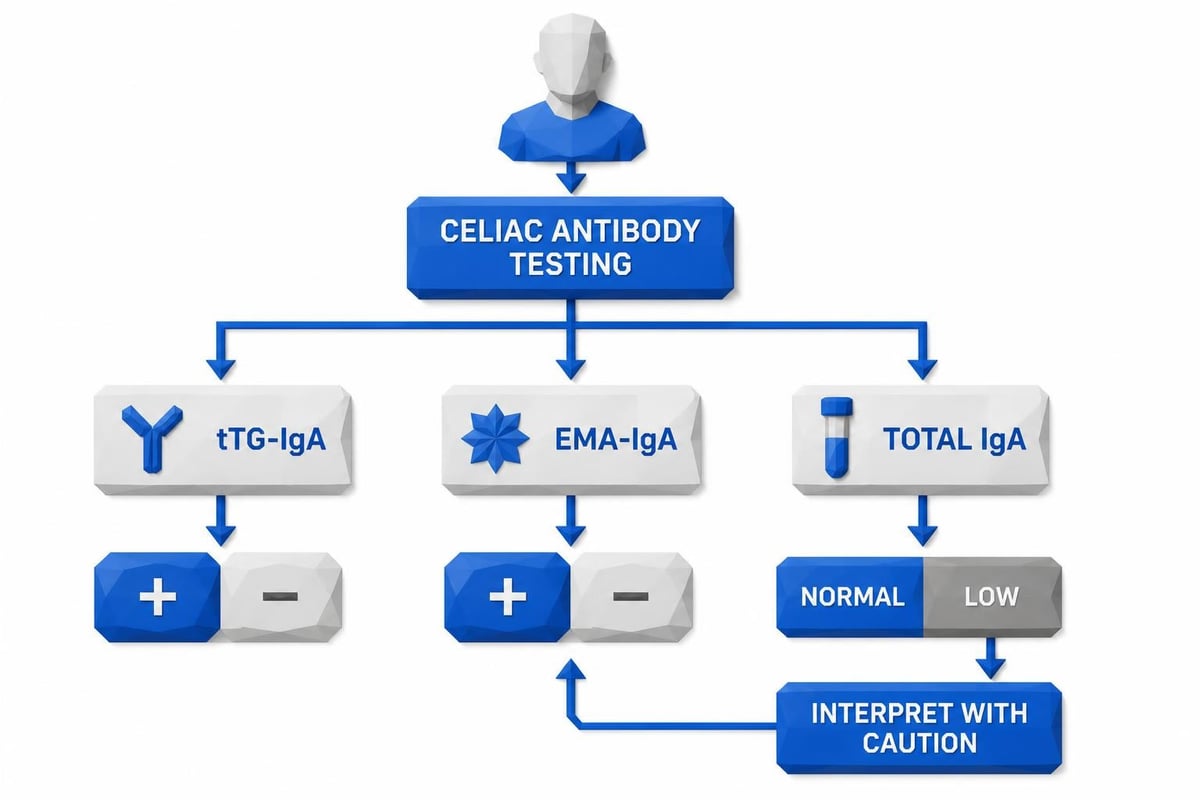
The most common celiac blood tests measure tissue transglutaminase antibodies (tTG-IgA) and endomysial antibodies (EMA-IgA). Both of these tests specifically detect IgA-class antibodies, which are the predominant immune response in celiac disease. Medical professionals prefer these tests because they demonstrate high sensitivity and specificity when patients have normal IgA production.
The Standard Celiac Testing Panel
A comprehensive celiac panel typically includes:
- Tissue transglutaminase IgA (tTG-IgA): The primary screening test
- Endomysial antibodies IgA (EMA-IgA): A confirmatory test with high specificity
- Deamidated gliadin peptide antibodies: Available in both IgA and IgG forms
- Total serum IgA: Essential for interpreting other results
Most laboratories perform these tests assuming the patient has normal immunoglobulin production. This clinical approach works well for the majority of patients but creates a critical blind spot for those with IgA deficiency.
Understanding IgA Deficiency
Immunoglobulin A represents one of five antibody classes the human immune system produces. It plays a crucial role in protecting mucosal surfaces, particularly in the digestive and respiratory tracts. When someone has IgA deficiency, their body produces little to no IgA antibodies.
Selective IgA deficiency is defined as serum IgA levels below 7 mg/dL with normal IgG and IgM levels. This condition occurs in approximately 1 in 300 to 1 in 700 people in the general population. However, research published in Clinical Chemistry demonstrates that IgA deficiency appears significantly more frequently among celiac disease patients.
Symptoms and Diagnosis of IgA Deficiency
Many individuals with IgA deficiency experience no symptoms and never receive a diagnosis. Others may have:
- Recurrent respiratory infections
- Increased susceptibility to gastrointestinal infections
- Higher rates of autoimmune diseases
- Allergic conditions
- Asthma or chronic sinusitis
The connection between IgA deficiency and autoimmune conditions explains the elevated prevalence in celiac disease populations. This immunological overlap creates a perfect storm for diagnostic challenges.
The False Negative Problem
The relationship between iga deficiency and false negative celiac tests creates a significant diagnostic gap. When patients with IgA deficiency undergo standard celiac screening, their test results will appear negative regardless of whether they actually have celiac disease.
This occurs because the tests measure IgA antibodies that these patients cannot produce. The tTG-IgA test will show negative results not because the patient lacks celiac disease, but because they cannot mount an IgA antibody response to tissue transglutaminase. Similarly, EMA-IgA tests will return negative results for the same reason.
| Test Type | Normal IgA Patient | IgA Deficient Patient |
|---|---|---|
| tTG-IgA | Accurate detection | Always negative |
| EMA-IgA | Accurate detection | Always negative |
| Total IgA | Normal range | Below 7 mg/dL |
| tTG-IgG | Less sensitive | Accurate detection |
| DGP-IgG | Less sensitive | Accurate detection |
The consequence is clear: without measuring total IgA levels, healthcare providers may incorrectly conclude that a patient does not have celiac disease when they actually do. Medical experts note that this represents one of the most common causes of missed celiac diagnoses.
Real-World Impact
Consider a patient experiencing chronic diarrhea, weight loss, and fatigue. Their physician orders a celiac panel, which returns negative for tTG-IgA. Without checking total IgA levels, the doctor moves on to investigate other conditions. The patient continues suffering from untreated celiac disease, potentially developing complications like osteoporosis, anemia, or intestinal damage.
This scenario plays out regularly in medical practices. The solution requires awareness of this limitation and systematic inclusion of total IgA measurement in every celiac screening panel.

Alternative Testing Strategies
When IgA deficiency is identified, alternative testing approaches become necessary. The most reliable method involves IgG-based antibody tests, which measure a different antibody class that IgA-deficient patients can produce normally.
IgG-Based Celiac Tests
The following IgG tests provide accurate results for IgA-deficient individuals:
- Tissue transglutaminase IgG (tTG-IgG): Measures IgG antibodies against the same tissue transglutaminase enzyme
- Deamidated gliadin peptide IgG (DGP-IgG): Detects IgG antibodies against modified gluten proteins
- Endomysial antibodies IgG (EMA-IgG): Less commonly performed but available
While IgG-based tests demonstrate slightly lower sensitivity and specificity compared to their IgA counterparts in the general population, they represent the gold standard for diagnosing celiac disease in IgA-deficient patients. Healthcare guidelines recommend these tests specifically for this population.
The Importance of Total IgA Measurement
Every celiac disease screening panel should include total serum IgA measurement. This single test determines whether the IgA-based antibody results are interpretable. When ordering labs without insurance, patients should specifically verify that total IgA is included in their panel.
Total IgA testing costs relatively little but provides enormous value. It functions as a quality control measure for the entire celiac screening process. Without it, the entire panel's reliability becomes questionable for approximately 1 in 300 patients.
Comprehensive Testing Through Direct-Access Labs
Modern lab testing services have evolved to address gaps in traditional healthcare delivery. Patients experiencing symptoms consistent with celiac disease can now access comprehensive testing panels without waiting for doctor appointments or dealing with insurance authorizations.
When investigating iga deficiency and false negative celiac tests, individuals benefit from ordering complete panels that include:
- Total serum IgA
- Tissue transglutaminase antibodies (both IgA and IgG)
- Deamidated gliadin peptide antibodies (both IgA and IgG)
- Complete blood count (to check for anemia)
- Comprehensive metabolic panel (to assess nutritional status)
Services like those available through ordering labs without a doctor enable proactive health management. Rather than undergoing incomplete screening and potentially receiving misleading results, patients can ensure comprehensive evaluation from the start.

Interpreting Your Results
Understanding test results requires careful consideration of all components together. A single test cannot provide the complete picture when evaluating for celiac disease, especially when IgA deficiency might be present.
Normal Total IgA Results
When total IgA falls within the normal range (typically 70-400 mg/dL), standard IgA-based antibody tests remain reliable. Negative tTG-IgA and EMA-IgA results strongly suggest the absence of celiac disease, assuming the patient has been consuming gluten regularly.
Positive results on IgA-based tests indicate likely celiac disease and warrant follow-up with a gastroenterologist for confirmatory intestinal biopsy. The positive predictive value of these tests exceeds 95% when performed correctly.
Low or Absent IgA Results
When total IgA measures below 7 mg/dL, all IgA-based antibody results become uninterpretable. The focus shifts entirely to IgG-based tests. Even if tTG-IgA shows negative, this provides no information about celiac disease status.
In this scenario:
- Positive IgG tests: Strongly suggest celiac disease despite negative IgA tests
- Negative IgG tests: Reduce celiac disease likelihood but don't completely exclude it
- Clinical symptoms persist: Consider genetic testing (HLA-DQ2/DQ8) or endoscopic biopsy
Patients discovering low IgA levels should work with healthcare providers familiar with this condition. The broader health implications of IgA deficiency extend beyond celiac disease and may require additional medical management.
Borderline Results
Antibody levels falling just above or below the positive threshold create uncertainty. Understanding lab results in these situations requires clinical correlation with symptoms, family history, and other laboratory findings.
Borderline results may indicate:
- Early celiac disease with developing antibody response
- Partial gluten restriction affecting antibody levels
- Non-celiac gluten sensitivity
- False positive results from other autoimmune conditions
Repeat testing after several months of consistent gluten consumption often clarifies borderline results. Patients should consume gluten equivalent to 1-2 slices of bread daily for at least six weeks before repeat testing.
Taking Control of Your Diagnosis
The complexity of iga deficiency and false negative celiac tests underscores why informed patients achieve better health outcomes. Rather than accepting incomplete screening, individuals can advocate for comprehensive testing that accounts for immunological variations.
Before pursuing any celiac testing, patients should:
- Continue eating gluten-containing foods regularly (going gluten-free before testing causes false negatives)
- Request or order a complete panel including total IgA measurement
- Consider direct-access testing if healthcare providers offer only limited panels
- Document all symptoms, their duration, and their relationship to gluten consumption
- Gather family history information about celiac disease and autoimmune conditions
Cost Considerations
Traditional healthcare routes often involve multiple appointments, co-pays, and insurance complexities. Transparent lab test pricing through direct-access services frequently costs less than insurance-based testing when factoring in total out-of-pocket expenses.
Many patients find that paying directly for comprehensive panels provides both financial and time savings. Results typically arrive within 1-3 days, enabling faster decision-making about medical follow-up.
When to Seek Medical Follow-Up
Lab testing provides valuable screening information but doesn't constitute a final diagnosis. Positive antibody results or symptomatic patients with IgA deficiency should pursue medical evaluation regardless of test results.
Medical follow-up becomes essential when:
- Any celiac antibody test returns positive
- IgA deficiency is identified (requires immune system evaluation)
- Symptoms persist despite negative screening tests
- Nutritional deficiencies appear on blood work
- Family history includes celiac disease
Gastroenterologists perform confirmatory testing through upper endoscopy with small intestinal biopsies. This procedure remains the gold standard for celiac disease diagnosis. However, antibody testing determines who needs this invasive procedure.
Genetic Testing Considerations
Approximately 95% of celiac disease patients carry specific genetic markers (HLA-DQ2 or HLA-DQ8). Genetic testing helps exclude celiac disease in difficult cases. A negative genetic test makes celiac disease highly unlikely, though not completely impossible.
Genetic testing proves particularly valuable for:
- IgA-deficient patients with negative IgG antibody tests but persistent symptoms
- Individuals who started a gluten-free diet before antibody testing
- Children with unclear results or reluctance to undergo endoscopy
- Family members of diagnosed celiac patients assessing their risk
The genetic markers don't diagnose celiac disease themselves-about 30-40% of the general population carries these genes, but only a small fraction develops the condition. However, their absence effectively rules out the diagnosis.
The Bigger Picture of Autoimmune Testing
IgA deficiency's association with multiple autoimmune conditions means that discovering this immunological variation has implications beyond celiac disease. Patients with confirmed IgA deficiency face increased risks for:
| Condition | Approximate Risk Increase |
|---|---|
| Celiac disease | 10-20 times higher |
| Type 1 diabetes | 2-3 times higher |
| Systemic lupus erythematosus | 2-3 times higher |
| Rheumatoid arthritis | 2 times higher |
| Inflammatory bowel disease | 2-3 times higher |
Healthcare providers should screen IgA-deficient patients more carefully for autoimmune conditions. The immunological dysfunction that causes IgA deficiency creates systemic vulnerability to immune-mediated diseases.
Additionally, IgA-deficient individuals should inform healthcare providers before receiving blood transfusions or intravenous immunoglobulin products. Rare but serious allergic reactions can occur when these patients receive products containing IgA.
Making Informed Testing Decisions
The knowledge that iga deficiency and false negative celiac tests represent a real diagnostic pitfall empowers patients to make better testing choices. Rather than relying on potentially incomplete screening, individuals can ensure comprehensive evaluation from the initial test order.
When evaluating testing options, prioritize panels that include:
- Total serum IgA (essential for result interpretation)
- Multiple antibody types (both IgA and IgG when possible)
- Supporting tests for nutritional status
- Clear, detailed result reports with reference ranges
Direct-access laboratory services democratize healthcare by placing testing control in patients' hands. The ability to order comprehensive lab tests without navigating insurance restrictions or waiting for doctor appointments accelerates the diagnostic process.
Fast turnaround times-often 1-3 days-mean patients spend less time wondering about their health status and more time taking appropriate action. Whether results indicate the need for medical follow-up or provide reassurance, quick answers improve quality of life.
Understanding how IgA deficiency creates false negative results in standard celiac testing helps patients avoid months or years of misdiagnosis and continuing symptoms. Complete panels that include total IgA measurement and alternative antibody tests provide accurate screening regardless of immune system variations. Justlabs offers comprehensive celiac testing panels with transparent pricing and rapid results, giving you the complete picture you need before pursuing medical follow-up for this potentially serious digestive condition.